
Building a Scalable On-Demand Booking Platform with FastAPI, Flutter and Geo-Based Provider Matching
Turning a Complex Service Marketplace into a Simpler Booking Experience
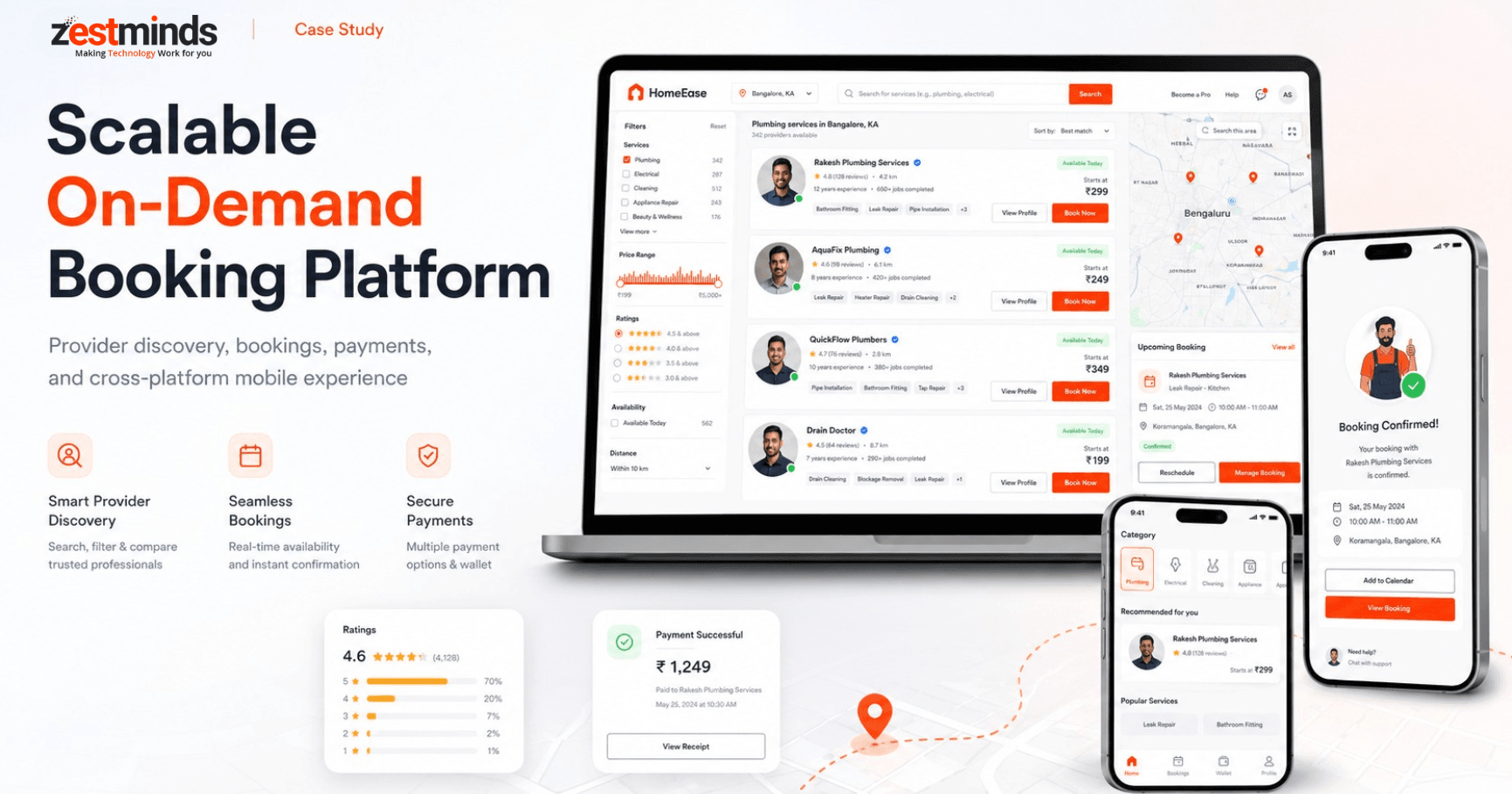
Customers expect to find the right service provider, confirm availability, and complete a booking without unnecessary calls or delays. This case study shows how Zestminds helped modernize an on-demand platform with structured booking workflows, location-based provider discovery, mobile apps, payments, and a scalable backend.
Introduction
Client: Confidential On-Demand Services Platform
Industry: Local Services Marketplace / Booking Technology
Market: Confidential
Engagement: Platform Modernization, Product Engineering, Mobile App Development, Payment Integration, and Cloud Deployment
Selected Technologies: FastAPI (Python), React, Flutter, PostgreSQL, AWS, Docker
Confidentiality note: The client name and selected interface details have been anonymized because this engagement was completed several years ago. The project challenges, delivered workflows, and technical contribution described below reflect Zestminds' work on the platform.
Project Overview
The client was developing an on-demand marketplace designed to help customers discover and book local service professionals across multiple categories. The platform covered services such as home repairs, maintenance, cleaning, appliance support, and personal-care appointments.
The product needed to serve two distinct user groups:
- Customers looking for relevant providers, available time slots, clear pricing, and a reliable booking experience.
- Service providers managing profiles, service areas, availability, incoming requests, booking updates, and payments.
As the marketplace expanded, its existing technical foundation made it harder to maintain consistent service data, support mobile users, process booking updates, and introduce new marketplace features. Zestminds was engaged to strengthen the platform architecture and create a more structured experience across discovery, booking, payments, and provider operations.
Business and Technical Challenges
An on-demand booking product is more complex than a standard appointment form. It must coordinate customer intent, provider availability, service areas, booking states, payments, notifications, and operational exceptions without creating confusion for either side of the marketplace.
The engagement focused on solving several connected challenges:
- Fragmented service and provider data: Different service categories required a consistent structure for attributes, pricing, availability, and provider eligibility.
- Limited provider discovery: Customers needed a faster way to find providers relevant to their service request and location.
- Booking-state complexity: Requests, confirmations, rescheduling, cancellations, completion, and payment status had to remain synchronized.
- Inconsistent mobile experience: The product needed a unified customer and provider experience across modern mobile devices.
- Payment visibility: Customers and administrators needed clearer transaction and booking-status information.
- Backend maintainability: The platform required a modular foundation that could support new categories, integrations, and future product changes.
The goal was not simply to redesign the interface. The product needed a dependable operational workflow underneath the customer-facing experience.
Zestminds' Responsibility
Zestminds worked across the platform's product and engineering layers. Our responsibility included:
- Reviewing the existing booking journey and technical constraints
- Designing modular backend APIs for marketplace operations
- Structuring customer, provider, service, availability, and booking data
- Building location-aware provider discovery and relevance-based ranking
- Developing cross-platform mobile experiences
- Integrating payment-provider workflows and transaction status handling
- Improving administrative visibility into bookings and provider activity
- Supporting deployment, infrastructure, and release workflows on AWS
The engagement combined SaaS product development, marketplace engineering, mobile delivery, and backend modernization rather than treating each feature as an isolated module.
Solution Architecture and Core Workflows
The updated platform was organized around clear domain workflows instead of a tightly coupled collection of screens. Backend services exposed structured APIs for the web and mobile applications, while transactional data was maintained in a relational database.
Core modules included:
- Customer accounts and profiles
- Provider onboarding and service profiles
- Service categories and configurable service attributes
- Provider service areas and availability
- Search, filtering, and provider ranking
- Booking requests and status transitions
- Payments and transaction-status updates
- Customer-provider notifications
- Administrative booking and provider management
FastAPI supported a clear API layer for high-traffic product workflows and integration points. This helped separate frontend behavior from core marketplace rules and made the system easier to extend as new services and operational requirements were introduced.
For companies planning similar backend work, our FastAPI development services cover API architecture, platform modernization, integrations, and production deployment.
Location-Based Provider Matching
A major product requirement was helping customers find suitable service providers without manually reviewing a long, unstructured list.
The provider-matching workflow used practical relevance signals such as:
- Requested service category
- Customer location and provider service radius
- Provider availability
- Profile completeness and verification status
- Ratings and previous service performance
- Additional service-specific eligibility rules
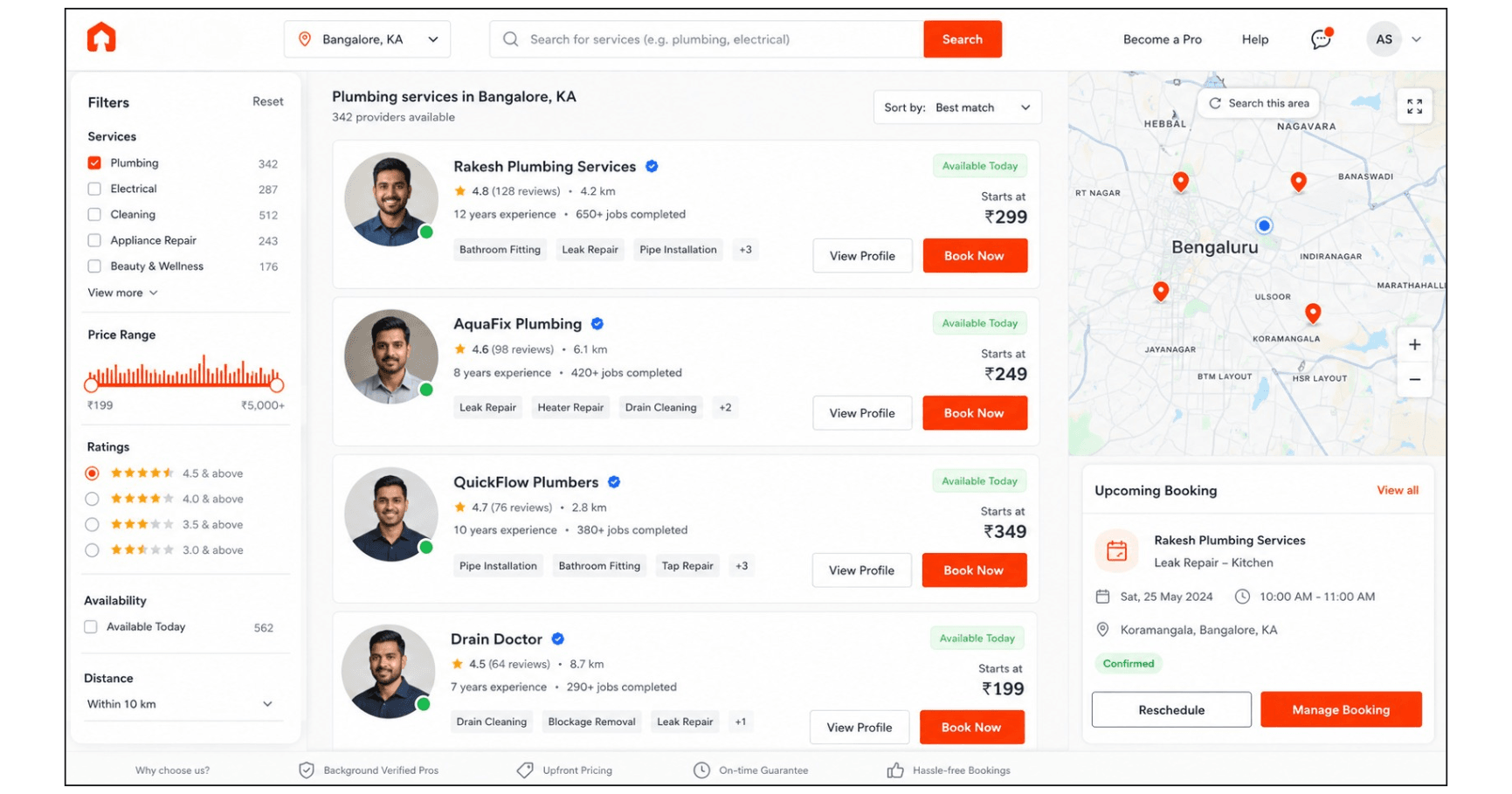
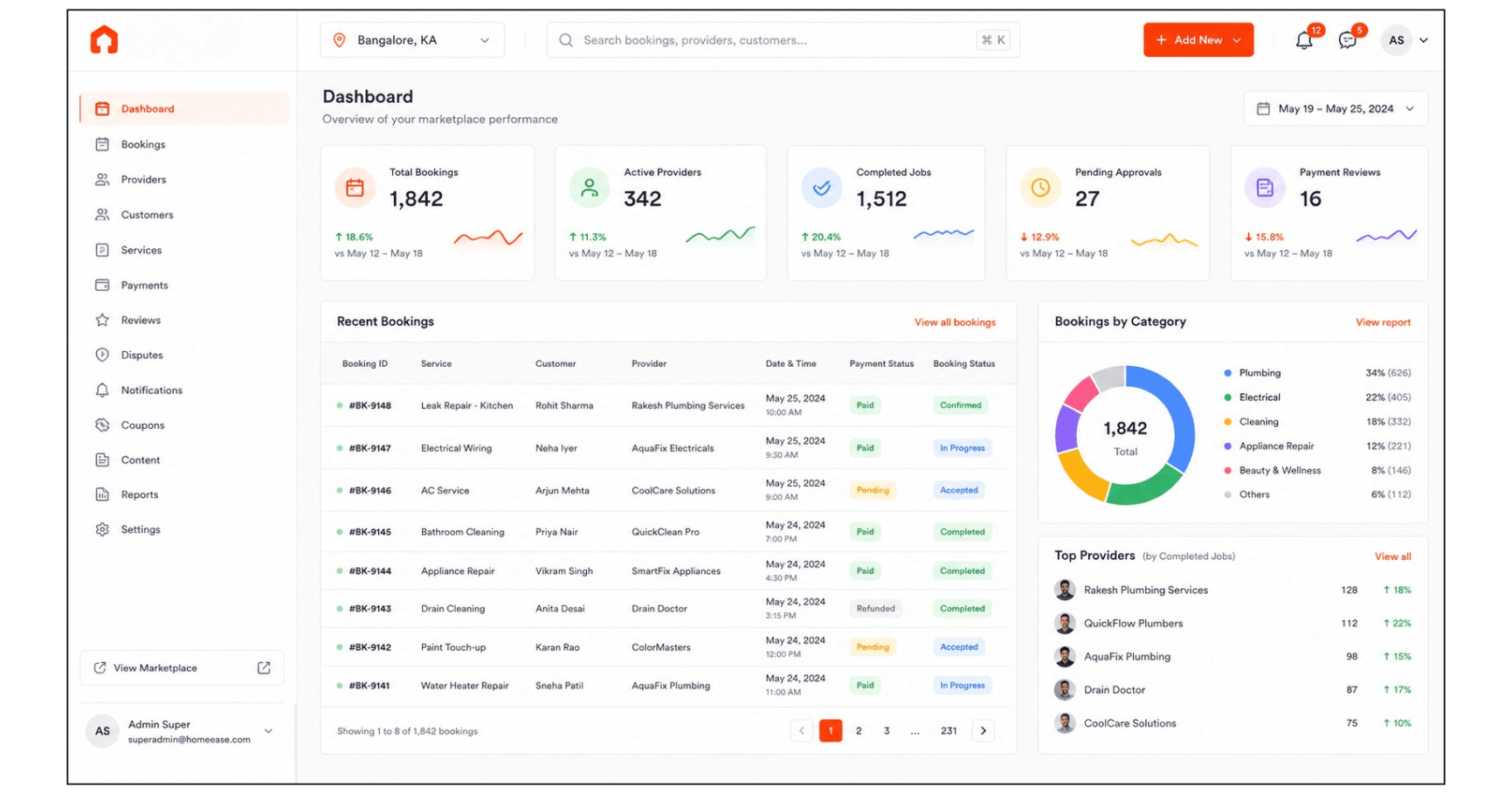
** Interface visuals in this case study are representative recreations created to protect the identity of the confidential client.
Google Maps and location services supported address handling, distance calculations, and service-area logic. The ranking layer then organized eligible providers based on relevance rather than presenting results in an arbitrary order.
This is an important distinction: the platform did not depend on vague or unexplained “AI.” Its immediate value came from structured marketplace data, transparent matching rules, and a technical foundation capable of incorporating behavioural or machine-learning signals where sufficient data was available.
Booking and Payment Workflow
The booking workflow was designed as a controlled sequence of states so that customers, providers, and administrators could understand what was happening at each stage.
A typical journey included:
- The customer selects a service and provides the required details.
- The platform identifies eligible providers based on category, location, and availability.
- The customer submits a booking request or selects an available provider.
- The provider accepts, declines, or proposes an updated schedule.
- The booking status is synchronized across customer, provider, and administrative views.
- Payment status and service completion are recorded against the booking.
- Notifications keep both parties informed about important changes.
Payment providers were integrated through secure, tokenized workflows, reducing the application's direct handling of sensitive payment-card information. Webhook and transaction-status handling helped the platform distinguish successful, pending, failed, cancelled, or refunded payment events instead of relying only on the customer's browser response.
This approach created better operational visibility and a more dependable foundation for supporting multiple payment methods and markets.
Cross-Platform Mobile Experience
Flutter was used to provide a consistent mobile experience across iOS and Android while allowing the product team to maintain a shared application codebase.
The mobile experience supported key customer and provider actions, including:
- Account and profile management
- Service browsing and location-based discovery
- Provider profile review
- Booking creation and status tracking
- Availability and incoming-request management
- Notifications and important booking updates
- Payment and transaction-status visibility
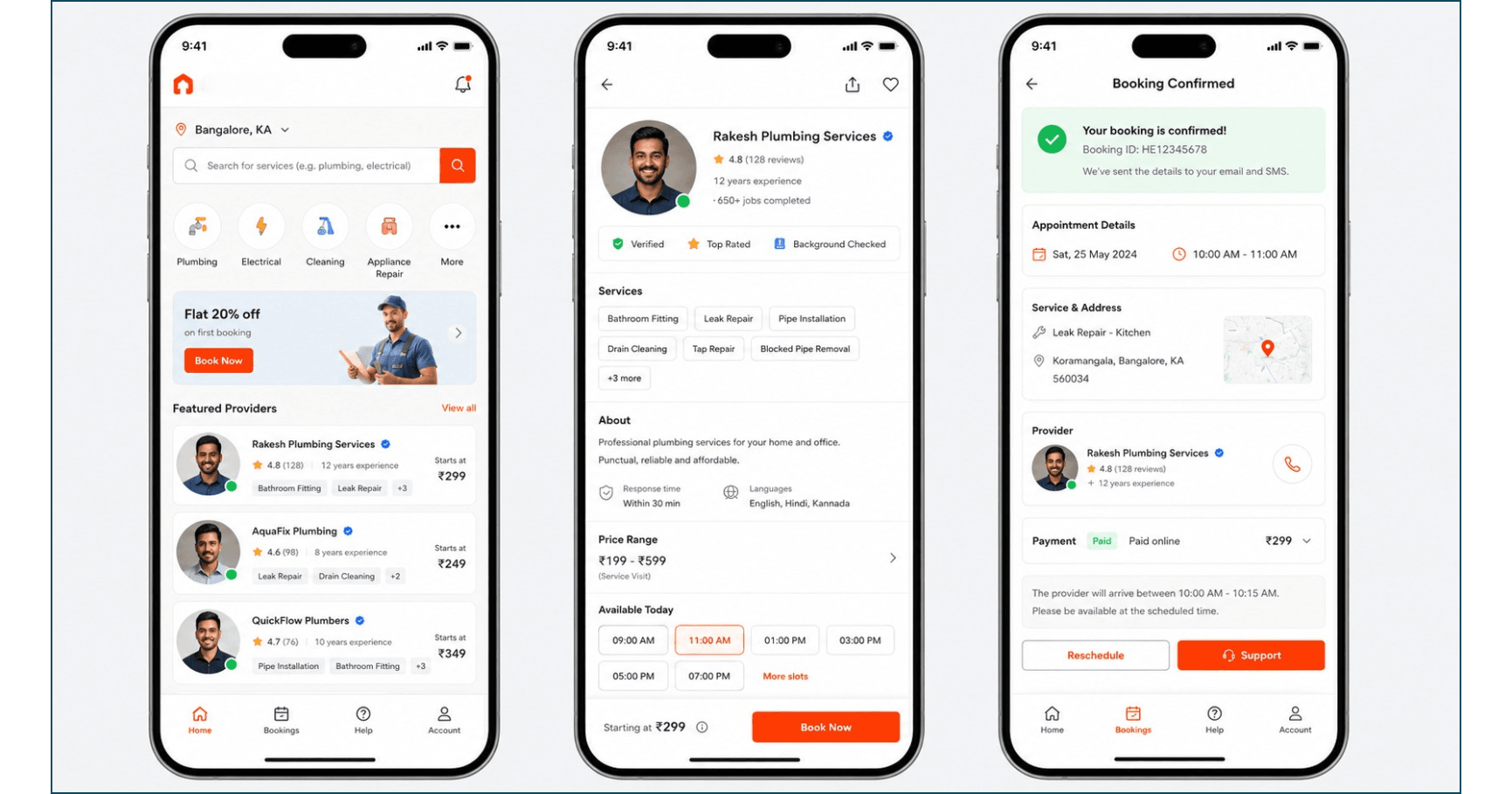
Rather than reproducing the website screen by screen, the mobile workflows were organized around the actions users needed to complete quickly while away from a desktop.
Provider-Side Booking and Schedule Management
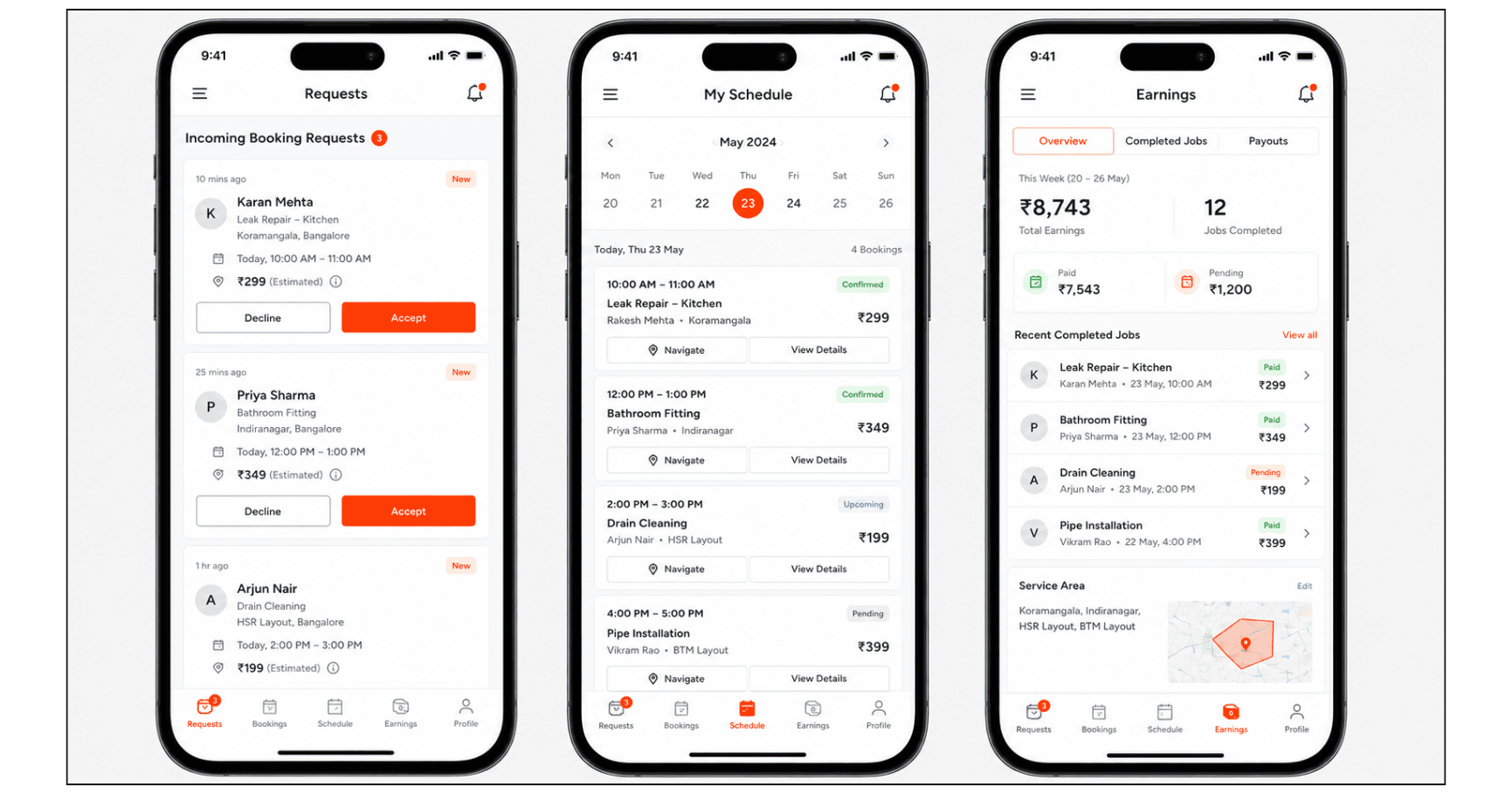
The provider application supported incoming booking requests, daily schedules, service-area management, job status updates and payment visibility. This helped service professionals manage marketplace activity without depending on manual calls or separate spreadsheets.
Marketplace Administration and Operational Visibility
The administrative dashboard gave the operations team a central view of bookings, providers, payment states, approval queues and service-category activity. This reduced dependence on disconnected operational tools and made marketplace exceptions easier to identify and manage.
Cloud Deployment and Maintainability
The platform was deployed using AWS services for application hosting, managed data storage, file delivery, and supporting infrastructure. Docker-based environments helped improve consistency across development and deployment, while automated release workflows reduced repetitive manual deployment steps.
The modernization prioritized maintainability as much as raw performance:
- Clear separation between frontend applications and backend business rules
- Reusable APIs for web and mobile clients
- Structured booking and payment states
- Modular services that could be extended as the marketplace grew
- Improved visibility into operational errors and transaction outcomes
- A cloud foundation capable of supporting changing traffic and storage requirements
This gave the client a stronger base for adding service categories, onboarding more providers, and improving the marketplace without repeatedly rebuilding its core workflows.
Project Outcomes
The engagement transformed the product from a collection of loosely connected booking functions into a more structured marketplace platform.
- Faster service discovery: Customers could narrow providers using service, location, availability, and relevance signals.
- Clearer booking operations: Defined booking states improved visibility for customers, providers, and administrators.
- Consistent mobile access: Cross-platform applications supported the most important marketplace workflows on iOS and Android.
- Improved payment handling: Payment-provider integrations and transaction-status tracking created a more reliable checkout process.
- More maintainable architecture: Modular APIs and structured domain data made future product development easier.
- Better expansion readiness: The platform could support additional categories, locations, provider types, and integrations.
As this is an anonymized historical engagement, detailed commercial metrics are not being published. The outcomes above focus on the product and engineering improvements delivered by Zestminds.
Technology Stack
- Backend and APIs: Python, FastAPI
- Web Application: React
- Mobile Applications: Flutter for iOS and Android
- Data Layer: PostgreSQL, Redis
- Location Services: Google Maps APIs
- Cloud Infrastructure: AWS
- Payments: Third-party payment gateway integrations
- DevOps and Delivery: Docker, GitHub Actions
What This Case Study Demonstrates
This project demonstrates Zestminds' ability to work across the full lifecycle of a two-sided marketplace, including product architecture, booking logic, provider operations, payments, mobile applications, backend APIs, and cloud deployment.
The same engineering patterns are relevant to:
- Home-services marketplaces
- Healthcare and wellness appointment platforms
- Beauty and salon booking products
- Repair and maintenance marketplaces
- Field-service and technician-dispatch systems
- Tutoring, consulting, and professional-service platforms
- Rental and reservation marketplaces
Explore our MVP development services for a new marketplace product, or review our broader software development case studies.
Frequently Asked Questions
What are the core modules of an on-demand booking marketplace?
A typical platform requires customer and provider accounts, service categories, provider service areas, availability, search and matching, booking-state management, payments, notifications, reviews, and an administrative dashboard. The exact architecture depends on whether the product supports instant booking, provider approval, bidding, subscriptions, commissions, or multiple locations.
Does an on-demand booking platform need artificial intelligence?
Not necessarily. Most platforms should first establish reliable service data, location logic, availability, booking workflows, and measurable ranking rules. Machine learning becomes useful when the product has enough behavioural and transaction data to improve recommendations, demand forecasting, fraud detection, or operational decisions.
How does location-based provider matching work?
The platform first filters providers by service category, service area, and availability. Eligible providers can then be ranked using distance, ratings, reliability, profile quality, pricing, or other business-specific signals. Zestminds can implement this logic through backend APIs and mapping integrations.
Can an existing booking platform be modernized without rebuilding everything at once?
Yes. A phased modernization can separate high-value workflows behind APIs, improve booking and payment states, replace specific frontend or mobile components, and migrate legacy modules gradually. Our FastAPI team can help plan incremental backend modernization where a full rewrite would create unnecessary risk.
Can Zestminds build both customer and provider applications?
Yes. We build customer-facing applications, provider or partner applications, administrative dashboards, backend APIs, and third-party integrations as parts of one coordinated product. This reduces the risk of each application implementing marketplace rules differently.
How long does it take to build an on-demand booking platform?
A focused MVP can often be delivered in phases, while a multi-category marketplace with separate customer and provider apps, payments, location matching, messaging, and advanced administration requires a broader roadmap. The timeline depends on workflow complexity, integration requirements, existing systems, and the level of operational automation required.
How can I discuss a similar marketplace with Zestminds?
Share your target users, booking model, provider workflow, required integrations, and current product stage through the Zestminds contact page. Our team can help define an MVP, modernization plan, or scalable product architecture.
Build or Modernize Your On-Demand Booking Platform
Planning a service marketplace, appointment platform, field-service product, or provider-booking application? Zestminds can help you design and develop the complete system, including marketplace architecture, mobile apps, provider onboarding, location-based discovery, availability, payments, backend APIs, and cloud deployment.
Table of Contents
- Project Overview
- Business and Technical Challenges
- Zestminds' Responsibility
- Solution Architecture and Core Workflows
- Location-Based Provider Matching
- Booking and Payment Workflow
- Cross-Platform Mobile Experience
- Cloud Deployment and Maintainability
- Project Outcomes
- Technology Stack
- What This Case Study Demonstrates
- Frequently Asked Questions
- Build or Modernize Your Booking Platform
Before You Scale Further, Review the Architecture.
Let’s evaluate where your system stands — and where it may break under growth.
Schedule an Architecture Review 30-minute technical discussion. No obligation.