
Real-World Applications of Generative AI in 2026
Generative AI applications in 2026 are no longer about demos or experimentation. Businesses now use generative AI to support decisions, automate workflows, and deliver measurable ROI across industries. This guide explains where generative AI actually works in production, how it has evolved, and which real-world use cases hold up under pressure.


Generative AI isn't new in 2026, but the way serious businesses use it has changed in meaningful ways.
A few years ago, most teams were experimenting. Someone added a chatbot to the website. Marketing tried AI-generated blogs. Product teams shipped "AI features" without knowing if they would survive real usage. Back then, the question was simple: Can we use generative AI at all?
Today, that question feels outdated.
If you're leading a product, engineering, or operations team now, your questions sound more like:
- Where does generative AI actually create value?
- Which applications hold up in real production?
- And where does AI quietly create more work than it removes?
This article answers those questions clearly. We'll walk through real-world applications of generative AI in 2026, explain how they've evolved, and show where companies are seeing practical, measurable impact.
Think of this as a consultant-level conversation, not a trend roundup.
What Are Generative AI Applications?
Generative AI applications are software systems that use AI models to create new outputs, text, images, code, summaries, designs, or recommendations, based on patterns learned from large datasets.
In practical terms, generative AI doesn't just analyze information. It produces something usable inside a workflow.
In 2026, these applications usually:
- Sit inside existing systems, not beside them
- Operate with guardrails, approvals, or business rules
- Support people instead of trying to replace them
Many CTOs share a common lesson here: once teams move beyond basic chatbot use cases, generative AI starts creating value inside real workflows rather than as a standalone tool, as explored in how businesses move beyond chat-first AI implementations.
That shift, from tool to system, is what defines modern generative AI applications.
- Produces new outputs
- Embedded in workflows
- Has guardrails/review
- Measured by business outcome
How Generative AI Applications Have Evolved by 2026
To understand today's use cases, it helps to see what has changed beneath the surface.
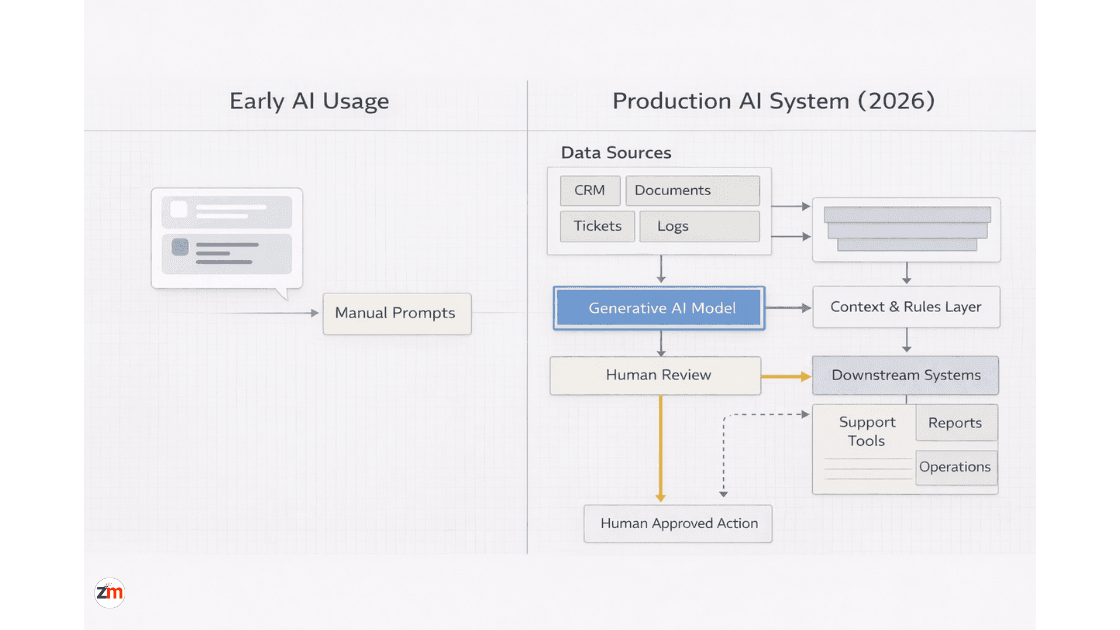
From experiments to infrastructure
Early generative AI projects often lived on the edges. In 2026, successful teams treat AI the same way they treat APIs or databases—designed for uptime, security, and maintainability, following cloud architecture best practices for reliable AI systems.
Experienced founders often note that the biggest mistake was treating AI as a feature, instead of as part of the system architecture. This shift mirrors what many teams have already seen with automation tools that survive real production environments.
From content generation to decision support
Initial adoption focused on speed: writing faster, summarizing quicker, generating more. The real value now comes from decision support.
AI helps teams:
- Review complex documents before meetings
- Spot risks or inconsistencies earlier
- Reduce mental overhead in high-context work
From generic outputs to contextual intelligence
Pure prompt-based systems rarely survive production. Modern applications use company data, structured rules, and user context to generate outputs that make sense inside real constraints.
That's why today's generative AI feels quieter, but far more useful.
Generative AI Applications by Industry
Adoption looks very different across industries. The strongest use cases appear where friction is obvious, work volume is high, and outcomes are well defined.
| Industry | Real-World Generative AI Application | Business Impact |
|---|---|---|
| Healthcare | Clinical note summarization, diagnostic support | Reduced admin time, faster decisions |
| Finance | Financial reporting, risk summaries | Improved compliance, quicker reviews |
| Legal | Contract analysis, clause drafting | Lower review costs, faster turnaround |
| SaaS & Tech | AI support agents, internal copilots | Reduced support load, faster resolution |
| Marketing | Campaign content, audience insights | Higher conversion, shorter cycles |
| E-commerce | Product descriptions, visual generation | Better listings, improved sales |
| Manufacturing | Design optimization, quality analysis | Fewer defects, faster prototyping |
| Education | Personalized learning content | Better engagement, adaptive delivery |
| HR & Recruitment | Resume screening, job matching | Faster hiring, improved consistency |
| Customer Support | Context-aware AI chat assistants | 24/7 coverage, improved CX |
If you scan this list and think, "That's already a pain point for us," you're not alone. Generative AI works best when it removes friction teams already feel daily.
Before diving into detailed examples, it helps to keep three realities in mind:
- These use cases succeed because they fit existing workflows
- Humans remain accountable at every critical step
- ROI comes from consistency, not novelty
Top Real-World Generative AI Use Cases
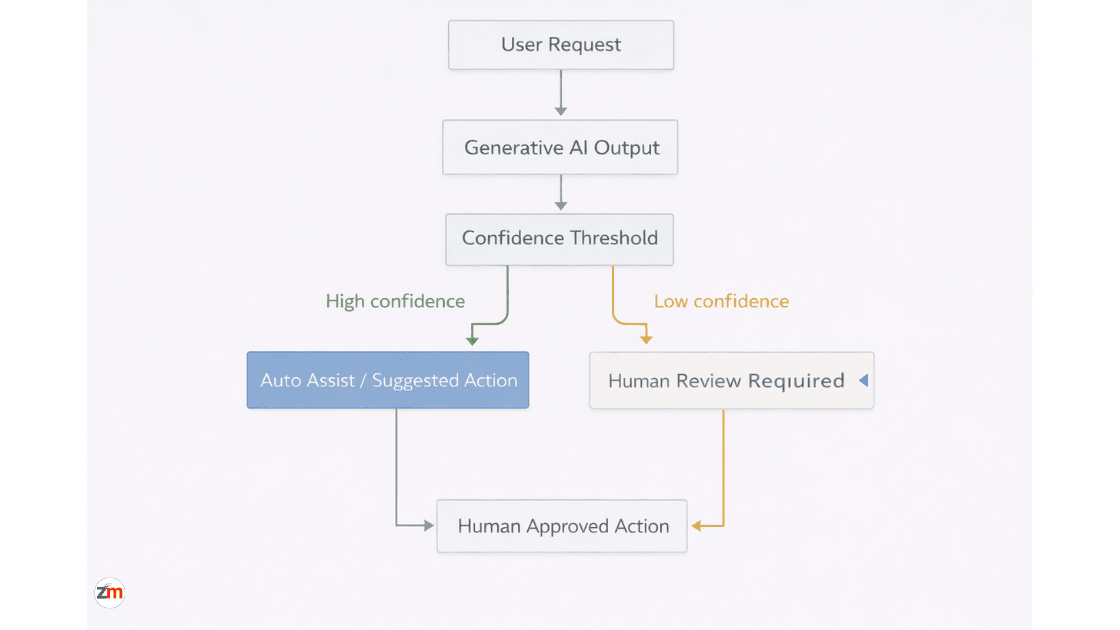
Quick context:
In production environments, generative AI delivers value when it supports human decisions, operates inside existing workflows, and is measured against real business outcomes, not demos or novelty.
Below are the use cases we consistently see holding up under real operational pressure.
1. Healthcare Documentation and Clinical Support
Healthcare adopted generative AI early because the pain was obvious.
Clinicians spend a significant part of their day documenting care rather than delivering it. In real deployments, generative AI is used to summarize patient interactions, draft clinical notes, and prepare handoff reports.
These systems do not make diagnoses. They prepare structured summaries that doctors review, edit, and approve.
Production reality:
This conservative, review-first approach is already visible in HIPAA-compliant AI systems used in live hospital environments, where accuracy and auditability matter more than speed.
The impact shows up as fewer documentation delays, better continuity of care, and more time for patients.
2. Financial Reporting and Analysis
Finance teams operate under tight deadlines and high scrutiny, which makes generative AI a natural fit when applied carefully.
In production, AI is used to draft management reports, summarize variances, and explain trends across financial periods. Analysts then validate and refine the output.
The biggest gain isn't speed alone, it's consistency.
Production reality:
Most finance teams restrict AI access to structured, approved datasets. Open-ended prompts without data controls rarely survive audits.
3. Legal Contract Review and Drafting
Legal teams are cautious adopters by necessity, which is why their AI use cases tend to last.
Generative AI is commonly used to flag risky clauses, compare agreements against templates, and draft standard sections for routine contracts.
Final decisions always remain human.
The value isn't automation, it's focus. Lawyers spend less time scanning and more time interpreting.
4. Marketing Content and Campaign Execution
Marketing was an early testing ground for generative AI, but mature usage looks very different from early experiments.
Today, teams use AI to generate campaign variations, localize messaging, and analyze performance feedback across channels.
Strategy, positioning, and brand voice remain human-led.
A common realization: AI saves time only once direction is clear. Without clarity, it simply produces noise faster.
5. E-commerce Product Content
Large catalogs make manual content management impractical.
Generative AI is now used to generate consistent product descriptions, normalize attributes, and create marketplace-specific variations at scale.
In production, these systems are heavily template-driven to maintain accuracy and brand consistency.
The ROI often shows up quietly, as better listings and reduced operational effort.
6. Manufacturing Design and Quality Insights
Manufacturing teams apply generative AI where design complexity and documentation intersect.
Real-world applications include generating design alternatives under constraints, summarizing quality inspection reports, and documenting production processes for compliance.
Engineers remain in control.
Production reality:
In manufacturing environments, AI systems are usually kept separate from real-time control loops. This reduces risk while still delivering insight and speed.
7. HR and Talent Operations
Hiring combines high volume with high context, making it suitable for AI support when guardrails are clear.
HR teams use generative AI to screen resumes, draft role descriptions, and manage candidate communication workflows.
The key is structure. Clear criteria improve speed and fairness; vague inputs amplify bias.
8. Customer Support Automation
Modern AI support systems look very different from early chatbots.
In production, generative AI understands conversation context, pulls from internal knowledge bases, and escalates intelligently when confidence drops.
Production reality:
High-performing systems are designed to fail gracefully. When uncertainty increases, AI hands off to human agents instead of guessing.
What These Use Cases Have in Common
Across industries, successful generative AI applications share a few traits:
- AI produces a strong first pass
- Humans retain final responsibility
- Systems are designed around real constraints
This is why these use cases scale, and why many others quietly stall after pilots.
When NOT to Use Generative AI (A Quick Reality Check)
Generative AI is a poor fit when the cost of being wrong is higher than the cost of being slow.
| Scenario | Why AI is risky |
|---|---|
| Medical decisions | High stakes; errors can cause harm and may become part of a permanent record |
| Legal judgments | Outputs can be incorrect or incomplete; accountability remains human |
| Safety systems | Irreversible actions require deterministic controls and strict verification |
| Unclear data | Ambiguity increases hallucination risk and inconsistent outcomes |
Avoid autonomous use when outputs must be:
- Perfectly accurate or legally final
- Safety-critical or irreversible
- Based on unclear data or shifting rules
Experienced teams treat generative AI as decision support, not decision authority. When accountability matters, humans stay firmly in control.
Where Generative AI Delivers Real Business ROI
Across industries, ROI appears consistently when three conditions are met:
- Work is repeatable and high-volume
- Quality expectations are clearly defined
- Human oversight is built into the loop
Generative AI excels at reducing cognitive load. It handles the first draft, first summary, or first pass, so people can focus on judgment and nuance.
When these conditions aren't present, AI often creates more complexity than value.
Key Considerations Before Adopting Generative AI
Before committing resources, it's worth stepping back and asking a few practical questions.
- Data control
- Review path
- Failure ownership
- Audit/logging
- Fallback plan
Data quality and access
AI outputs reflect the data behind them. Clean inputs matter more than clever prompts.
Security and compliance
Security and compliance are especially critical in regulated environments, where following established AI risk management practices helps teams build safer systems.
Cost and scalability
Model usage is only one cost. Infrastructure, monitoring, and iteration matter just as much.
Change management
Adoption fails when teams feel replaced or confused. It succeeds when AI feels supportive and predictable.
A slower, well-structured rollout usually outperforms a rushed launch.
FAQs About Generative AI Applications
How are businesses actually using generative AI in 2026?
In 2026, businesses use generative AI inside real workflows rather than as standalone tools. Common uses include drafting clinical documentation, summarizing financial reports, reviewing contracts, supporting customer service agents, and generating structured content with human review built into the process.
What is the difference between generative AI use cases and AI experiments?
AI experiments focus on testing what a model can generate, while real generative AI use cases are designed for production. Production use cases include clear inputs, guardrails, review steps, and measurable business outcomes such as time saved, error reduction, or improved consistency.
Can generative AI be trusted for business-critical decisions?
Generative AI should not make final business-critical decisions on its own. In production systems, AI is used for decision support—creating summaries, recommendations, or first drafts—while humans retain accountability for approvals, exceptions, and high-risk outcomes.
Which industries benefit the most from generative AI today?
Industries with high-volume knowledge work benefit the most, including healthcare, finance, legal services, SaaS, e-commerce, manufacturing, HR, and customer support. These sectors see value where repetitive documentation, analysis, or communication slows teams down.
What are the biggest risks of using generative AI in production?
The biggest risks include incorrect outputs, lack of auditability, unclear data sources, and over-automation. These risks are reduced by adding human review, confidence thresholds, logging, and restricting AI usage in safety-critical or legally final scenarios.
How do companies measure ROI from generative AI applications?
Companies measure ROI by tracking time saved, reduction in manual effort, improved consistency, faster turnaround times, and error reduction. Successful teams evaluate generative AI against operational metrics, not content volume or novelty.
Is generative AI suitable for regulated industries like healthcare or finance?
Yes, generative AI is used in regulated industries when implemented with strict controls. Successful deployments include human approval steps, limited data access, audit logs, and compliance-aligned workflows rather than fully autonomous AI systems.
A Practical Next Step
If you're exploring generative AI but unsure where it fits, start small. Map one workflow. Identify where people lose time or context. Test AI there, carefully.
For teams moving from curiosity to execution, a short assessment phase can help clarify readiness, identify viable use cases, and outline next steps before any serious build begins.
Final Thought
In 2026, generative AI applications aren't about novelty or noise. They're about discipline, integration, and outcomes.
The companies seeing results aren't chasing trends. They're fixing real problems, one workflow at a time.
Table of Contents
- What Are Generative AI Applications?
- How Generative AI Applications Have Evolved by 2026
- Generative AI Applications by Industry
- Top Real-World Generative AI Use Cases
- Where Generative AI Delivers Real Business ROI
- Key Considerations Before Adopting Generative AI
- FAQs About Generative AI Applications
- A Practical Next Step
Shivam Sharma
Latest Insight & Articles
Before You Scale Further, Review the Architecture.
Let’s evaluate where your system stands — and where it may break under growth.
Schedule an Architecture Review 30-minute technical discussion. No obligation.