
How to Set Up an AI Assistant with Zapier + OpenAI
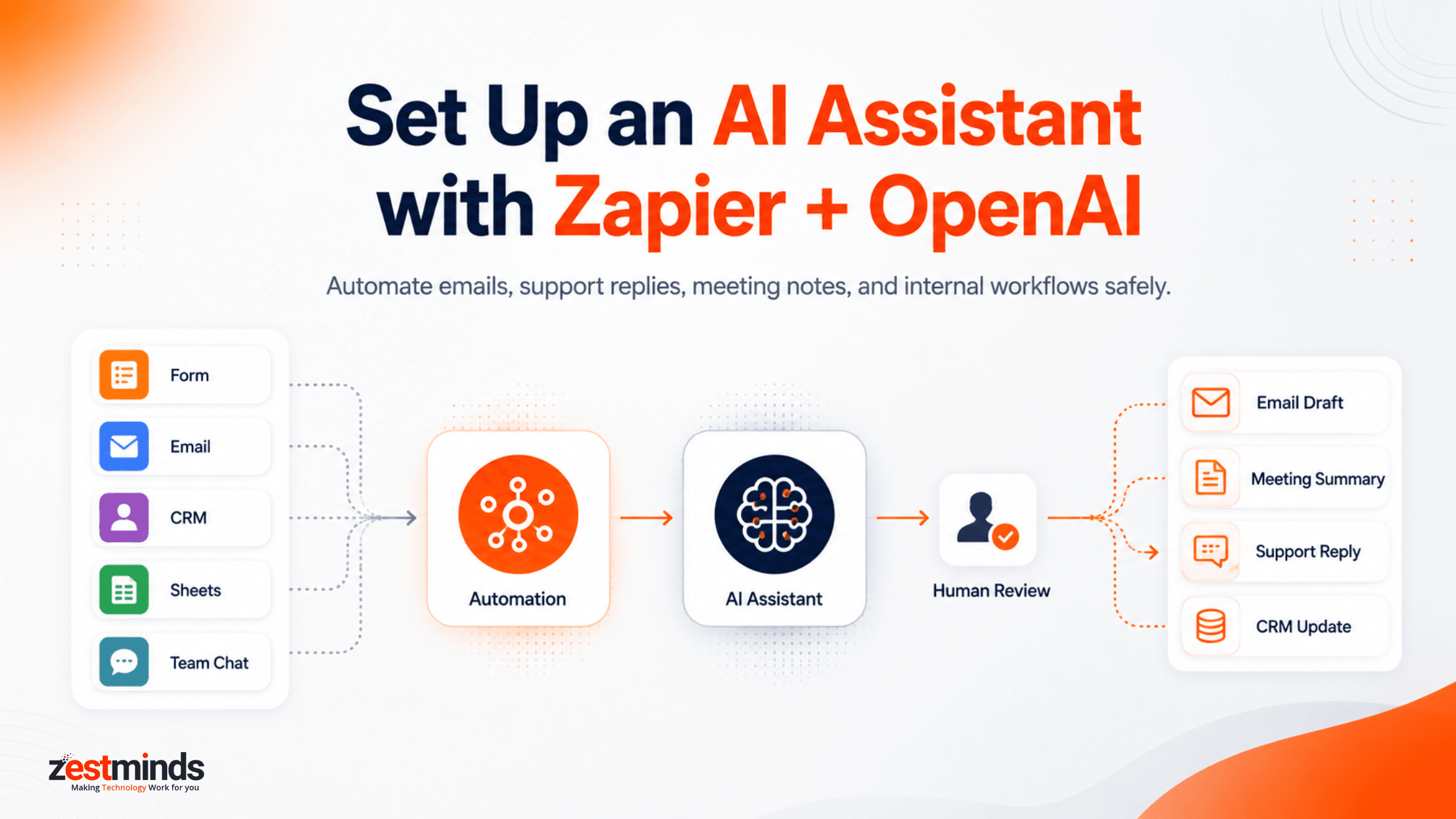
Set up an AI assistant with Zapier + OpenAI to automate lead follow-ups, email drafts, support replies, meeting summaries, CRM updates, and other internal workflows safely.

Introduction
Tired of juggling manual tasks, missed follow-ups, scattered meeting notes, and repetitive support replies? Zapier + OpenAI can help you build simple internal AI assistants that save time without forcing your team to write custom code from day one.
Running a startup today is like playing chess on a treadmill. You are planning, selling, hiring, supporting customers, and fixing operations all at the same time. The answer is not always to add more people or more tools. Sometimes, the smarter move is to automate one painful workflow at a time.
Zapier works like the connector between your business apps. OpenAI adds the thinking layer that can summarize, draft, classify, extract, and respond. Together, they can help your team automate practical workflows across sales, support, operations, reporting, and internal knowledge management.
In this guide, we will show you how to use Zapier + OpenAI to:
- Set up an AI assistant for internal workflows
- Automate lead follow-ups, email drafts, meeting summaries, and support replies
- Connect OpenAI with tools like Gmail, Slack, Notion, Google Sheets, Typeform, HubSpot, and Salesforce
- Avoid common mistakes like vague prompts, auto-sending risky replies, and exposing sensitive data
- Understand when Zapier is enough and when a custom AI workflow is safer
At Zestminds, we build business-ready AI workflow automation services for teams that want to reduce manual work without creating messy, unreliable automation in the background.
"Automation is good, so long as you know exactly where to put the machine." - Eliyahu Goldratt
Why Startups Are Using Zapier + OpenAI for Internal Workflows
Most teams do not struggle because they lack tools. They struggle because their tools do not talk to each other properly. Leads come through forms, notes sit in meeting recordings, support requests stay in inboxes, and follow-ups get delayed because someone has to manually move information from one system to another.
That is where Zapier + OpenAI becomes useful. Zapier moves data between apps. OpenAI can turn that data into a draft, summary, classification, response, or next action. For a small team, this can save hours every week if the workflow is designed carefully.
Still doing manual data entry or copy-pasting follow-up emails? That is like hiring a smart person and then asking them to spend half the day moving sticky notes from one wall to another.
How Zapier + OpenAI Work Together
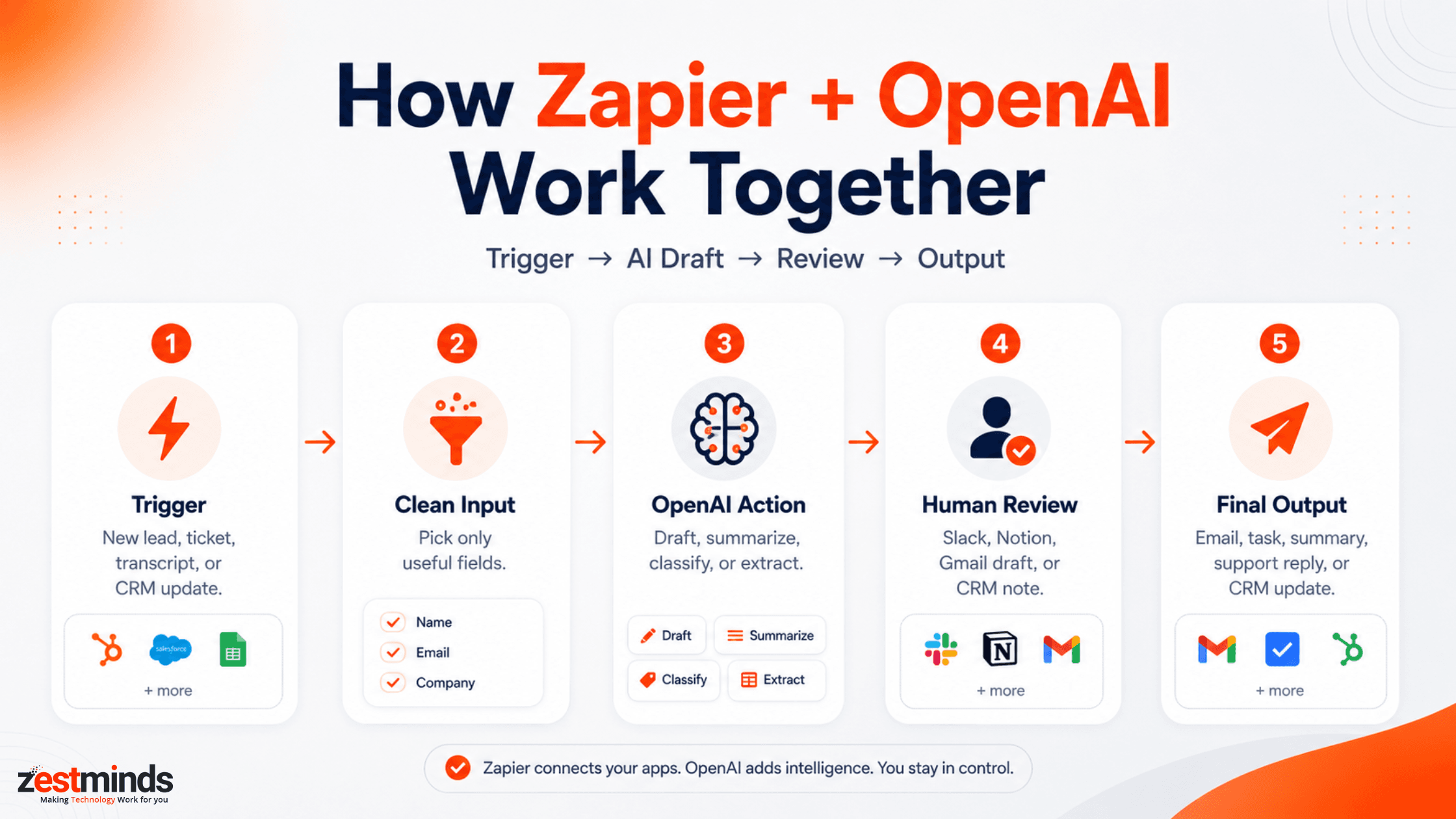
Zapier watches your apps for triggers. A trigger could be a new form submission, a new row in Google Sheets, a new CRM deal, a new support request, or a new meeting transcript.
OpenAI processes the information. It can write an email, summarize a meeting, classify a ticket, extract key points, create a proposal draft, or generate a checklist.
A simple Zapier + OpenAI workflow usually looks like this:
- Trigger: A new event happens in a tool like Typeform, Webflow, Google Sheets, Gmail, HubSpot, or Slack.
- Input cleanup: Zapier collects the useful fields and removes unnecessary information.
- OpenAI action: OpenAI receives a structured prompt and generates the output.
- Review step: The output is sent to a human, Slack channel, Notion page, or CRM note for approval.
- Final action: The approved output is sent, stored, assigned, or logged in the right system.
How to Set Up an AI Assistant with Zapier and OpenAI
Before building anything, keep the first workflow small. Do not try to automate your entire sales, support, and operations process in one weekend. Start with one repetitive workflow where the input and output are clear.
Here is a practical setup path:
- Choose one workflow: Start with lead follow-up, meeting summaries, support drafts, proposal drafts, or CRM updates.
- Pick the trigger app: This could be Typeform, Webflow, Google Sheets, Gmail, HubSpot, Salesforce, Slack, or another connected tool.
- Define the input fields: Decide what data OpenAI actually needs, such as name, email, service interest, message, deal stage, ticket type, or meeting transcript.
- Create the OpenAI action: Use Zapier's OpenAI or ChatGPT action to send the selected data with a clear prompt.
- Add structure to the prompt: Mention tone, output format, business rules, and what the AI should avoid.
- Add a review step: Send the AI output to Slack, Notion, Gmail draft, or CRM notes before final use.
- Test with real examples: Try normal cases, edge cases, incomplete inputs, and poor-quality messages.
- Monitor results: Check output quality, task usage, token cost, failed Zaps, and team feedback.
A good AI assistant is not just a prompt connected to an app. It needs clear inputs, safe outputs, review steps, and a fallback plan when something does not work as expected.
Need help mapping the right workflow first? Start with our AI workflow automation guide before building too many Zaps at once.
Real Internal AI Workflows You Can Build
1. Lead Follow-Up Email Assistant
- Trigger: New lead in Google Sheets, Typeform, Webflow, or CRM.
- OpenAI action: Draft a personalized email based on service interest, company type, and message.
- Review step: Save the email as a Gmail draft or send it to Slack for sales review.
- Output: Sales team approves and sends the follow-up faster.
- Business value: Faster response time without copy-pasting the same email again and again.
2. Meeting Summary Generator
- Trigger: New meeting transcript or recording summary from Zoom, Google Meet, or another meeting tool.
- OpenAI action: Summarize key points, decisions, blockers, and action items.
- Review step: Send summary to Slack, Notion, Trello, ClickUp, or Asana.
- Output: Team gets a clean summary without manually writing meeting notes.
- Business value: Less follow-up confusion and fewer forgotten tasks.
3. Support Ticket Drafting Assistant
- Trigger: New support request from Typeform, Gmail, Intercom, Zendesk, or a website form.
- OpenAI action: Classify the ticket and draft a helpful response.
- Review step: Send the response to Notion, Slack, or the helpdesk for approval.
- Output: Support team replies faster while still keeping control over final communication.
- Business value: Faster first response time without blindly auto-sending AI replies.
4. Internal Knowledge Base Auto-Updater
- Trigger: New internal document, blog, policy note, SOP, or product update.
- OpenAI action: Summarize the content and suggest tags.
- Review step: Send the summary to Notion, Google Docs, or an internal knowledge base for review.
- Output: Your team gets searchable internal knowledge without manually rewriting every update.
- Business value: Better knowledge sharing across sales, support, marketing, and operations.
5. Proposal Draft Generator
- Trigger: CRM opportunity moves to qualified stage.
- OpenAI action: Generate a proposal outline from lead details, service interest, budget range, and project notes.
- Review step: Sales or delivery team edits the proposal before sending.
- Output: Faster first draft without losing human judgment.
- Business value: Reduces proposal preparation time while keeping pricing, scope, and promises under human control.
Example: Automate Email Writing with OpenAI and Zapier
Email automation is one of the easiest places to start, but it is also where teams can make mistakes quickly. A poorly written or wrongly personalized AI email can damage trust, especially in sales and customer support.
A safer AI email workflow should work like this:
- Trigger: A new lead submits a form or a CRM deal is updated.
- Data collection: Zapier collects name, company, service interest, message, source, and CRM stage.
- Prompt: OpenAI writes a short, warm email based only on the available data.
- Draft mode: Gmail or Outlook saves the output as a draft instead of sending it directly.
- Review: Sales team checks tone, facts, and next step.
- Send: Human approves and sends the final email.
Example prompt:
Write a short and warm follow-up email to {{name}} from {{company}}.
They are interested in {{service_interest}}.
Use a helpful tone. Do not invent case studies, pricing, timelines, or guarantees.
End by asking if they are open to a short discovery call this week.
The important part is not only writing the prompt. The important part is controlling what data goes into the prompt and making sure the final email is reviewed before it reaches a real customer.
Step-by-Step Workflow: Lead Follow-Up Assistant
Let's use a simple lead follow-up assistant as an example. This is useful for startups, agencies, SaaS companies, and service businesses that receive leads from website forms or landing pages.
- Data source: A form sends lead data to Google Sheets, HubSpot, Salesforce, or another CRM.
- Zapier trigger: A new row, form submission, or CRM deal starts the workflow.
- Filter: Zapier checks if the lead has enough information to generate a useful draft.
- OpenAI action: OpenAI receives the lead details and creates a first email draft.
- Review destination: The draft is sent to Gmail, Slack, Notion, or CRM notes.
- Human approval: Sales team reviews the message before sending.
- Tracking: The workflow logs status, owner, and next step in the CRM.
Sample prompt:
Write a helpful follow-up email for a new lead.
Lead name: {{name}}
Company: {{company}}
Service interest: {{service}}
Message: {{message}}

Rules:
- Keep it under 120 words.
- Do not mention pricing unless provided.
- Do not invent project examples.
- Ask for a 15-minute discovery call.
- Use a professional but friendly tone.
If this workflow touches real customer data, avoid going live without testing privacy, access, and review rules first.
If you want this mapped properly for your sales, support, or operations workflow, explore how Zestminds builds AI workflow automation services for business teams.
Common Mistakes to Avoid with Zapier + OpenAI
| Mistake | Why It Hurts | Safer Fix |
|---|---|---|
| Using vague prompts | The AI gives generic, inconsistent, or off-brand output. | Add tone, format, business rules, examples, and clear limits. |
| Auto-sending AI emails | A wrong message can reach a lead or customer before anyone catches it. | Use draft mode or send AI output to Slack or Notion for review. |
| Sending too much data to OpenAI | Private or unnecessary data may be included in the prompt. | Send only the fields required for the task. |
| No approval step | The workflow may look fast but becomes risky for customer-facing replies. | Add human review for emails, support replies, proposals, and sensitive workflows. |
| No fallback handling | If Zapier, OpenAI, or an app fails, the task may silently break. | Add error notifications, fallback owners, and failed-task tracking. |
| No prompt versioning | Teams forget what changed and cannot compare output quality. | Keep prompt versions in Notion, Google Docs, or your internal documentation. |
| Ignoring token and task usage | Costs can rise as workflow volume increases. | Monitor Zapier task usage and OpenAI usage regularly. |
| Trusting AI without grounding | The AI may make up facts if it does not have verified context. | Use review steps or learn how RAG can ground AI replies in trusted business data. |
Simple automation is easy to start. Reliable automation needs testing, monitoring, and clear ownership. Otherwise, your "smart workflow" becomes that one intern who works fast but occasionally sends the wrong file to the wrong person.
Do You Need an OpenAI API Key for Zapier?
It depends on the Zapier app, action, and workflow you are building. Some Zapier AI features can be configured through built-in app connections. More advanced workflows may need OpenAI API access, model selection, Webhooks, structured prompts, or backend validation.
For current product-specific setup details, it is better to check the official Zapier ChatGPT and OpenAI setup guide. If your workflow needs direct API-level control, the OpenAI developer documentation is the safest place to review current API behavior.
You may need a more advanced OpenAI setup when:
- You want better control over model behavior and output format.
- You need structured outputs for CRM, support, or reporting workflows.
- You want to connect OpenAI with internal tools that are not available as simple Zapier apps.
- You need logging, permission checks, or custom business rules.
- You want to use RAG or internal company data safely.
For a quick test, Zapier can be enough. For business-critical workflows, the setup should be reviewed like any other system that touches customer or operational data.
When No-Code AI Automation Is Enough vs When You Need a Custom Tool
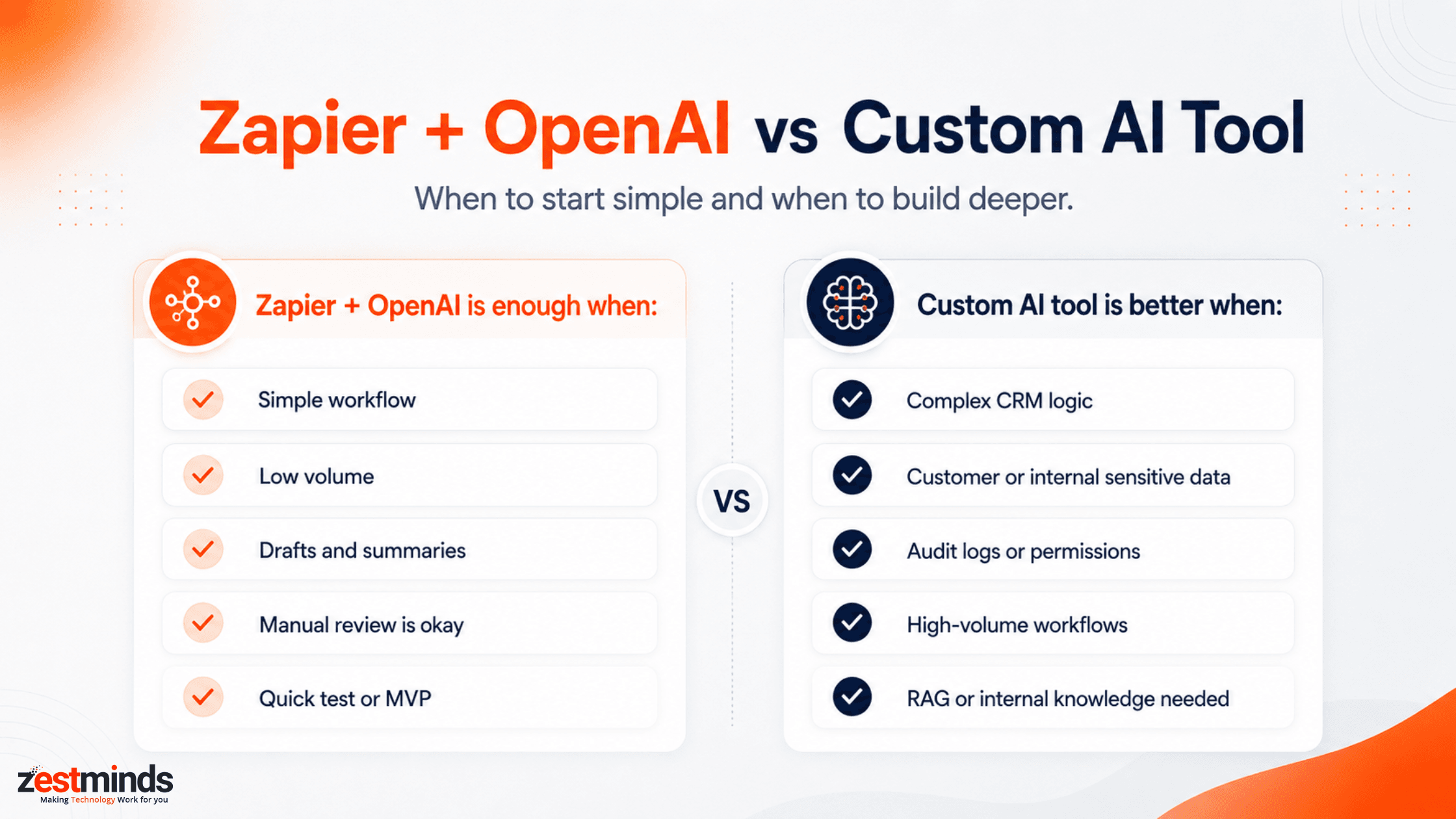
Zapier + OpenAI is a great starting point. It lets teams test ideas quickly without waiting for a full software build. But not every internal AI workflow should stay inside a no-code setup forever.
| No-Code AI Automation Is Usually Enough When | A Custom AI Tool Is Better When |
|---|---|
| The workflow is simple and low-risk. | The workflow touches many systems, teams, or approval rules. |
| The output is a draft, summary, or notification. | The output affects customer communication, billing, compliance, or decisions. |
| Manual review is acceptable. | You need permissions, dashboards, audit logs, or role-based access. |
| The volume is low or moderate. | The workflow runs at high volume or needs stronger reliability. |
| The data is not sensitive. | The workflow handles customer data, PII, contracts, support history, or internal records. |
| You are testing an idea quickly. | You need a long-term internal AI system connected to your business logic. |
That does not mean Zapier is bad. It means Zapier is often the right first step. Once the workflow becomes important to revenue, support, delivery, or customer experience, it may need stronger architecture.
For deeper builds, Zestminds helps teams with custom AI development services, including OpenAI integrations, RAG, workflow dashboards, API integrations, approval systems, and internal AI tools.
Using RAG to Ground AI Replies in Business Data
Basic prompts work when the AI only needs to write or summarize. But if the AI needs to answer using your actual policies, product documents, FAQs, contracts, support history, pricing rules, or internal SOPs, then you need better grounding.
That is where RAG, or Retrieval Augmented Generation, becomes useful. RAG helps the AI pull from trusted business data before generating an answer. This reduces the risk of made-up replies and gives your team more control over what the AI can use.
RAG is useful for workflows like:
- Support assistants that answer from approved help docs.
- Sales assistants that use current product or service information.
- Proposal assistants that follow approved scope and pricing rules.
- Internal knowledge assistants that search company documents.
- Operations assistants that summarize SOPs or policy updates.
If your workflow needs RAG, vector search, or internal knowledge grounding, see our AI content automation case study with OpenAI, LangChain, Weaviate, and FastAPI for a more advanced example of AI automation architecture.
Tools That Pair Well With Zapier + OpenAI
Zapier + OpenAI becomes more useful when connected to the tools your team already uses. The right setup depends on where the workflow starts, where the AI output should go, and who needs to review it.
| Tool | Role in Workflow | Example Use |
|---|---|---|
| Gmail or Outlook | Email draft or delivery | Lead follow-up or support reply draft |
| Slack or Microsoft Teams | Review and alerts | Send AI output to a team channel for approval |
| Notion or Google Docs | Knowledge storage | Save meeting summaries or internal SOP summaries |
| Typeform or Webflow | Form input | Trigger lead qualification or email draft workflow |
| HubSpot, Salesforce, or Pipedrive | CRM context | Personalize follow-ups based on deal stage |
| Trello, Asana, or ClickUp | Task creation | Create tasks from meeting action items |
| Google Sheets or Airtable | Lightweight database | Store lead data, summaries, or workflow logs |
If you are comparing Zapier with Make.com, n8n, or custom backend automation, start with the workflow goal first. The best tool depends on complexity, cost, reliability, privacy needs, and how much control your team needs.
How Zestminds Builds Business-Ready AI Workflows
For simple workflows, your team may be able to create a Zap and test it internally. But when automation touches real leads, support tickets, customer data, CRM records, or internal decisions, it should be designed more carefully.
A business-ready AI workflow usually needs:
- Workflow mapping: Clear trigger, input, output, owner, and review path.
- Prompt design: Structured prompts with tone, format, rules, and limits.
- App and API integration: Clean connection with CRM, email, forms, dashboards, or internal systems.
- Human approval: Review steps for emails, proposals, support replies, and sensitive actions.
- Error handling: Alerts when Zapier, OpenAI, or a connected app fails.
- Monitoring: Tracking for output quality, costs, usage, and failed runs.
- Upgrade path: Move from Zapier to Make.com, n8n, FastAPI, or custom backend when needed.
For a practical example, see our workflow automation case study, where Zapier, n8n, FastAPI, and controlled AI were used together to make business automation more reliable with backend logic and human oversight.
Conclusion: Automate the Right Way
Automation is not about replacing your team. It is about freeing people from repetitive work so they can focus on decisions, customers, and growth.
Zapier + OpenAI is a strong starting point for internal AI assistants. You can use it to draft emails, summarize meetings, classify support tickets, update knowledge bases, and move information between tools. But the safest workflows are not the ones that run the fastest. They are the ones that are tested, reviewed, monitored, and connected to the right business context.
Start small. Pick one workflow. Add a review step. Track the results. Then scale what works.
If you already have a workflow in mind, you can share your workflow with Zestminds and we will suggest the safest automation path.
FAQs
1. How do I set up an AI assistant with Zapier and OpenAI?
Start with one workflow, choose a trigger app, send the data to OpenAI through Zapier, write a clear prompt, and send the output to Gmail, Slack, Notion, or your CRM. Always test the workflow before using it with real customers.
2. Do I need an OpenAI API key to use OpenAI with Zapier?
It depends on the Zapier app or action you use. Some AI features can be connected through Zapier's built-in integrations, while advanced OpenAI workflows may need API access, model settings, or Webhooks.
3. Can I automate email writing with OpenAI and Zapier?
Yes. You can use Zapier to trigger OpenAI when a new lead, form entry, or CRM update appears. For business emails, it is safer to create drafts first instead of auto-sending every AI-generated reply.
4. Is Zapier an AI tool or an automation platform?
Zapier is mainly an automation platform. It connects apps and moves data between them. With OpenAI or Zapier's AI features, it can also power AI-assisted workflows.
5. Can Zapier connect OpenAI with my CRM, forms, Slack, or Gmail?
Yes. Zapier can connect OpenAI with tools like Typeform, Webflow forms, Google Sheets, Gmail, Slack, HubSpot, Salesforce, and many other apps. The exact setup depends on the trigger, action, and data you want to pass.
6. When should I use a custom AI tool instead of Zapier + OpenAI?
Zapier is good for simple workflows and quick tests. A custom AI tool is better when you need permissions, audit logs, dashboards, RAG, complex CRM logic, high-volume processing, or stricter data handling.
7. Is Zapier + OpenAI safe for customer data or PII?
It can be designed more safely, but it should not be treated as automatically safe. Safety depends on what data you send, where it is stored, who can access it, and whether review steps are added. Avoid sending sensitive data until the workflow is properly reviewed.
Table of Contents
- Introduction
- Why Startups Are Using Zapier + OpenAI for Internal Workflows
- How Zapier + OpenAI Work Together
- How to Set Up an AI Assistant with Zapier and OpenAI
- Real Internal AI Workflows You Can Build
- Example: Automate Email Writing with OpenAI and Zapier
- Step-by-Step Workflow: Lead Follow-Up Assistant
- Common Mistakes to Avoid with Zapier + OpenAI
- Do You Need an OpenAI API Key for Zapier?
- When No-Code AI Automation Is Enough vs When You Need a Custom Tool
- Using RAG to Ground AI Replies in Business Data
- Tools That Pair Well With Zapier + OpenAI
- How Zestminds Builds Business-Ready AI Workflows
- FAQs
Shivam Sharma
Before You Scale Further, Review the Architecture.
Let’s evaluate where your system stands — and where it may break under growth.
Schedule an Architecture Review 30-minute technical discussion. No obligation.