
Why Hiring Dedicated Developers Fails for Most Startups (And When It Actually Works)
Hiring dedicated developers fails when startups treat it like a shortcut to speed. It works when product ownership is clear, decisions are fast, and engineering structure already exists. Without that foundation, velocity drops and costs quietly rise. When structured well, however, a dedicated team becomes a long-term growth engine, not just extra hands on keyboards.


You have probably heard it more than once:
"Just hire dedicated developers."
Need to move faster? Build a dedicated team.
Hiring locally feels slow or expensive? Try offshore engineers.
Want flexibility without long-term payroll risk? Same suggestion.
On the surface, it sounds logical. A flexible extension of your team. Lower cost. Faster ramp-up. Less HR friction.
But here is the reality experienced founders eventually learn:
Hiring dedicated developers is not a shortcut.
It is an operating model decision.
A dedicated development team model is a long-term extension of your product organization. It is not a one-off vendor relationship or a simple project contract. It is a team embedded into your roadmap, product context, engineering rituals, and execution rhythm.
For startups and SaaS teams, the question is not only whether developers are available. The real question is whether your operating structure is ready to absorb them.
And when that decision is made without structure, things unravel quietly before they fail visibly.
Let us unpack where it breaks, and where it genuinely works.
Why Founders Choose to Hire Dedicated Developers
Before we critique the model, let us acknowledge something important.
It is attractive, for good reasons.
Speed Without HR Overhead
Hiring in-house takes time. Sourcing, interviews, onboarding, benefits, and retention all require serious commitment.
Dedicated developers feel simpler.
You bypass months of recruiting and get engineers ready to contribute faster.
When you are under investor pressure, losing time to competitors, or trying to ship product milestones, that speed is hard to ignore.
Cost Predictability
In markets like the US, UK, Germany, Australia, or Canada, senior engineering salaries are significant. Offshore or nearshore dedicated teams can look financially efficient.
- Lower direct payroll cost
- Scalable headcount
- Fewer long-term employment liabilities
- Better flexibility than permanent hiring
On a spreadsheet, it makes sense.
But spreadsheets do not always capture structural friction. They rarely show the cost of unclear scope, rework, slow approvals, poor architecture decisions, or weak product ownership.
That is where the real cost picture begins.
Flexibility
The promise sounds safe:
Scale up when needed.
Scale down when priorities shift.
For early-stage startups where direction evolves frequently, that flexibility feels reassuring.
Many CTOs share a common lesson though: flexibility without structure becomes instability.
Access to Broader Skill Sets
A strong development partner can provide access to multiple roles, including:
- Backend engineers
- Frontend specialists
- QA engineers
- DevOps support
- AI/ML capability where relevant
- Technical leads or delivery coordination
Instead of hiring each role individually, you plug into a pre-built engineering ecosystem.
That can be powerful, but only if roles are mapped to outcomes. Adding more people without roadmap clarity does not create speed. It creates coordination overhead.
The Hidden Assumption
What is rarely discussed is this:
The dedicated team model assumes you already have:
- Product clarity
- Stable architecture
- Clear scope definition
- Strong decision ownership
- A practical release rhythm
If those pieces are not in place, the model does not compensate for the gaps. It amplifies them.
And amplification in engineering is rarely subtle.
When Should You Hire Dedicated Developers?
You should hire dedicated developers when you need ongoing execution capacity and already have enough clarity to guide that capacity well.
The model usually makes sense when:
- You have a clear 60 to 90-day product roadmap.
- One person owns product decisions and priorities.
- Your technical direction is mostly stable.
- You need continuity across multiple releases, not just one fixed task.
- You can provide product context, documentation, and feedback quickly.
- Your internal team needs additional engineering bandwidth without permanent hiring pressure.
For example, if a SaaS founder has already validated the product and now needs backend improvements, frontend releases, QA discipline, and deployment support over several months, a dedicated setup can work well.
But if the product idea is still vague, the scope changes every few days, and nobody owns technical decisions, hiring developers will not fix the core problem.
In that case, MVP development planning or a short discovery phase may be safer before expanding engineering capacity.
Where the Dedicated Developer Model Breaks Down
This is where most disappointments happen.
Not because developers are not skilled.
But because the operating model was not aligned with reality.
Across startup and product engagements, a common pattern appears: capacity increases, but clarity does not. When that happens, velocity does not automatically improve. In many cases, it slows down because more people are now waiting for the same unclear decisions.
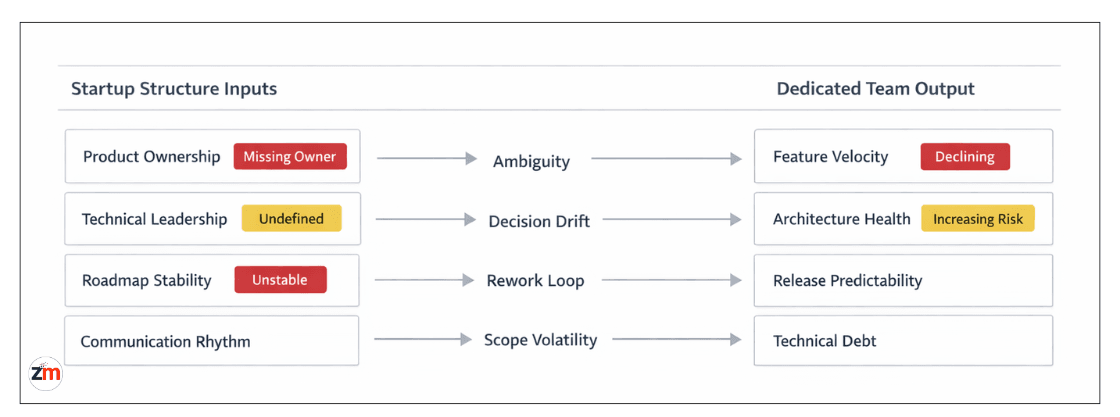
1. Lack of Strong Product Ownership
A dedicated team needs direction.
If your instructions sound like:
"Let us build something like X, but better."
That is inspiration, not execution clarity.
Without clear user stories, priorities, acceptance criteria, and decision boundaries, the team fills in gaps themselves.
Assumptions creep in.
Rework increases.
Velocity drops.
And suddenly, the efficient model feels expensive.
2. Treating Developers as Task Executors
Some founders unintentionally treat dedicated developers like ticket processors.
Tasks go in. Code comes out.
But strong engineering requires context, business understanding, long-term thinking, and architectural awareness.
When developers do not see the broader picture, they optimize locally.
Features ship.
Systems suffer.
Experienced founders often learn that the quality of decisions matters more than the speed of execution.
3. Scope Instability
Startups pivot. That is normal.
But the dedicated model works best with at least short-term roadmap stability.
If every week brings a new direction, priority reshuffle, or feature reset, momentum collapses.
The team spends more time recalibrating than building.
The problem is not change. The problem is constant change without structure.
4. Weak Technical Leadership Internally
This is one of the most common root causes.
If you do not have:
- A CTO
- A senior tech lead
- An engineering manager
- Or strong technical decision capability
You may struggle to guide a distributed engineering team effectively.
Even with a capable external partner, someone must own final trade-offs, architecture decisions, engineering priorities, and release risks.
Without clear technical ownership:
- Technical debt accumulates quietly.
- Architecture decisions drift.
- Security risks may go unnoticed.
- Performance issues surface late.
- Maintenance cost rises over time.
Gaps like these often surface in areas such as performance, scalability, or security exposure highlighted in widely referenced resources like the OWASP Top Ten security risks.
The system works, until it does not.
5. Communication Friction
Distributed teams require deliberate communication design.
Not more meetings.
Better clarity.
When there is no:
- Sprint rhythm
- Decision log
- Documentation habit
- Clear async workflow
- Release ownership
- Shared backlog visibility
Small misunderstandings grow into big inefficiencies.
Time zones amplify confusion.
And what was meant to be a velocity boost becomes coordination drag.
6. False Cost Comparisons
Many founders compare:
Dedicated developer monthly cost
vs
In-house salary
That is incomplete.
You must also factor:
- Oversight time
- Rework risk
- Architecture correction
- Management bandwidth
- Delayed releases
- Long-term maintenance
If leadership bandwidth is thin, total cost rises invisibly.
That is why some teams say, "Dedicated developers did not work for us."
Often, readiness, not talent, was the missing variable, which is why understanding how to choose the right development partner becomes just as important as the hiring model itself.
Dedicated Developer vs Dedicated Development Team: What's the Difference?
These terms are often used together, but they do not mean the same thing.
A dedicated developer is usually one engineer assigned to your project or product for a defined period. This can work well when you already have internal product and technical leadership, and you need extra hands for execution.
A dedicated development team is broader. It may include backend developers, frontend developers, QA, DevOps, project coordination, and technical leadership depending on the need. This model is better when you need roadmap continuity, structured delivery, and multiple skills working together.
The difference matters because hiring one developer when you actually need a delivery system creates pressure on both sides.
| Model | Best For | Risk If Misused |
|---|---|---|
| Dedicated Developer | Adding focused engineering capacity to an existing team | The developer waits on unclear decisions or missing technical direction |
| Dedicated Development Team | Ongoing product execution with multiple roles and delivery rhythm | The team becomes expensive if roadmap and ownership are unclear |
| Project-Based Outsourcing | Clearly defined MVPs, features, or fixed deliverables | It may not support long-term product evolution well |
If you only need one engineer, a dedicated developer model may be enough. If you need roadmap continuity, QA, DevOps, and delivery ownership, a structured team may be safer.
Dedicated Team vs In-House vs Project-Based: A Strategic Comparison
The real question is not whether to hire dedicated developers.
It is which model fits your current stage.
Each solves a different problem.
| Factor | In-House Team | Project-Based | Dedicated Team |
|---|---|---|---|
| Ownership Depth | High | Low | Medium to High |
| Cost Flexibility | Low | High | Medium |
| Best for MVP? | Rarely | Yes | Sometimes |
| Best for Long-Term Scaling? | Yes | No | Yes, with structure |
| Requires Strong Product Lead | Yes | Medium | Yes |
| Risk if Roadmap Unstable | Medium | Low | High |
In-House Team
Best suited for:
- Long-term product evolution
- Deep institutional knowledge
- Stable funding and roadmap
- Core IP ownership
Strengths:
- High ownership
- Cultural alignment
- Long-term continuity
Weaknesses:
- High fixed cost
- Hard to scale down
- Slow hiring cycles
If your product direction is stable and capital runway is healthy, in-house teams create strong internal leverage.
Project-Based Outsourcing
Best suited for:
- Clearly defined deliverables
- MVP builds
- Specific feature releases
- Fixed-scope technical work
Strengths:
- Defined scope
- Fixed timeline
- Predictable cost
Weaknesses:
- Limited long-term ownership
- Harder to evolve organically
- Less suitable for ongoing roadmap uncertainty
This works when you know exactly what needs to be built.
Not when you are still figuring it out.
Dedicated Development Team
Best suited for:
- Long-term roadmap execution
- Scaling existing products
- Extending internal teams
- Ongoing SaaS or product development
Strengths:
- Continuity
- Flexible scaling
- Integrated workflow
- Better context retention than short-term freelancing
Weaknesses:
- Requires strong structure
- Fails under constant pivoting
- Needs clear product leadership
Think of it this way:
In-house is owning the factory.
Project-based is ordering custom equipment.
Dedicated team is leasing a production line.
Leasing works if you know what you are producing and why. If you do not, the model may still add capacity, but it will not automatically create product direction, technical discipline, or release clarity.
A Simple Diagnostic Question
Ask yourself:
"What will this team build over the next 90 days?"
If that answer feels vague, you are not necessarily unready, but you may need clearer planning before committing to a dedicated structure.
Clarity reduces friction.
Friction reduces velocity.
When Hiring Dedicated Developers Actually Works
Now let us be clear: this model can be extremely powerful.
When aligned correctly, it creates real leverage, especially when structured around a well-defined model to hire dedicated developers rather than ad hoc resource allocation.
In product teams with clear 90-day roadmaps and strong ownership, dedicated developers are easier to integrate because decisions, priorities, and release expectations are already visible. Teams operating reactively usually struggle more, even when the engineers are capable.
Dedicated team readiness signals:
- 90-day roadmap documented
- Single decision owner identified
- Architecture documented
- Sprint cadence defined
- Metrics tied to outcomes
1. Clear Product Vision
You understand:
- Who your user is
- What problem you solve
- What success metrics matter
Ambiguity is reduced.
Dedicated teams perform best when direction is stable enough to compound progress.
2. Defined Technical Architecture
Before scaling externally, you need:
- Core stack decisions
- Coding standards
- Deployment process
- DevOps clarity
- Code review expectations
If architecture is debated mid-build, instability spreads quickly.
Strong foundations often align with principles outlined in the AWS Well-Architected Framework, which focuses on building secure, efficient, resilient, and operationally sound cloud applications.
Strong foundations enable acceleration.
3. Stable Short-Term Roadmap
No startup has a perfectly fixed plan.
But if priorities change every few days, execution suffers.
A 2 to 3-month horizon of clarity makes a significant difference.
Velocity compounds under stability.
4. Strong Internal Decision-Maker
There must be someone who can:
- Evaluate trade-offs
- Approve architecture
- Challenge assumptions
- Make final calls
- Protect the team from random priority changes
Without decision authority, distributed execution slows dramatically.
Leadership clarity protects momentum.
5. Partnership Mindset
The most successful setups treat the dedicated team as an extension of the company, not an external vendor.
That means:
- Shared backlog
- Shared documentation
- Shared sprint rituals
- Shared KPIs
- Shared accountability
- Shared release visibility
When integration is deep, the team can make better engineering decisions because they understand the business context, not just the ticket list.
A Real-World Contrast
Consider two startup situations.
Startup A:
- Unclear specs
- Weekly pivots
- No technical lead
- Ad hoc communication
- Features discussed verbally but rarely documented
Result: frustration, rework, unclear accountability, and slow releases.
Startup B:
- Clear roadmap
- Defined architecture
- Strong product owner
- Structured sprint cadence
- Release process agreed upfront
Result: predictable releases, better engineering judgment, and stronger delivery rhythm.
Same model.
Different discipline.
When You Should Not Hire Dedicated Developers Yet
Sometimes the best decision is not to hire more developers immediately.
You may not be ready for dedicated developers if:
- Your product idea is still changing every few days.
- No one owns product decisions clearly.
- You do not have a prioritized backlog.
- Your technical architecture is undocumented or unstable.
- You cannot review work or answer questions on time.
- You expect developers to define product strategy for you.
- You are only comparing hourly rates, not total delivery risk.
This does not mean the model is wrong forever.
It means the structure should come first.
A short planning, discovery, or architecture review phase can often prevent months of confusion later.
What to Prepare Before Hiring Dedicated Developers
Before committing budget, prepare the operating basics. This makes onboarding faster and reduces preventable rework.
- Product brief: What problem are you solving, for whom, and why now?
- 90-day roadmap: What outcomes should the team support in the next quarter?
- Prioritized backlog: Which features, fixes, and technical tasks matter first?
- Architecture notes: What stack, integrations, infrastructure, and constraints already exist?
- Acceptance criteria: How will the team know a task is complete?
- Code review process: Who reviews pull requests and approves technical changes?
- Release process: How do changes move from development to production?
- Communication rhythm: What happens synchronously, asynchronously, and in sprint ceremonies?
If these pieces are missing, developers will still write code, but they may not move the product in the right direction.
A Smarter Way to Structure Dedicated Development for Startups
If you are considering hiring dedicated developers, shift the question.
Do not ask: "Should we?"
Ask: "How do we structure it to win?"
Here is a practical approach.
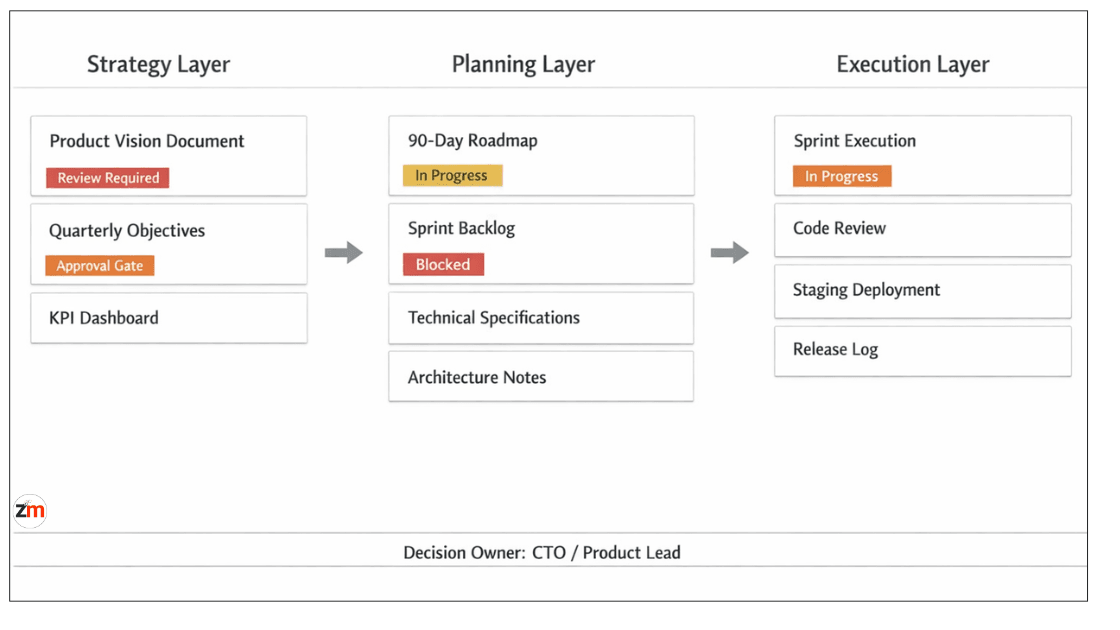
Step 1: Define 90-Day Outcomes
Not just feature lists.
Define measurable outcomes.
For example:
- Launch paid beta
- Improve onboarding conversion
- Stabilize infrastructure at 10k users
- Reduce production issues before a major release
When engineers understand the objective, their decisions improve. This is why early-stage teams often benefit from practical planning before scaling execution.
Step 2: Clarify Ownership
Document clearly:
- Who owns product decisions
- Who approves technical trade-offs
- Who prioritizes backlog
- Who signs off releases
- Who handles urgent production decisions
Ambiguity at this level creates silent delays.
Step 3: Establish Engineering Rituals
Before scaling, define:
- Sprint cadence
- Documentation tools
- Code review process
- Deployment flow
- Incident response protocol
Structure prevents drift.
For a closer look at delivery rhythm, team communication, and execution discipline, review the structured development process.
Many CTOs note that predictable rhythm matters more than aggressive deadlines.
Step 4: Start Lean, Expand Gradually
Avoid hiring five developers at once unless your structure is already mature.
Start with:
- One senior engineer
- One mid-level engineer
- Or a small pod mapped to a defined roadmap area
Stabilize process.
Then expand.
Scaling chaos is still chaos, just louder.
Step 5: Design for Knowledge Continuity
Ensure:
- Architecture diagrams are maintained
- Decisions are logged
- Documentation is updated
- Coding standards are enforced
- Handover notes are not treated as an afterthought
Knowledge trapped in people's heads creates long-term risk.
Distributed teams require institutional memory.
Step 6: Measure Velocity Objectively
Track:
- Cycle time
- Deployment frequency
- Rework rate
- Defect leakage
- Blocked tasks
- Production issues after release
If velocity declines, investigate structure before blaming talent.
Execution issues often trace back to clarity gaps.
Quick Decision Checklist Before You Scale
Before committing budget to a dedicated team, validate these points:
- We have a clear 90-day roadmap.
- A single person owns product decisions.
- Architecture and stack decisions are stable.
- Sprint and release rituals are defined.
- Success metrics are documented.
- We know who approves technical trade-offs.
- We can provide timely feedback to the team.
If two or more of these feel uncertain, strengthen structure first.
| Question | Yes | No |
|---|---|---|
| Do we have a stable 90-day roadmap? | ||
| Is one person accountable for product decisions? | ||
| Is one person accountable for technical decisions? | ||
| Is architecture documented? | ||
| Do we have defined sprint rituals? | ||
| Are success metrics clearly defined? |
What Most Founders Overlook
Hiring dedicated developers does not fix unclear strategy.
It magnifies whatever foundation exists.
Clear roadmap? You accelerate.
Weak architecture? You amplify instability.
Strong leadership? You scale smoothly.
Unclear ownership? You stall.
The model is a multiplier.
Your structure determines what it multiplies.
This is why serious engineering partners evaluate roadmap, ownership, architecture, and communication rhythm before simply assigning developers.
Frequently Asked Questions
Why do dedicated development teams fail?
Dedicated development teams usually fail because of unclear ownership, unstable scope, weak technical leadership, poor documentation, or no sprint rhythm. The issue is often structure, not developer skill.
When should a startup hire dedicated developers?
A startup should hire dedicated developers when it has a clear 60 to 90-day roadmap, one decision owner, stable priorities, and enough product clarity to guide ongoing execution.
What should be ready before hiring dedicated developers?
Before hiring dedicated developers, prepare a product roadmap, prioritized backlog, architecture notes, acceptance criteria, communication rhythm, code review process, and release workflow.
Is hiring dedicated developers cheaper than building in-house?
It can reduce direct hiring and payroll costs, but total cost depends on rework, oversight, architecture quality, and delivery discipline. Lower monthly rates do not always mean lower project cost.
What is the difference between a dedicated developer and a dedicated development team?
A dedicated developer is usually one engineer assigned to your work. A dedicated development team may include developers, QA, DevOps, project coordination, and technical leadership for ongoing delivery.
Are dedicated developers better than freelancers?
Dedicated developers are usually better for long-term roadmap work, product continuity, and deeper context. Freelancers can work well for small, clearly defined tasks or short-term specialist needs.
Is a dedicated development team good for MVP development?
A dedicated team can work for MVP development if the roadmap is clear and the product needs ongoing iteration. For a tightly scoped MVP, a project-based model may sometimes be simpler.
How can startups reduce risk when hiring dedicated developers?
Start small, define 90-day outcomes, assign one product owner, document architecture, set sprint rituals, agree on release process, and measure progress using cycle time, rework, and delivery quality.
Final Thought Before You Decide
Hiring dedicated developers is not about cost alone.
It is about operational maturity.
When structured well, it enables:
- Faster scaling
- Access to specialized expertise
- Sustainable product growth
- Better continuity across releases
When misaligned, it drains attention, time, and budget.
The difference is not just talent.
It is leadership and structure.
Next Step: Evaluate If This Model Fits Your Startup
If you are evaluating whether the dedicated team model fits your stage, start with a structured comparison before committing budget or expanding headcount.
Review real product engineering case studies to see how structured execution, technical ownership, and delivery rhythm reduce product development risk.
If you are unsure whether you need one developer, a dedicated team, or a more structured product build, talk to a CTO-led development team before you scale the team.
Clarity now prevents expensive corrections later.
In This Blog
- Why Founders Choose to Hire Dedicated Developers
- When Should You Hire Dedicated Developers?
- Where the Dedicated Developer Model Breaks Down
- Dedicated Developer vs Dedicated Development Team
- Dedicated Team vs In-House vs Project-Based
- When Hiring Dedicated Developers Actually Works
- When You Should Not Hire Dedicated Developers Yet
- What to Prepare Before Hiring Dedicated Developers
- A Smarter Way to Structure Dedicated Development
- Frequently Asked Questions
- Final Thought Before You Decide
Shivam Sharma
Before You Scale Further, Review the Architecture.
Let’s evaluate where your system stands — and where it may break under growth.
Schedule an Architecture Review 30-minute technical discussion. No obligation.