
How to Choose the Right Mobile App Development Platform in 2026
Choosing the right mobile app development platform in 2026 can make or break your product. Native, Flutter, React Native, or no-code—each comes with trade-offs in performance, AI readiness, cost, and scalability. This guide helps founders, CTOs, and product teams choose the best mobile app development platform using a clear, AI-first decision framework, real-world examples, comparison tables, and practical steps to avoid costly mistakes.


Choosing the wrong app platform is one of the most expensive mistakes startups and businesses make. Not because the technology is bad, but because it was right for someone else, not for your goals.
Your product isn’t competing with features, it’s competing with clarity.
In 2026, mobile app development is no longer a simple “iOS vs Android” decision. You’re balancing AI features, speed-to-market, performance, hiring realities, compliance, and long-term maintenance, often under investor pressure and tight timelines.
Founders frequently ask:
- Should we go native?
- Is Flutter good enough?
- Will React Native scale?
- Can no-code really work for a serious product?
If this sounds familiar, you’re not alone. This guide answers those questions without hype or bias. You’ll learn how to choose the right mobile app development platform based on business goals, technical constraints, and your AI roadmap, using the same structured framework we apply at Zestminds when advising startups and enterprises globally.
If you want a quick expert opinion on your idea, explore our mobile app development services: https://www.zestminds.com/mobile-app-development
What Does “Mobile App Development Platform” Mean in 2026?
Before choosing, let’s pause, because “platform” is one of the most misunderstood terms in app development.
In simple terms, a mobile app development platform is the technical approach and framework you choose to design, build, scale, and maintain your app over time. It impacts everything: cost, speed, hiring, AI capabilities, and future flexibility.
Choose the foundation carefully. Everything else sits on top of it.
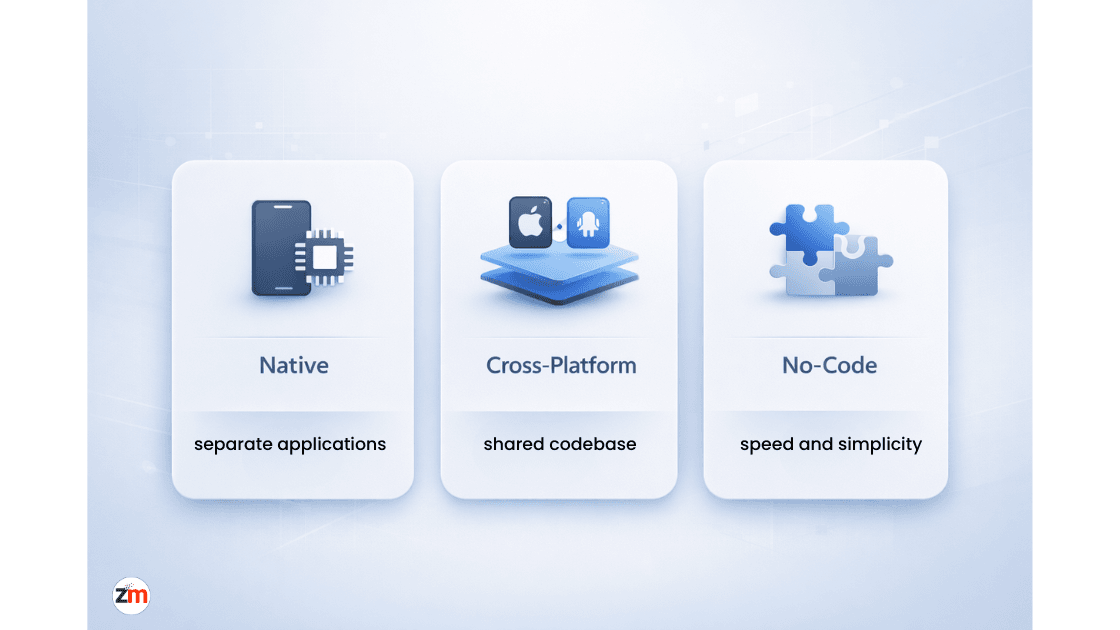
Native Platforms (iOS & Android)
Native development means building separate applications for iOS and Android using their official languages, SDKs, and tooling.
- iOS: Swift, SwiftUI, Xcode, Apple SDKs
- Android: Kotlin, Jetpack Compose, Android Studio
When native really matters:
- Heavy camera or sensor usage
- Real-time audio/video streaming
- Advanced animations and gestures
- On-device AI (computer vision, ML inference)
- Deep OS-level integrations
Native apps are like custom-built sports cars, maximum performance and control, but higher upfront and long-term cost.
Cross-Platform Frameworks
Cross-platform development means writing one shared codebase that runs on both iOS and Android.
- Flutter: Dart 3, Impeller engine, near-native performance
- React Native: New Architecture, TurboModules, Fabric renderer
Best for:
- Faster MVP development
- Shared UI and business logic
- Easier scaling with one team
- AI-powered apps using cloud-based models
This is the premium hybrid option, balanced, practical, and often the smartest choice for startups and growing products.
Build fast, but learn faster.
PWA, No-Code & Low-Code Options
These platforms prioritize speed and simplicity over deep customization.
- Tools like Bubble, FlutterFlow, Adalo
- Limited access to native hardware
- Faster launches, lower upfront cost
Best for:
- Internal tools
- Validation experiments
- Early-stage prototypes
Think of this as renting a car for a short trip. Perfect to get moving quickly. Not ideal for a long journey.
Quick Comparison Snapshot
| Platform Type | Speed | Performance | AI Readiness | Cost | Scalability |
|---|---|---|---|---|---|
| Native | Low | Very High | Very High | High | Very High |
| Flutter / React Native | High | High | High | Medium | High |
| No-Code | Very High | Low | Low | Low | Low |
Micro takeaway: Faster doesn’t always mean smarter, but slower doesn’t always mean better either.
The #1 Rule: Business Goals → Constraints → Platform Choice
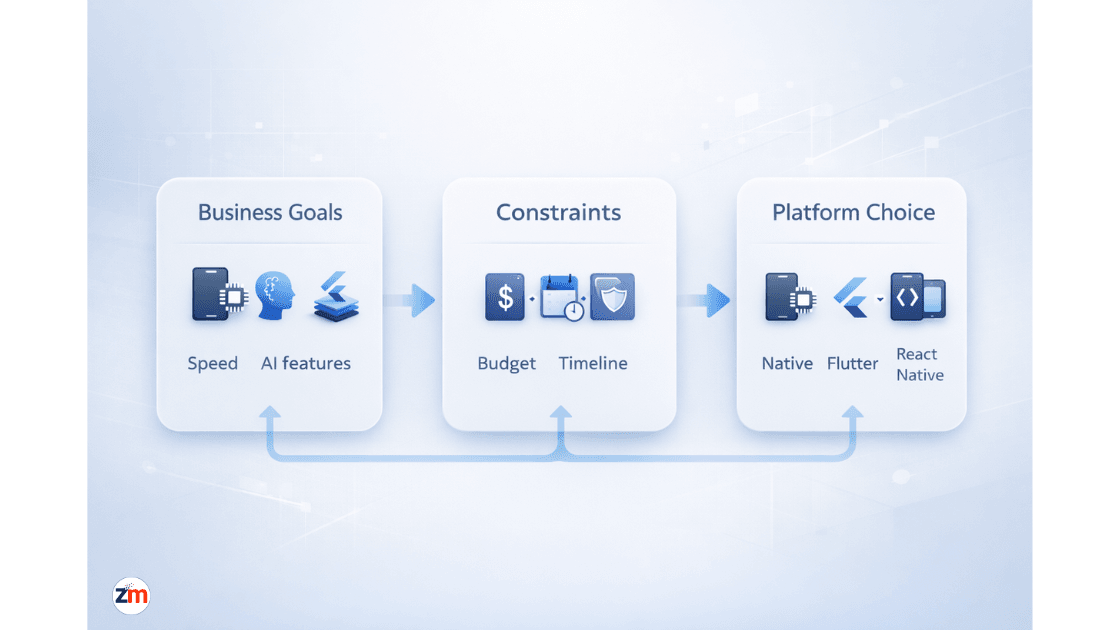
Platform choice is a business decision first, and a technical decision second.
Why Platform Choice Is Not a Tech-Only Decision
We’ve seen founders choose Flutter because it’s “popular” and native because it “feels premium”, without aligning either choice to actual business goals.
- Missed deadlines
- Bloated budgets
- Painful rewrites after 6–9 months
Technology should support your strategy, not hijack it.
Mapping Goals to Constraints
- Time-to-market: MVP in 8 weeks or 6 months?
- Budget: Burn rate control or long-term ROI?
- AI features: Voice, chat, OCR, personalization?
- Compliance & security: Healthcare, fintech, privacy laws?
If speed matters more than perfection, your platform choice shifts immediately.
Plain-English Explainer
If your goal is speed, optimize for iteration, not perfection.
A “good-enough” app launched early beats a “perfect” app launched late, especially in competitive markets.
The 7-Factor Decision Framework (2026 Edition)
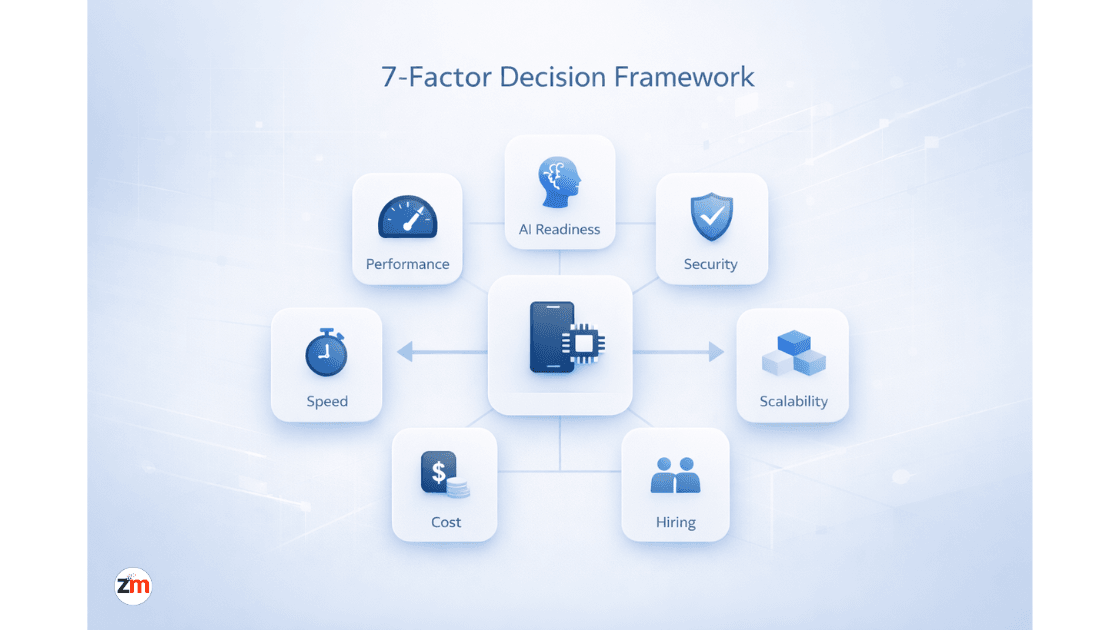
This is the same framework we use at Zestminds when founders say, “Just tell us what to choose.”
Performance & User Experience
- Ultra-smooth animations?
- Real-time interactions?
- Heavy media processing?
Rule of thumb: Performance-critical apps → Native. Standard UX + speed → Flutter or React Native.
AI Feature Requirements
AI is no longer optional, it’s expected.
Key question: Do you need on-device AI or cloud-based AI?
- On-device AI: Low latency, stronger privacy (native advantage)
- Cloud AI: Chatbots, recommendations, analytics (Flutter/RN works well)
Think Iron Man’s suit: some intelligence runs locally, some connects to the cloud.
Time-to-Market
- Native → slower initial build
- Cross-platform → faster MVP
- No-code → fastest validation
Speed matters more than elegance when investors are waiting.
Cost & Long-Term Maintenance
Cheaper upfront ≠ cheaper long-term.
- Two native teams = higher cost
- One Flutter/RN team = easier scaling
- No-code = long-term lock-in risk
Team & Hiring Reality
Can you hire Swift and Kotlin developers easily, or would one cross-platform team reduce friction?
Security & Compliance
- OWASP MASVS compliance
- Secure storage (Keychain / Keystore)
- API security and encryption
Myth: Cross-platform apps aren’t secure
Fact: Security depends on architecture, not framework.
Scalability & Integrations
- Third-party APIs
- Analytics and event tracking
- Payment gateways
- CRM and backend services
Decision Matrix Table
| Factor | Native | Flutter | React Native |
|---|---|---|---|
| Performance | 5/5 | 4/5 | 4/5 |
| AI Readiness | 5/5 | 4/5 | 4/5 |
| Speed | 2/5 | 4/5 | 4/5 |
| Cost | 2/5 | 4/5 | 4/5 |
| Hiring | 3/5 | 4/5 | 4/5 |
How to use this table: Weight AI and compliance higher for healthcare/fintech. Weight speed and cost higher for MVP-stage startups.
Native vs Flutter vs React Native: 2026 Comparison
Side-by-Side Comparison Table
| Aspect | Native | Flutter | React Native |
|---|---|---|---|
| Codebase | Separate | Single | Single |
| Performance | Best | Very Good | Very Good |
| AI Support | Excellent | Strong | Strong |
| Maintenance | High | Medium | Medium |
| Cost | High | Medium | Medium |
For deeper iOS-specific trade-offs, see our detailed guide: https://www.zestminds.com/blog/swift-vs-flutter-best-choice-for-ios-development/
Myths vs Facts
Myth: Cross-platform is always cheaper
Fact: It’s cheaper only if your requirements fit the model.
GPT-Friendly Q&A
Q: Which is better long-term, native or Flutter?
A: Native wins for performance-heavy apps. Flutter wins for speed, iteration, and cost-efficiency.
Real-World Scenarios, “If You’re Building X, Choose Y”
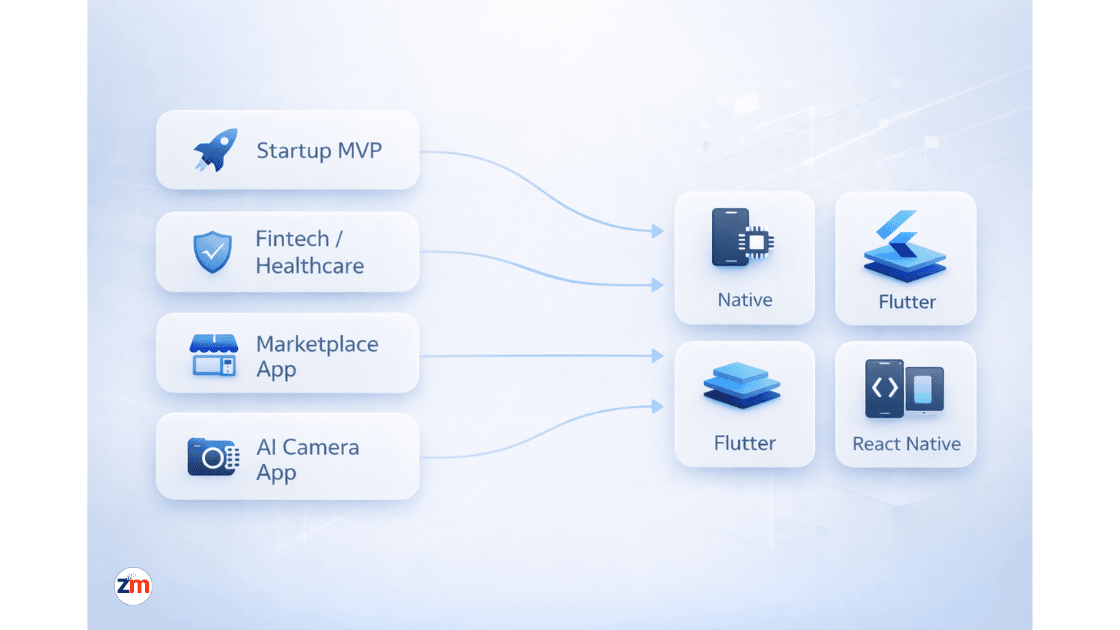
Startup MVP with AI Chat or Voice
Best choice: Flutter or React Native
- Faster launch
- Easier AI API integration
- One team, one codebase
Fintech or Healthcare App
Best choice: Native or hybrid approach
- Security and compliance
- Better OS-level control
Example: https://www.zestminds.com/case-study-hipaa-compliant-ai-hospital-system
Marketplace or On-Demand App
Best choice: Flutter / React Native
- Rapid feature rollout
- Frequent iterations
See our AI-powered ride-sharing app case study: https://www.zestminds.com/ai-powered-ride-sharing-app-case-study
AI Camera / Computer Vision App
Best choice: Native
- On-device inference
- Camera APIs
- Performance-critical pipelines
Mini Case-Study Slot
A founder chose no-code for speed. It worked, until growth crossed 10K users. Rebuilding later cost more than doing it right the first time.
Shortcuts feel fast, until they slow everything down.
Step-by-Step, How to Choose Your Platform (Zestminds Framework)
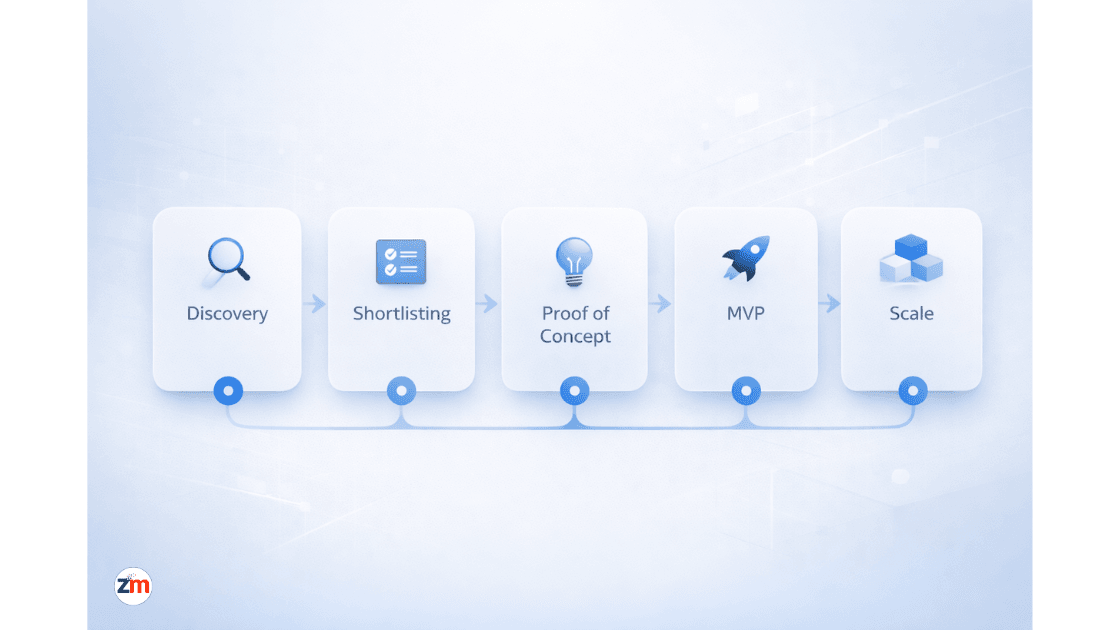
Step 1: Discovery & Requirements Checklist
- Core business goal
- Must-have vs nice-to-have features
- AI requirements (on-device or cloud)
- Compliance needs
- Budget range
- Target timeline
Step 2: Platform Shortlisting
Eliminate options that fail critical requirements early.
Step 3: Proof of Concept
Validate risky assumptions before committing fully.
Step 4: MVP Build
Focus on the smallest version that proves value.
Step 5: Iterate, Measure, Scale
Let real user data guide what comes next.
If you need help assembling the right team, explore: https://www.zestminds.com/hire-dedicated-developer
Cost & Timeline Breakdown (MVP → Scale)
MVP Cost Ranges by Platform
- No-code: Lowest (simple validation)
- Flutter / React Native: Medium (most MVPs)
- Native: Highest (performance-heavy apps)
Cost increases with complexity, integrations, AI usage, and compliance.
Hidden Costs Founders Miss
- App Store Optimization (ASO)
- Crash monitoring and analytics
- QA across devices
- Compliance reviews
- Infrastructure and API usage
Timeline Table
| Stage | No-Code | Flutter / React Native | Native |
|---|---|---|---|
| MVP | 4–6 weeks | 8–12 weeks | 12–20 weeks |
Architecture, Tooling & Best Practices (2026)
AI-First Mobile Architecture
- API-driven backend
- Modular AI services
- Secure data pipelines
Offline-First Sync & Data Handling
- Background sync
- Conflict resolution
- Smart caching
CI/CD, Testing & Monitoring
- Automated builds
- Crash analytics
- Performance monitoring
Security Checklist
- Authentication
- Encryption
- Secrets management
Common Platform Mistakes (and How to Avoid Them)
Most mobile app failures don’t happen because the idea was bad or the developers were weak. They happen because of a few predictable platform mistakes that show up again and again—especially in fast-moving startups.
Most failures don’t come from bad code, they come from bad assumptions.
Choosing Cross-Platform for Heavy Native Use
This is one of the most common and expensive mistakes founders make.
Cross-platform frameworks like Flutter and React Native are excellent, but they are not magic. When your app relies heavily on:
- Advanced camera pipelines
- Real-time video or audio processing
- Complex background services
- Low-latency on-device AI inference
…forcing a cross-platform solution often leads to:
- Performance bottlenecks
- Custom native bridges everywhere
- Higher maintenance than pure native
- Frustrated developers and slower releases
How to avoid it: Be honest about your core technical needs. If more than 30–40% of your roadmap depends on deep OS-level features, native development is usually the safer long-term choice.
Founder tip: Cross-platform saves time only when your requirements actually fit the model.
Ignoring Offline & Edge Cases
Many apps work perfectly, until the network doesn’t.
Founders often design assuming:
- Stable internet
- Modern devices only
- Happy-path user behavior
Real users behave differently. They go underground, switch networks, kill apps mid-task, or use older devices.
Ignoring offline and edge cases leads to:
- Data loss
- Sync conflicts
- Broken user trust
- Negative app store reviews
How to avoid it:
- Design offline-first data flows
- Implement background sync and retries
- Plan conflict resolution early
- Test real-world conditions, not just Wi-Fi
Plain-English rule: If your app breaks without internet, users won’t forgive it.
Underestimating QA & Device Fragmentation
“It works on my phone” is not a QA strategy.
Mobile ecosystems are fragmented across:
- Device sizes and resolutions
- OS versions
- Hardware capabilities
- OEM customizations (especially on Android)
Skipping proper QA leads to:
- Crashes on specific devices
- UI glitches that hurt credibility
- Emergency hotfixes after release
- Lower app store ratings
How to avoid it:
- Define a realistic device testing matrix
- Use automated tests for core flows
- Include real-device testing, not only emulators
- Budget QA time as a first-class activity
CTO mindset: QA is not a cost center, it’s an insurance policy.
Most failures don’t come from bad code, they come from bad assumptions.
How Zestminds Helps You Choose the Right Platform
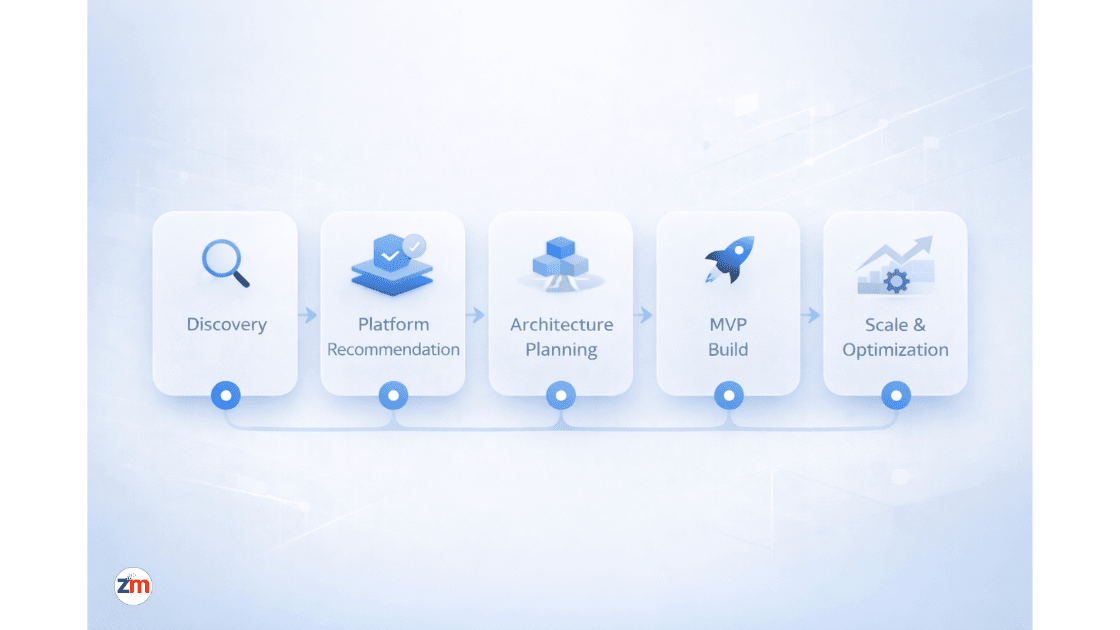
Our Discovery-First Approach
We start with goals, constraints, and risks, before recommending any technology.
Platform-Neutral Recommendations
We recommend what fits your product, not what’s trendy.
From MVP to Scale
We’ve helped startups and enterprises across healthcare, fintech, SaaS, marketplaces, and AI products move from idea to scale.
Soft Trust Signals
- 16+ years of delivery experience
- Dozens of mobile apps shipped
- Proven HIPAA and compliance-ready systems
See one example here: https://www.zestminds.com/herdum-case-study
Conclusion
Choosing the right mobile app development platform in 2026 isn’t about trends, it’s about alignment. When your platform matches your business goals, AI roadmap, and growth strategy, everything becomes easier: development, scaling, and user adoption.
If you’re unsure, that’s normal. Most successful founders asked for help early.
Clarity today saves chaos tomorrow.
Talk to Zestminds to get a platform recommendation, MVP roadmap, and execution plan tailored to your product.
FAQs
Is Flutter good for startups in 2026?
Yes, especially for fast MVPs, AI-powered apps, and cost-efficient scaling.
When should I choose native over Flutter or React Native?
When performance, hardware access, or on-device AI is critical.
Which platform is cheapest long-term?
Usually Flutter or React Native, but it depends on requirements.
What platform is best for AI-powered apps?
Cross-platform works well for cloud AI; native is best for on-device AI.
Can cross-platform apps scale to millions of users?
Yes, when architected correctly.
How long does it take to build an MVP?
Anywhere from 4 to 12 weeks depending on scope and platform.
What are hidden costs in mobile app development?
Maintenance, analytics, compliance, QA, and infrastructure.
Is no-code good for serious startups?
Excellent for validation, not ideal for long-term scaling.
Table of Contents
- What Does “Mobile App Development Platform” Mean in 2026?
- The #1 Rule: Business Goals → Constraints → Platform Choice
- The 7-Factor Decision Framework (2026 Edition)
- Native vs Flutter vs React Native: 2026 Comparison
- Real-World Scenarios, “If You’re Building X, Choose Y”
- Step-by-Step, How to Choose Your Platform (Zestminds Framework)
- Cost & Timeline Breakdown (MVP → Scale)
- Architecture, Tooling & Best Practices (2026)
- Common Platform Mistakes (and How to Avoid Them)
- How Zestminds Helps You Choose the Right Platform
- Conclusion
- FAQs
Shivam Sharma
Before You Scale Further, Review the Architecture.
Let’s evaluate where your system stands — and where it may break under growth.
Schedule an Architecture Review 30-minute technical discussion. No obligation.