
MVP Development Company: Build Your Startup MVP in 6–8 Weeks
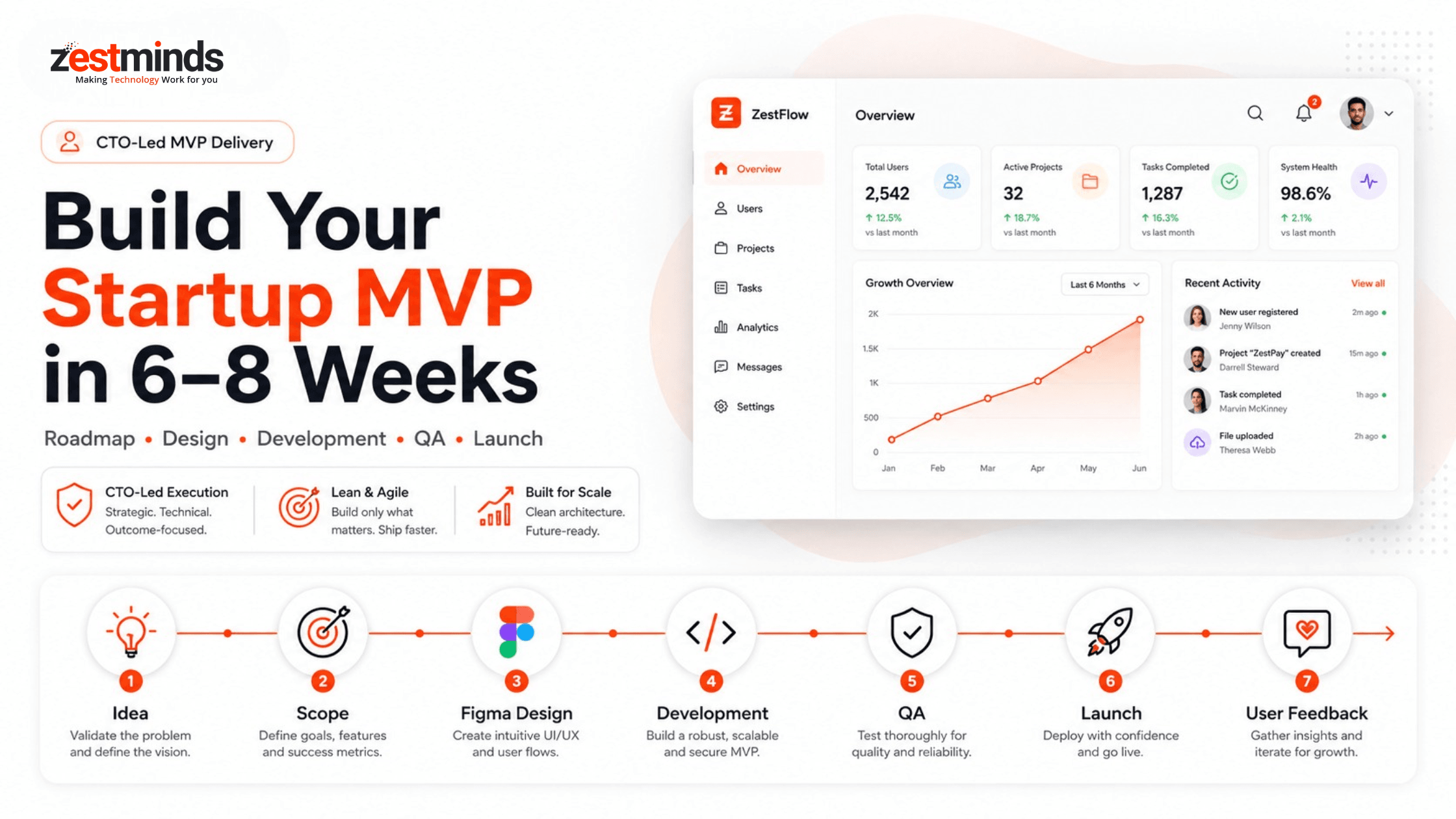
Startup ideas do not win by staying in pitch decks for months. They win when founders test them with real users, real workflows, and real feedback. A focused MVP development company can help you move from idea to a working product in 6–8 weeks when the scope is clear, the team is aligned, and the first version is built around one core problem.
This guide explains how startup MVP development works, what can realistically be built in a few weeks, how much it may cost, which tech stacks make sense, what mistakes to avoid, and how to choose the right development partner before you spend serious runway.
If you already have a product idea and want expert help turning it into a buildable roadmap, explore our MVP development services.

Why Startups Cannot Afford to Skip MVPs
Imagine pitching investors. They nod politely, like your idea, and then ask the question every founder eventually hears.
“When can we try it?”
That is the reality of today's startup market. Competitors move fast. Users expect quick value. Investors want signals, not only slides. Spending 12–18 months building the “perfect” product before validation is like renting a stadium before checking if anyone wants to play your sport.
An MVP is your food truck before the restaurant. It is fast, focused, and built to test whether people actually want what you are building.
Why hire an MVP development company?
- Speed: A focused MVP can often launch in 6–8 weeks instead of taking several months.
- Cost control: You build only what is needed to validate demand.
- Better execution: Design, backend, frontend, QA, and deployment move together.
- Investor confidence: A working product is stronger than a pitch deck alone.
- Founder focus: You stay focused on users, market, and fundraising while the team handles delivery.
The important point is not just speed. The real value is learning faster without wasting budget on features nobody asked for.
What Exactly Is an MVP? And What It Is Not
An MVP is often confused with a prototype or proof of concept, but they are not the same thing.
- Prototype: A visual demo or clickable mockup. It helps test design and flow, but it usually has no real backend functionality.
- POC: A technical experiment used to prove that something can work.
- MVP: A functional product that solves one real problem for real users.
- Full product: A more polished, scaled, and feature-rich version built after validation.
MVP vs Prototype vs POC
Here is a simple comparison:
| Type | Purpose | Real Users? | Example |
|---|---|---|---|
| Prototype | Tests user flow and design direction | No | Clickable Figma screens for an AI dating app |
| POC | Tests technical feasibility | No | AI model generates sample match suggestions |
| MVP | Tests real market demand with working features | Yes | Users create profiles, match, chat, and share feedback |
Takeaway: A prototype helps people see the idea. A POC proves the technology can work. An MVP helps you learn whether users actually need the product.
What Can You Realistically Build in 4, 6, or 8 Weeks?
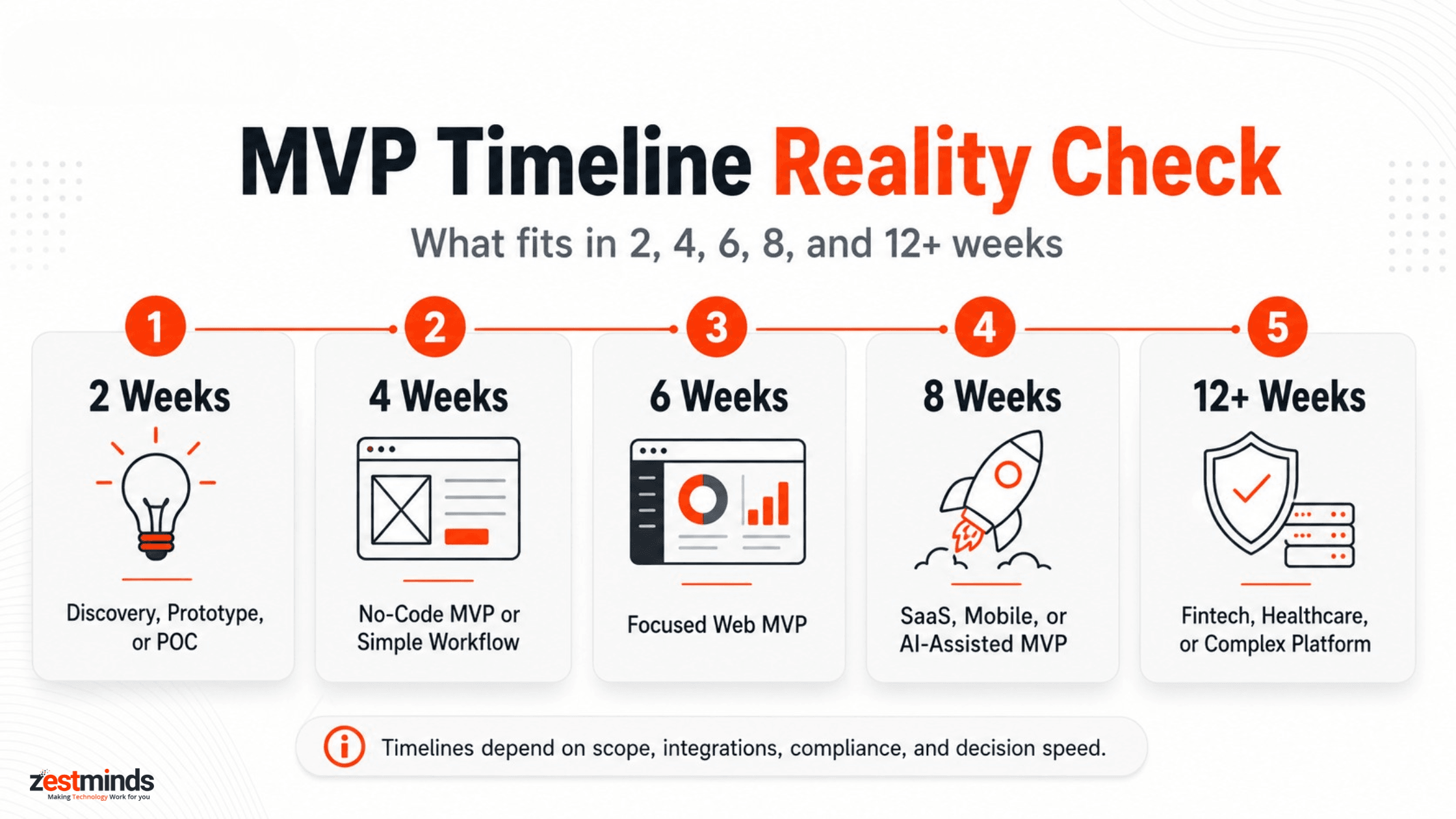
Not every MVP should be promised in the same timeline. A simple no-code validation tool and a healthcare SaaS product with secure messaging are not the same project. The timeline depends on scope, integrations, compliance, design readiness, and decision speed.
| Timeline | Best For | Realistic Output |
|---|---|---|
| 2 weeks | Discovery, prototype, or POC | Product roadmap, clickable prototype, technical feasibility test, or landing-page validation |
| 4 weeks | Very focused MVPs | No-code MVP, internal tool, simple workflow, or limited demo with one core user journey |
| 6 weeks | Focused web MVPs | Authentication, core dashboard, basic admin, one main workflow, and pilot-ready release |
| 8 weeks | SaaS, mobile, marketplace, or AI-assisted MVPs | Core product flows, integrations, QA, deployment, analytics, and first-user onboarding |
| 12+ weeks | Complex or regulated MVPs | Fintech, healthcare, EHR connectivity, advanced AI, multi-sided platforms, or compliance-heavy builds |
A serious 6–8 week MVP is not about cutting corners. It is about cutting the wrong features.
The 6–8 Week MVP Development Roadmap
A sprint-based approach helps founders move from idea to live product without losing control of scope, cost, or quality.
Week 1: Discovery and Roadmapping
This is where the idea becomes a buildable plan. The team defines the target user, core problem, must-have features, risky assumptions, technical needs, and launch goal.
- Clarify the product vision and business model.
- Define target users and core use cases.
- Separate must-have features from nice-to-have ideas.
- Identify integrations, compliance needs, and technical risks.
- Create the MVP roadmap, timeline, and budget range.
Output: MVP blueprint with scope, milestones, team needs, and delivery plan.
Weeks 2–3: MVP Design Sprint
Design is not decoration at this stage. It is how the team prevents rework. A good MVP design sprint turns rough ideas into clear user flows, wireframes, and clickable screens before development begins.
- Map user journeys and critical flows.
- Create wireframes for core screens.
- Build clickable Figma designs.
- Define the design system only as much as version one needs.
- Freeze the first development scope.
Output: Development-ready Figma designs and clear user flows.
Weeks 3–6: Agile Development
This is where the MVP becomes functional. Backend, frontend, mobile, APIs, database, integrations, and admin workflows are built in focused sprints.
- Set up backend, database, APIs, and core architecture.
- Build frontend or mobile screens from approved designs.
- Integrate payments, messaging, AI, CRM, analytics, or third-party APIs where needed.
- Run weekly sprint demos with founder feedback.
- Keep non-essential features out of version one.
Output: Functional MVP with the core product journey working end to end.
Weeks 6–7: QA and Launch Readiness
Many MVPs fail not because the idea is weak, but because the first release feels unstable. QA keeps the first user experience clean enough for pilot users, investors, or early customers.
- Test core workflows across devices and browsers.
- Fix priority bugs and edge cases.
- Check security basics, roles, permissions, and data handling.
- Validate analytics events and conversion paths.
- Prepare deployment and release checklist.
Output: Stable MVP release candidate ready for pilot launch.
Week 8: Launch and Support
The first launch should be controlled. The goal is not to impress everyone. The goal is to get useful feedback from the right first users.
- Deploy to cloud, app stores, or production environment.
- Onboard pilot users or internal teams.
- Monitor bugs, user behavior, and drop-off points.
- Train the founder or internal team on basic product usage.
- Plan 2–4 weeks of post-launch support.
Output: Live MVP with real users, feedback, and next-step roadmap.
Week 8 and Beyond: Post-Launch Iteration
After launch, the product roadmap should be driven by usage data, user feedback, and business priorities — not assumptions.
- Review analytics and user feedback.
- Prioritize fixes and highest-value improvements.
- Prepare investor demo material if needed.
- Plan scale, infrastructure, and future product phases.
Output: Validated product roadmap for beta, fundraising, or scale.
Ready to map your MVP?
If you have an idea, feature list, or investor deadline, you can book a free MVP roadmap session and get clarity on scope, timeline, team, and budget before development begins.
Best MVP Tech Stack by Product Type
The best MVP tech stack is not the one with the trendiest framework. It is the one that helps you launch fast, maintain the product, integrate what matters, and scale only when traction proves the need.
| MVP Type | Practical Stack Options | Why It Works |
|---|---|---|
| SaaS MVP | React or Next.js, Node.js or Python, PostgreSQL, Stripe | Good for dashboards, subscriptions, user roles, reporting, and admin workflows |
| AI MVP | Python, FastAPI, OpenAI, vector database, cloud storage | Useful for RAG, chatbots, automation, recommendations, and AI workflows |
| Mobile MVP | Flutter or React Native with API backend | Helps launch iOS and Android faster without building two separate native apps first |
| Marketplace MVP | React, Node.js or Laravel, PostgreSQL, Stripe Connect | Supports buyers, sellers, payments, roles, listings, and transaction workflows |
| Healthcare or fintech MVP | Python, Node.js, secure APIs, audit logs, encrypted data storage | Better for security, compliance planning, integrations, and controlled access |
| Low-code or no-code MVP | Bubble, FlutterFlow, Retool, Airtable, custom APIs where needed | Useful for validation, internal workflows, admin tools, or early-stage experiments |
If your MVP includes AI features, a focused AI MVP development approach can help you avoid building a chatbot wrapper and instead design workflows, data flows, model prompts, testing layers, and fallback logic from day one.
How Much Does It Cost to Build an MVP?
MVP development cost depends on the product type, feature scope, design complexity, integrations, compliance needs, and team location. A simple internal workflow MVP and a HIPAA-aware AI healthcare product will not have the same cost.
Region-wise MVP cost range
| Region | Typical Cost Range | Timeline | Notes |
|---|---|---|---|
| USA / Canada | $40K – $100K+ | 6–10 weeks | Higher rates, stronger local proximity, and often stricter compliance expectations |
| UK / Germany | $30K – $80K+ | 6–9 weeks | Good for privacy-conscious and GDPR-first product planning |
| Australia | $25K – $70K+ | 6–8 weeks | Balanced cost-quality expectations for startups and SMEs |
| India / Eastern Europe | $15K – $50K+ | 6–8 weeks | Cost-effective when the team has senior product and engineering ownership |
For founders targeting North America, MVP development for US startups often works best when product strategy, communication, sprint planning, and senior engineering ownership are clearly defined from the beginning.
MVP cost by complexity
| MVP Type | Cost Level | What Usually Affects Cost |
|---|---|---|
| Prototype or no-code MVP | Lower | Simple flows, limited backend, fewer integrations, faster validation |
| Simple web MVP | Medium | Login, dashboard, admin, database, basic workflows, deployment |
| SaaS MVP | Medium to high | Subscriptions, user roles, billing, analytics, permissions, reporting |
| Mobile MVP | Medium to high | iOS/Android support, push notifications, app store setup, API backend |
| AI MVP | High | LLM workflows, RAG, prompt testing, data handling, model evaluation, fallback logic |
| Regulated MVP | High | Healthcare, fintech, secure messaging, audit logs, compliance, integrations |
The safest way to manage MVP cost is to define the core validation goal first. If a feature does not help validate demand, onboard first users, or support investor demo clarity, it can usually wait.
MVP Design Sprint: From Figma to Development-Ready Scope
Many founders want to jump directly into coding. That can work for very simple tools, but for most SaaS, mobile, marketplace, and AI MVPs, a short design sprint saves time later.
A practical MVP design sprint should define:
- The primary user journey.
- The first 5–10 core screens.
- Clickable Figma prototype for stakeholder review.
- Development-ready UI states, forms, flows, and edge cases.
- What is included in version one and what is intentionally delayed.
Figma designs do not need to be over-polished for the first version. The goal is clarity. Good design helps founders avoid vague scope, endless revisions, and expensive development rework.
Solo Developer vs MVP Development Company
A solo developer can be a good choice for a prototype, internal tool, landing-page MVP, or very small product with limited risk. But a complete MVP usually needs more than coding.
| Option | Best For | Risk |
|---|---|---|
| Solo developer | Small prototypes, scripts, simple MVPs, early experiments | Limited design, QA, architecture, documentation, and backup capacity |
| Freelancer team | Budget-conscious builds with clear management from the founder | Coordination risk if roles, timelines, and ownership are not clear |
| MVP development company | SaaS, mobile, AI, marketplace, fintech, healthcare, or launch-ready MVPs | Higher upfront cost, but better team coverage and delivery structure |
If your MVP needs UX, backend, frontend, QA, integrations, deployment, and launch support, a dedicated MVP development team is usually safer than depending on one person for everything.
How to Hire an MVP Development Team for an 8-Week Launch
Hiring for speed does not mean hiring the cheapest team. It means choosing a team that can make decisions quickly, communicate clearly, and deliver working software in weekly sprints.
Core roles in an MVP team
| Role | Responsibility |
|---|---|
| Product strategist or PM | Scope, priorities, sprint planning, founder alignment, release control |
| UI/UX designer | User flows, wireframes, Figma designs, usability improvements |
| Backend developer | APIs, database, business logic, integrations, security basics |
| Frontend or mobile developer | User-facing product, responsive UI, mobile experience, app flows |
| QA engineer | Testing, bug tracking, release readiness, cross-device validation |
| DevOps or cloud engineer | Deployment, environments, monitoring, performance, CI/CD where needed |
Questions to ask before hiring
- Have you built MVPs in my industry before?
- Can you show examples of MVPs delivered in 6–8 weeks?
- How do you manage scope changes during sprints?
- Will I get weekly demos and sprint updates?
- Who owns the source code and IP?
- What happens after launch?
- How do you handle bugs, support, and handover?
What Should an MVP Development Contract Include?
A clear contract protects both the founder and the development team. It also reduces confusion when speed matters.
At minimum, the MVP contract should define:
- Scope: Features included in version one and features excluded from the MVP.
- Timeline: Milestones, sprint length, review dates, and launch target.
- Deliverables: Figma files, source code, deployment setup, documentation, and QA output.
- Payment milestones: Clear payment structure tied to delivery stages.
- IP ownership: Who owns the code, design, assets, and product work.
- Source code access: Repository access, handover process, and branch management.
- Change requests: How extra features or scope changes are estimated and approved.
- Post-launch support: Bug-fix period, support window, and ongoing maintenance options.
If a vendor cannot explain these clearly before development starts, that is a warning sign.
MVP Mistakes That Delay Launch or Waste Budget
- Building too many features: Version one should validate the core problem, not every future idea.
- Skipping user research: A founder assumption is not the same as market demand.
- Ignoring UX: If users cannot complete the core flow easily, they will not care how good the backend is.
- Choosing the wrong tech stack: A trendy stack can slow you down if it does not fit the product type.
- No QA or launch plan: Bugs in the core workflow can damage early trust.
- No analytics: Without usage data, every product decision becomes guesswork.
- Compliance blind spots: Healthcare, fintech, payments, and messaging products need security planning early.
- Weak scope control: Feature creep is the silent killer of MVP timelines.
Practical rule: Your MVP's job is not perfection. Its job is learning at speed.
Post-MVP: Scaling Your Product
After launch, the next step depends on what the data says. Some MVPs need UX improvement. Some need onboarding fixes. Some need infrastructure work. Some need a stronger business model before more features are added.
- Phase 1: MVP launch and first-user validation.
- Phase 2: Beta improvements based on real feedback.
- Phase 3: Product hardening for more users, security, and performance.
- Phase 4: Growth features, automation, integrations, and fundraising support.
For SaaS products, this is where SaaS MVP development starts turning into long-term product engineering: subscriptions, analytics, roles, reporting, usage tracking, and scale planning.
Compliance Considerations for MVPs
Compliance does not mean building an enterprise-grade product on day one. But it does mean understanding what data your MVP collects, stores, processes, and shares.
- Healthcare: HIPAA planning may be needed if the MVP handles protected health information.
- EU users: GDPR matters when personal data is collected or processed.
- California users: CCPA/CPRA may be relevant depending on data use and business model.
- Accessibility: WCAG should be considered early for public-facing products.
- Security: Encryption, role-based access, audit logs, and secure authentication should not be treated as afterthoughts.
A compliance-aware MVP builds more trust with users, pilots, investors, and enterprise buyers.
Case Studies: MVPs Delivered in Weeks
Proof matters because every agency can say it builds fast. What founders should look for is whether the team has handled real product complexity: AI workflows, SaaS dashboards, mobile apps, marketplaces, integrations, security, and post-launch support.
AI-Powered MVPs
AI MVPs often need more than prompt integration. They may require data workflows, retrieval, model testing, fallback handling, user feedback loops, and careful UX around AI output.
- Chat and voice agents.
- RAG-based knowledge systems.
- Computer vision pipelines.
- Personalization and recommendation flows.
For example, our AI-driven MVP case study shows how product planning, AI features, and practical engineering come together in a focused MVP build.
SaaS MVPs
SaaS MVPs need a clean foundation from day one because subscriptions, roles, dashboards, analytics, and admin workflows can become messy if rushed without architecture planning.
- Authentication and roles.
- Billing and subscriptions.
- Admin panels and reporting.
- Usage analytics and user management.
Mobile-First MVPs
Mobile MVPs work best when the first release focuses on the core user action instead of trying to launch every app feature at once.
- React Native or Flutter builds.
- Push notifications.
- Deep links.
- Offline or low-connectivity planning where needed.
Web Apps and Platforms
Web platform MVPs usually need secure APIs, user roles, dashboards, integrations, and a clean deployment setup so the product can improve quickly after launch.
- API-first architecture.
- Role-based access.
- Cloud deployment.
- CI/CD and monitoring where needed.
Explore more MVP and software development case studies to review how different product types are planned, built, launched, and improved.
The MVP Planning Checklist
Before you start development, make sure your idea is validated enough, your budget is realistic, and the team understands what must be launched first.
- Problem: Define the exact user problem your MVP solves.
- User: Identify the first target audience or pilot group.
- Scope: Choose the top 3–5 features needed for validation.
- Design: Prepare wireframes or Figma screens for core flows.
- Budget: Align cost expectations with product complexity.
- Timeline: Decide what must fit into 6–8 weeks and what can wait.
- Team: Confirm PM, UX, backend, frontend/mobile, QA, and deployment ownership.
- Analytics: Track activation, retention, drop-offs, and feature usage.
- Compliance: Plan early for data privacy, security, payments, healthcare, or financial workflows.
- Launch: Define pilot users, release checklist, support window, and feedback process.
Download the MVP Planning Checklist
Use this checklist with your team before you start development. It will help you define scope, timeline, budget, tech stack, launch readiness, and post-MVP priorities.
Need help turning this checklist into a roadmap?
You can book a free MVP roadmap session to review your idea, scope, timeline, and first-release priorities before development begins.
Regional GTM Strategies After MVP Launch
Once the MVP is live, the go-to-market path may differ by region. Keep this part simple at first. The MVP should prove usage before the product tries to scale everywhere.
- USA: Beta programs, investor demos, Product Hunt launches, and early customer pilots.
- UK and Germany: Privacy-first messaging, GDPR readiness, and trust-building proof.
- Canada: Accelerator pilots, healthtech opportunities, and B2B validation.
- Australia: Government grants, fintech pilots, and lean B2B testing.
- India and Eastern Europe: Larger beta pools, faster feedback cycles, and lower-cost testing.
The safest approach is to launch in one clear market, learn quickly, and expand after the MVP shows traction.
Frequently Asked Questions
How long does it take to build an MVP?
Most focused MVPs take 6–8 weeks when the scope is clear, the core user journey is defined, and the team works in weekly sprints. Complex AI, fintech, healthcare, or multi-sided products may need a phased launch.
What can realistically be built in a 6–8 week MVP?
A 6–8 week MVP can usually include core user flows, authentication, dashboard, basic admin, key integrations, payment or messaging features, QA, deployment, and a pilot-ready release. It should avoid non-essential features.
Can you build an MVP in 4 weeks?
Yes, but usually only for a very focused prototype, no-code MVP, landing-page MVP, or simple internal tool. A serious SaaS, mobile, AI, marketplace, or compliance-heavy MVP usually needs 6–8 weeks or more.
How much does MVP development cost?
MVP development commonly ranges from $15K–$70K+, depending on product complexity, design scope, integrations, AI features, compliance needs, and team location. Advanced AI or regulated MVPs may cost more.
Should I hire a solo developer or an MVP development company?
A solo developer can work for small prototypes or simple tools. For a complete MVP with UX, backend, frontend, QA, deployment, security, and launch support, an MVP development company is usually safer.
What should an MVP development contract include?
An MVP contract should clearly define scope, timeline, sprint deliverables, payment milestones, IP ownership, source code access, deployment responsibility, support period, and how change requests will be handled.
Do I need Figma designs before MVP development?
For most MVPs, yes. Figma wireframes or clickable designs help validate user flows, reduce rework, align the team, and make development faster. The design does not need to be over-polished for version one.
Do MVPs need security or compliance planning?
Yes, especially if the MVP handles user data, payments, healthcare data, financial data, or messaging. GDPR, HIPAA, CCPA, WCAG, encryption, audit logs, and role-based access should be considered early.
Conclusion
A good MVP is not the smallest product you can build. It is the smallest useful product that can validate a real business assumption. For most startup founders, the right 6–8 week MVP should include clear scope, practical design, focused development, QA, launch support, and enough tracking to know what users do next.
If your idea is ready for planning, start with the roadmap before writing code. The better the first scope, the faster the MVP can launch without wasting budget.
Plan your MVP before you build it
Share your idea, deadline, and current stage with Zestminds. We will help you map what belongs in version one, what should wait, and how a 6–8 week MVP build can be structured.
Table of Contents
- Why Startups Cannot Afford to Skip MVPs
- What Exactly Is an MVP?
- What Can You Realistically Build in 4, 6, or 8 Weeks?
- The 6–8 Week MVP Development Roadmap
- Best MVP Tech Stack by Product Type
- How Much Does It Cost to Build an MVP?
- MVP Design Sprint: From Figma to Development-Ready Scope
- Solo Developer vs MVP Development Company
- How to Hire an MVP Development Team for an 8-Week Launch
- What Should an MVP Development Contract Include?
- MVP Mistakes That Delay Launch or Waste Budget
- Post-MVP: Scaling Your Product
- Compliance Considerations for MVPs
- Case Studies: MVPs Delivered in Weeks
- The MVP Planning Checklist
- Regional GTM Strategies After MVP Launch
- Frequently Asked Questions
- Conclusion
Shivam Sharma
Before You Scale Further, Review the Architecture.
Let’s evaluate where your system stands — and where it may break under growth.
Schedule an Architecture Review 30-minute technical discussion. No obligation.