
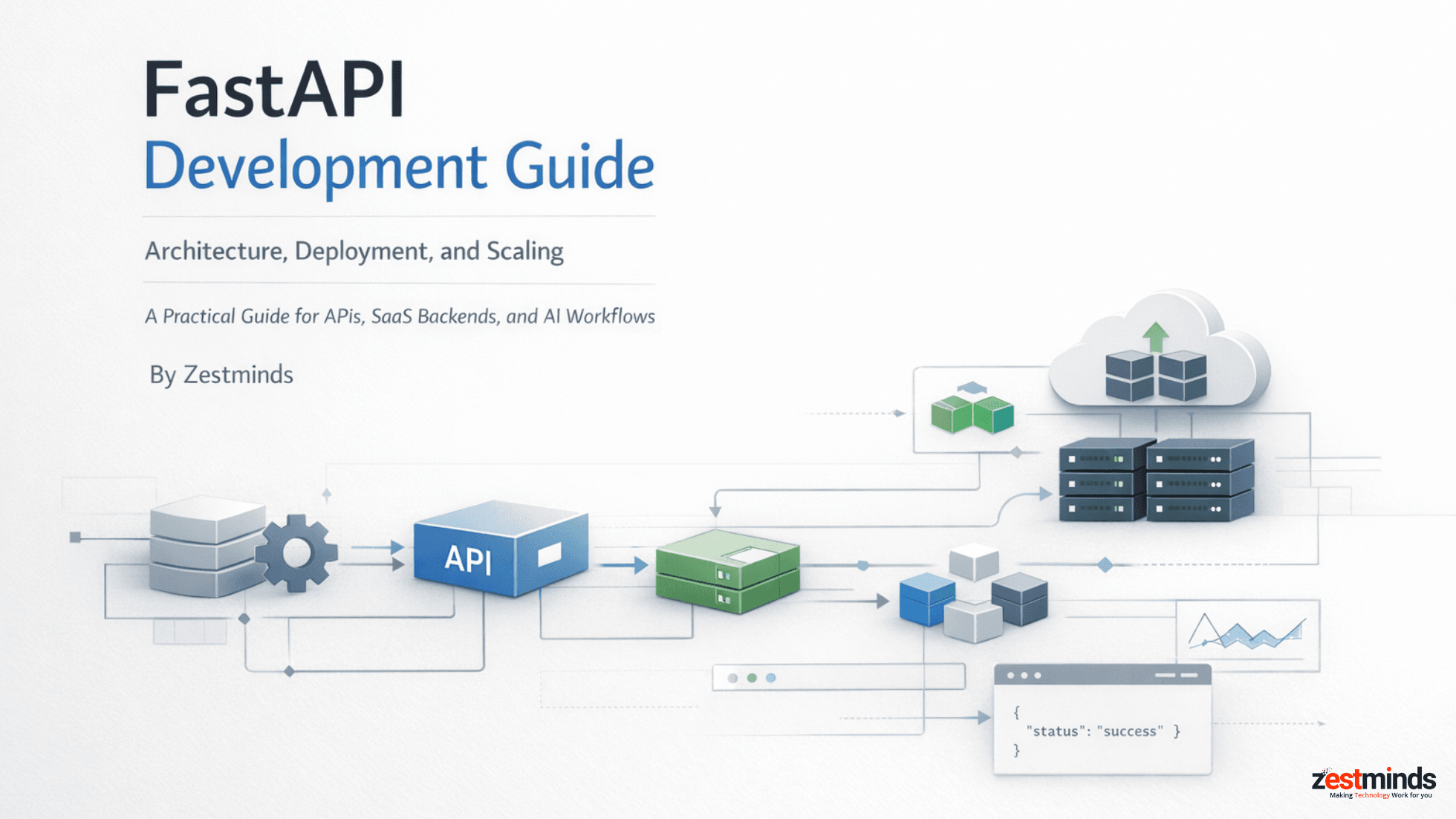
FastAPI Development Guide: Architecture, Deployment, and Scaling
FastAPI has become one of the strongest choices for teams building modern APIs, SaaS backends, AI workflows, and service-oriented platforms.
But choosing the framework is only the easy part. The real challenge starts when the backend needs to stay clean as the product grows, deployment has to work reliably, and traffic begins exposing the architectural shortcuts that looked harmless early on.
This guide is written to help you think through FastAPI in a more practical way. Not just what the framework does, but where it fits, what usually goes wrong, how teams structure it properly, and when it makes sense to bring in experienced support.

Who This Guide Is For
This guide is useful for founders, CTOs, technical leads, backend developers, and product teams evaluating FastAPI for real delivery work. If you are planning a new backend, cleaning up an existing API platform, or trying to understand whether FastAPI is the right fit for your product, this page will help you move faster with fewer wrong turns.
FastAPI Learning Path
If you are learning FastAPI for a real product, the best approach is not to consume random articles in no particular order. Teams usually get much better results when they move through the framework in stages: setup first, then structure, then deployment, then production performance.
That is the logic behind the path below.
| Step | Topic | Recommended Guide |
|---|---|---|
| 1 | Environment Setup | FastAPI Requirements and Setup |
| 2 | Backend Architecture | FastAPI Project Structure |
| 3 | Production Deployment | FastAPI Deployment Guide |
| 4 | Scaling APIs | FastAPI Production Issues |
If you are just getting started, begin with setup. If your backend is already live, the architecture, deployment, and production sections will probably matter more immediately.
Why Teams Use FastAPI
FastAPI has gained popularity quickly because it solves a very practical problem. Teams want backend systems that feel modern, stay fast under real usage, and do not force unnecessary complexity too early.
That is where FastAPI works well. It gives teams a clean way to build APIs with strong request validation, good performance, automatic docs, and a development experience that fits modern Python well.
- Asynchronous architecture for high concurrency
- Automatic request validation with Pydantic
- Interactive API documentation with OpenAPI and Swagger
- Clean integration with modern Python typing
- Excellent performance for API-first systems
The more important point, though, is not that FastAPI is fast. It is that it usually fits the kinds of backend systems many modern teams are building right now: API-first products, service layers, workflow engines, AI backends, and internal tools that need to communicate clearly with other parts of the stack.
When FastAPI Is a Good Fit
FastAPI is usually a strong choice when the backend is meant to behave like an application service layer rather than a traditional full-stack monolith.
That typically includes situations like these:
- You are building an API-first SaaS product
- You expect async processing, webhook handling, or background workflows
- You need a clean backend for AI features, agents, or orchestration layers
- You are creating internal tools with service-heavy logic
- You want a modern Python backend that stays lean without becoming messy too fast
It is not automatically the best answer for every product. If you need a more structured full-stack framework with heavier admin workflows and a broader built-in ecosystem, Django Development Services may be the better fit. If you need a lighter custom application or MVP with less framework overhead, Flask Development Services can also make sense.
The goal is not to force FastAPI into every problem. The goal is to choose it when its strengths actually match the product you are building.
Where Teams Usually Get Stuck
This is the part many guides skip. Most teams do not struggle with writing their first few endpoints. They struggle later, when the backend starts growing and the original shortcuts begin creating friction.
Here are the problems that show up again and again in real FastAPI projects:
- The project structure starts clean, then turns into a mix of routes, business logic, and database code in the same places
- Async features are added without a clear understanding of where they help and where they complicate things
- Deployment is treated like a development concern instead of a production discipline
- Background jobs, queues, and workflow processing get bolted on too late
- Performance assumptions are based on local testing instead of real production behavior
- AI workflows are attached to the backend without enough thought about orchestration, failure handling, or observability
If your team is already dealing with one of these issues, you are not alone. This is exactly the point where a framework stops being “easy” and starts revealing whether the architecture behind it is actually sound.
Already Running into One of These Problems?
If you are planning a new backend, cleaning up an existing FastAPI codebase, or trying to fix deployment and scaling issues before they slow the team down further, FastAPI Development Services can help you take a more practical next step.
Getting FastAPI Set Up the Right Way
Before teams start thinking about architecture or production traffic, they usually need to get the basics right. That means choosing the right Python version, setting up dependencies cleanly, and avoiding environment issues that become annoying later.
FastAPI applications generally run on modern Python versions, and many teams prefer newer releases because they benefit from stronger typing support and smoother async behavior. Small setup decisions made at the beginning often affect how predictable the development workflow feels later.
Recommended Guide
FastAPI Requirements and Setup Guide
This guide explains Python version compatibility, installation steps, dependency management, and the minimum configuration required to start building FastAPI applications with fewer avoidable problems.
How Teams Usually Structure FastAPI Projects
Once the first endpoints are working, project structure becomes the real issue. This is where teams either build a codebase that scales sensibly or create a backend that becomes harder to maintain with every sprint.
Most production FastAPI systems work better when responsibilities are separated clearly. Routes should not carry business logic. Service layers should not turn into random utility folders. Database access should not be spread across the application in ways that make testing and change management painful.
A more maintainable structure usually includes layers such as routers, services, repositories, models, and configuration modules. That separation makes feature development easier, improves collaboration, and reduces the risk of the backend turning into technical debt as the product grows.
Architecture Guide
FastAPI Project Structure (Production Architecture)
Learn how production FastAPI backends organize routers, business logic, database access layers, and configuration modules so the application stays manageable over time.
Deploying FastAPI Applications
FastAPI feels simple in development. Production is where reality starts. Running a local server is easy. Running a backend reliably with real traffic, stable environments, and safe releases is a different discipline altogether.
Most production FastAPI systems run behind ASGI servers such as Uvicorn or Hypercorn and are often deployed through Docker-based pipelines or cloud infrastructure. The framework itself is not the hard part. The hard part is making sure environment variables, process management, observability, load balancing, and release workflows are treated seriously.
This is one of the biggest transition points for growing teams. A backend that looked perfectly fine during development can start feeling fragile very quickly if deployment decisions were treated as an afterthought.
Deployment Guide
This guide explains how to deploy FastAPI applications using production infrastructure such as ASGI servers, Docker environments, and cloud platforms.
What Changes When FastAPI Starts Handling Real Traffic
This is the point where many teams discover that framework performance alone is not the real story. Once traffic grows, the backend starts feeling pressure from database usage, concurrency patterns, external dependencies, task processing, caching needs, and operational visibility.
At this stage, scaling is less about the framework being “fast” and more about whether the overall backend design can absorb load without becoming brittle. Good scaling decisions often involve stronger query patterns, queue-based workflows, background jobs, caching layers, and smarter service boundaries.
The teams that handle this well usually do not wait for a crisis. They plan for production behavior before the backend becomes painful to work with.
Performance Guide
FastAPI Production Issues Under Load
Explore common performance bottlenecks that appear in production FastAPI systems and the strategies teams use to improve reliability, concurrency, and throughput.
Using FastAPI for AI and Data Workflows
FastAPI has become especially popular in AI platforms and machine learning systems because it works well as the API layer connecting models, prompts, workflow engines, background jobs, and external services.
This does not mean every AI project should automatically use FastAPI. It means the framework fits well when you need clear request handling, good validation, async capability, and a service layer that can orchestrate work across multiple moving parts.
For teams building assistants, internal AI tools, data workflows, or agent-based systems, the backend often matters more than people expect. It is the part that keeps the system structured when the product starts doing more than just calling a model once.
AI Architecture Guide
Building AI Workflows with FastAPI and LangGraph
Learn how FastAPI can power AI pipelines and orchestrate workflows using modern agent frameworks.
FastAPI vs Django vs Flask
One of the most practical questions teams ask is not whether FastAPI is good, but whether it is better for their product than Django or Flask.
The answer depends on what you are building.
- FastAPI is usually strongest for API-first systems, async-heavy services, AI backends, and service-oriented platforms
- Django is often stronger for structured business applications, admin-heavy workflows, and products that benefit from a fuller framework model
- Flask works well for lightweight custom applications, MVPs, internal tools, and lean product builds
This is less about which framework is “best” and more about which one matches the shape of the backend you actually need.
Framework Comparison
This comparison guide explains how the three frameworks differ in performance, architecture, and real-world use cases.
Related Framework Services
Common Systems Built with FastAPI
FastAPI is commonly used in products and platforms where speed, structure, and scalability all matter. Some of the most common use cases include:
- AI and machine learning APIs
- Microservices architectures
- Real-time backend systems
- Data processing APIs
- SaaS application backends
- Internal tools and automation services
If your product depends on a clean API layer, workflow orchestration, or service communication, FastAPI is often worth serious consideration.
What Teams Should Evaluate Before Choosing FastAPI
Before committing to a backend framework, it helps to step back and ask a few practical questions.
- Will the product rely heavily on APIs or service communication?
- Do you expect async processing, webhook handling, or workflow orchestration?
- Does the team want a more API-first backend architecture?
- Do you need a lean framework with modern typing and strong performance?
- Would a more structured business application framework be more suitable?
These questions matter because framework choices have a habit of feeling minor early on and expensive later. Getting the fit right at the beginning usually saves both engineering time and product momentum.
When to Get FastAPI Development Help
It usually makes sense to bring in experienced support when the backend is no longer just a small internal build and starts affecting release confidence, delivery speed, maintainability, or product growth.
That often includes situations like these:
- You are starting a new API platform or SaaS backend
- You are cleaning up an existing codebase that has become harder to maintain
- You are planning production deployment and want fewer avoidable mistakes
- You are dealing with performance or scaling issues in a live environment
- You are building AI, automation, or workflow-heavy backend systems and need stronger structure
If that sounds familiar, Zestminds helps startups build scalable FastAPI backend systems with architecture designed for long-term maintainability, production readiness, and real product growth.
Frequently Asked Questions
Is FastAPI a good choice for SaaS products?
Yes. It is often a strong fit for SaaS products that depend on APIs, service communication, async processing, or modern backend workflows.
Can FastAPI be used for AI applications?
Yes. Many AI platforms use FastAPI as the backend layer for model APIs, workflow orchestration, assistants, background processing, and integrations.
Is FastAPI better than Django?
It depends on the product. FastAPI is usually a better fit for API-first and async-heavy systems. Django is often stronger for structured business applications with more built-in framework features.
When should a team get help with FastAPI development?
It usually makes sense to bring in help when you are starting a new backend, cleaning up an existing codebase, planning deployment, or solving scaling and reliability issues in production.
Continue the FastAPI Learning Path
If you want to go deeper, these resources cover the most useful next steps for building and running FastAPI systems in production.
| Topic | Recommended Resource |
|---|---|
| Setup and Requirements | FastAPI Requirements and Setup Guide |
| Project Structure | FastAPI Project Structure |
| Deployment | FastAPI Deployment Guide |
| Production Issues | FastAPI Production Issues Under Load |
| Framework Comparison | FastAPI vs Django vs Flask |
| Development Support | FastAPI Development Services |
Ready to Build or Improve a FastAPI Backend?
Whether you are planning a new API platform, improving an existing service, or working through deployment and performance issues, the next step usually becomes much clearer with the right engineering support.
Table of Contents
- FastAPI Learning Path
- Why Teams Use FastAPI
- When FastAPI Is a Good Fit
- Where Teams Usually Get Stuck
- Getting FastAPI Set Up the Right Way
- How Teams Usually Structure FastAPI Projects
- Deploying FastAPI Applications
- What Changes When FastAPI Starts Handling Real Traffic
- Using FastAPI for AI and Data Workflows
- FastAPI vs Django vs Flask
- Common Systems Built with FastAPI
- When to Get FastAPI Development Help
- Frequently Asked Questions
- Continue the FastAPI Learning Path