
Real Estate AI Lead Qualification Case Study: From Property Inquiry to CRM-Ready Sales Task
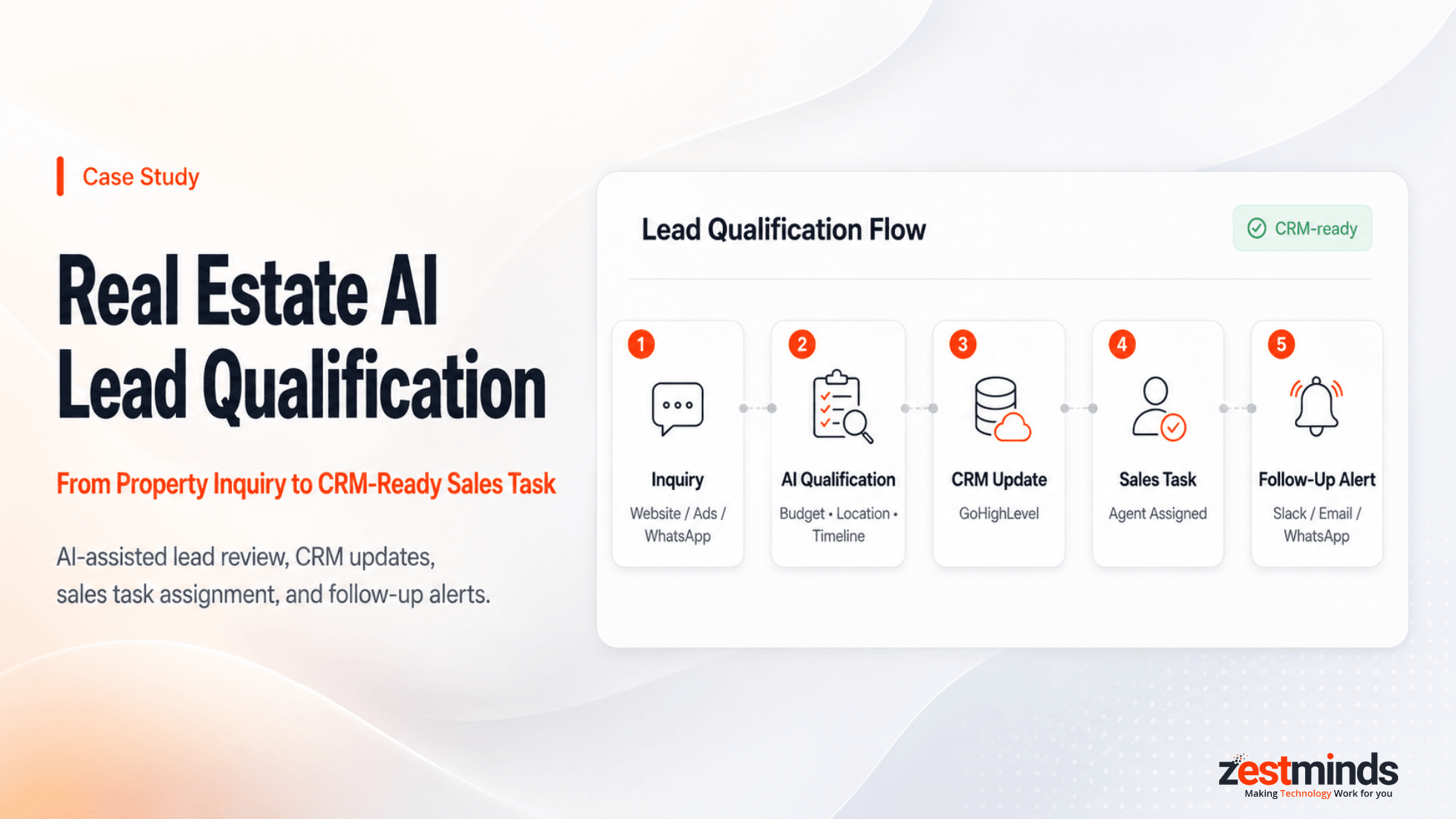
Executive Summary
A B2B-focused real estate business was receiving property inquiries from multiple channels, including website forms, landing pages, paid ads, property portals, email, and WhatsApp.
The sales team had to manually review every inquiry, understand the property requirement, check buyer or tenant intent, identify budget and timeline, update the CRM, assign the right agent, and trigger follow-up.
Zestminds built an AI-assisted lead qualification workflow using n8n, OpenAI/GPT APIs, GoHighLevel, Slack, email, WhatsApp alerts, human sales review, and workflow logs.
Project Snapshot
| Area | Details |
|---|---|
| Client Type | B2B-focused real estate business |
| Industry | Real estate sales, leasing, and property advisory |
| Main Challenge | Manual lead review, CRM updates, agent assignment, and delayed follow-up |
| Lead Sources | Website forms, landing pages, paid ads, property portals, email, WhatsApp |
| Solution | AI-assisted real estate lead qualification workflow |
| Workflow Orchestration | n8n |
| AI Layer | OpenAI/GPT API |
| CRM / Pipeline | GoHighLevel |
| Notifications | Slack, email, WhatsApp alerts |
| Human Role | Sales team reviewed lead summary, priority, and suggested next action |
| Business Impact | Faster lead review, reduced manual CRM entry, and more consistent sales follow-up |
Client Context
The client handled a steady flow of inbound real estate inquiries from different digital channels.
Some inquiries came from website forms and landing pages. Others came from paid campaigns, property portals, email, and WhatsApp.
The leads included different types of real estate requirements, such as commercial leasing, investment property interest, office space inquiries, and general property consultation requests.
The sales team needed to review each inquiry and understand:
- what type of property the lead was looking for,
- whether the lead was a buyer, tenant, investor, or business prospect,
- preferred location,
- budget range,
- timeline,
- urgency level,
- business or personal requirement,
- missing information,
- and the best next follow-up action.
The challenge was not a lack of leads. The challenge was turning raw inquiries into structured, sales-ready CRM records fast enough for the team to respond with context.
In real estate, response speed matters. A high-intent lead may contact multiple brokers, developers, or agencies at the same time.
If the sales team responds late or without understanding the requirement properly, the opportunity can go cold quickly.
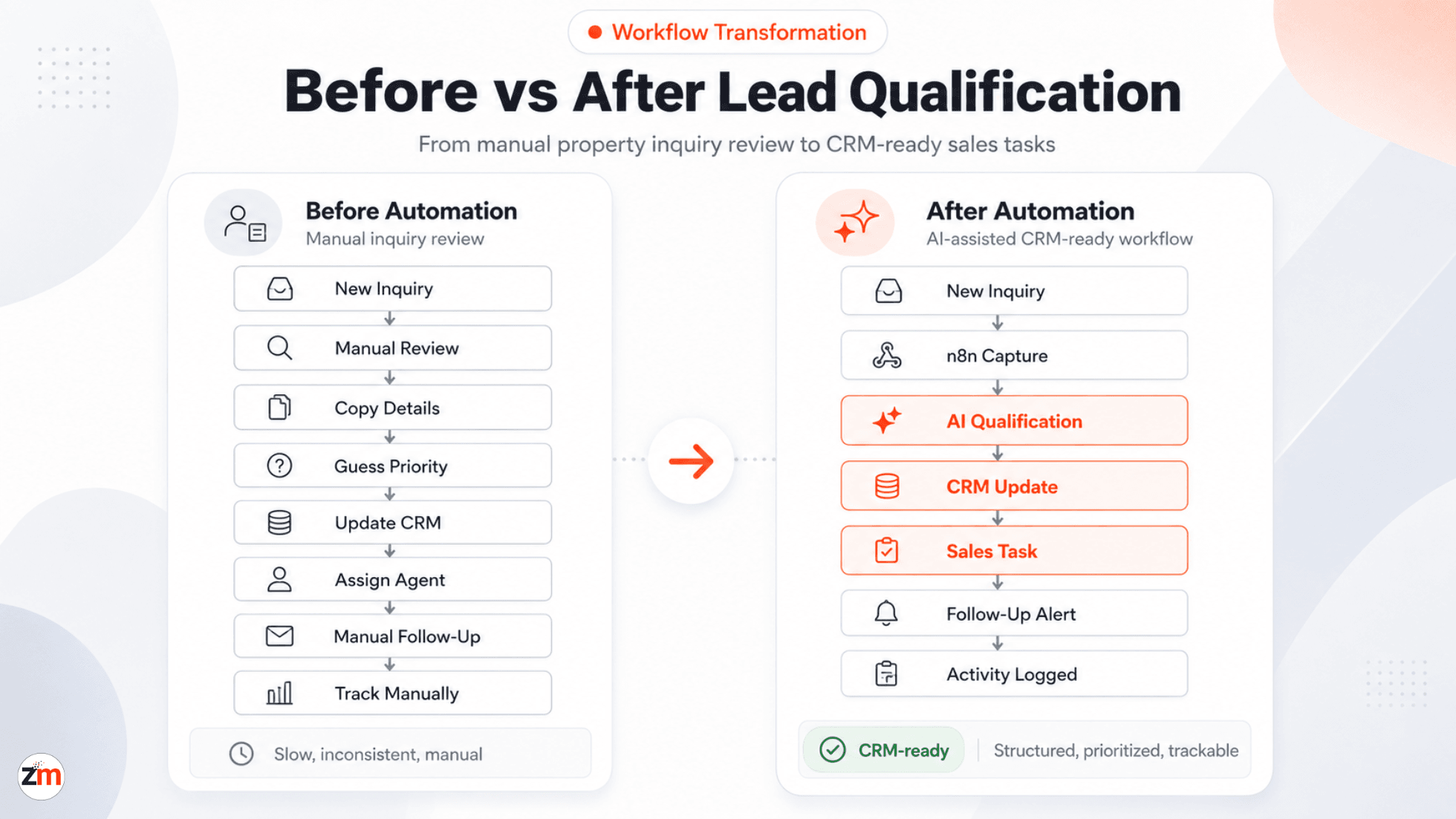
Manual Lead Qualification Before Automation
Before automation, the lead qualification process depended heavily on manual review.
The usual process looked like this:
New inquiry received → Sales team reviews manually → Property requirement is extracted → Lead priority is guessed → CRM record is created or updated → Sales task is assigned → Follow-up message is sent → Lead status is tracked manually
This created several operational issues:
- Leads from different sources were not always handled consistently.
- Sales reps spent time reviewing low-intent inquiries manually.
- CRM records were sometimes incomplete or delayed.
- Important details like budget, location, property type, and timeline were not always captured in a structured way.
- High-intent leads were not always prioritized quickly.
- Follow-up ownership depended too much on individual team members.
- Lead context was scattered across forms, emails, WhatsApp messages, ad leads, and CRM notes.
- The team had limited visibility into which leads were reviewed, assigned, followed up, or still waiting for action.
The client needed a better first-layer qualification process.
They did not want to replace the sales team. They wanted the sales team to stop spending time on repetitive lead sorting and CRM entry, so they could focus on qualified conversations.
The Core Challenge
The real challenge was not simply “lead automation.”
The real challenge was converting messy property inquiries into structured lead intelligence.
For every new inquiry, the team had to answer practical sales questions:
- Is this a buyer, tenant, investor, broker, or business lead?
- What type of property are they looking for?
- Which location are they interested in?
- What is their budget?
- How soon do they need the property?
- Is this lead high-intent or just browsing?
- Which agent or team should handle it?
- What should the first follow-up say?
- What information is missing?
Doing this manually for every inquiry slowed down the sales process.
At the same time, fully automated follow-up was risky. Real estate leads can be high-value, and an incorrect or poorly matched response can reduce trust.
AI should qualify and prepare the lead, automation should update the CRM and notify the team, and humans should stay involved where judgment is needed.
What Zestminds Built
Zestminds built an AI-assisted lead qualification automation workflow for real estate inquiries.
The workflow connected incoming lead sources, n8n automation, OpenAI/GPT-based lead analysis, GoHighLevel CRM updates, sales task assignment, team notifications, and workflow logs.
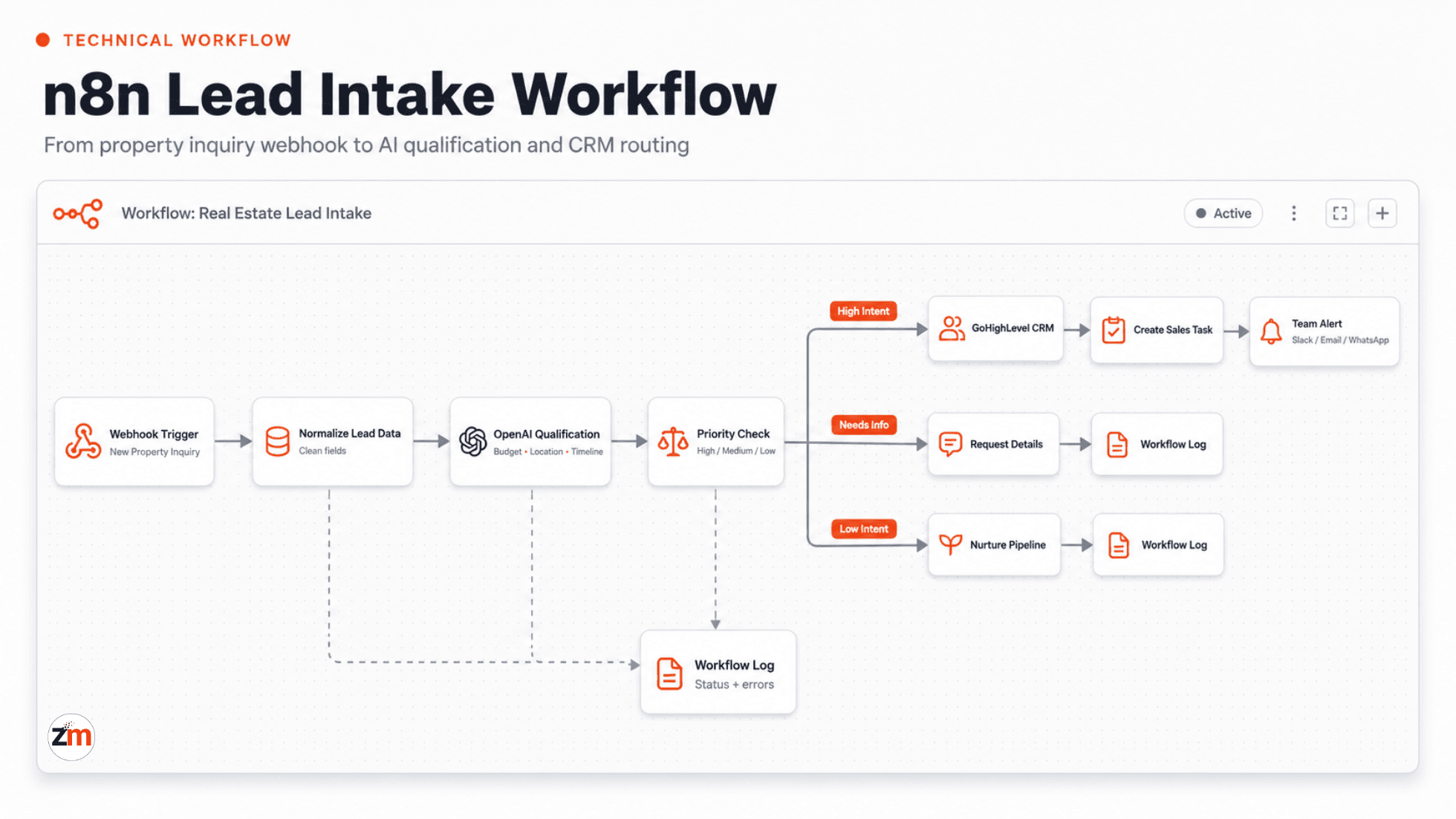
n8n acted as the orchestration layer. It captured new inquiries through webhooks or integrations, normalized the lead data, sent the inquiry to the AI layer, handled routing logic, and passed structured output into the CRM and notification channels.
OpenAI/GPT APIs analyzed the inquiry and prepared structured lead intelligence, including property type, intent, location, budget, timeline, urgency, missing information, and suggested next action.
GoHighLevel was used as the CRM and sales execution layer. It stored lead records, updated pipeline stages, created follow-up tasks, and supported follow-up workflows.
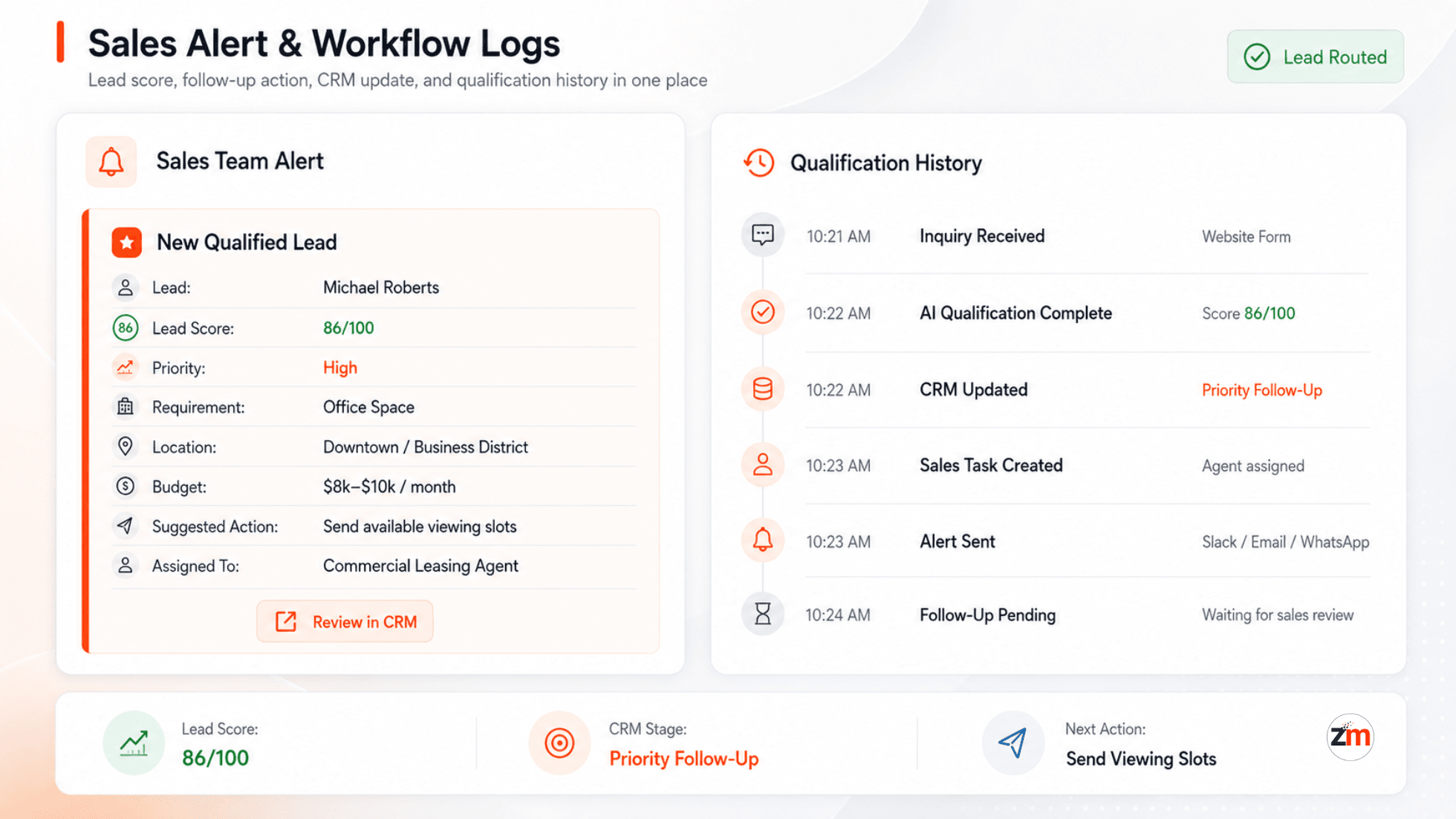
Slack, email, and WhatsApp alerts were used to notify the sales team when a qualified lead required attention.
AI prepares the lead for sales. The sales team still owns the relationship and final decision.
For businesses planning similar systems, Zestminds provides AI workflow automation services focused on practical CRM integrations, AI-assisted qualification, human review, and production-ready implementation.
Workflow After Automation
After automation, the workflow became more structured and faster to act on.
The new process looked like this:
New property inquiry received → n8n captures the lead → AI extracts property requirement and intent → Lead is categorized and prioritized → GoHighLevel contact/opportunity is created or updated → Sales task is assigned → Sales team receives alert → Follow-up draft or workflow is prepared → Activity is logged
Automated Workflow Steps
- A new inquiry was submitted through a website form, landing page, portal, email, WhatsApp, or ad campaign.
- n8n captured the lead data through a webhook or integration.
- n8n normalized the lead data and prepared it for AI processing.
- OpenAI/GPT analyzed the inquiry and extracted structured lead details.
- The lead was categorized by property type, intent, budget, location, urgency, and fit.
- GoHighLevel created or updated the contact and opportunity record.
- The workflow assigned a sales task or moved the lead to the right pipeline stage.
- Slack, email, or WhatsApp alerts notified the sales team.
- A follow-up draft or workflow was prepared where appropriate.
- Workflow logs stored the qualification result, CRM update, task creation, notification status, and errors if any step needed attention.
Tech Stack Used
| Layer | Tool / Technology | Role |
|---|---|---|
| Lead Intake | Website forms, landing pages, ads, portals, email, WhatsApp | Captured incoming real estate inquiries |
| Workflow Orchestration | n8n | Webhook intake, data normalization, branching, API calls, and routing |
| AI Qualification | OpenAI/GPT API | Extracted property requirement, intent, budget, timeline, urgency, and suggested next action |
| CRM / Pipeline | GoHighLevel | Contact records, opportunity creation, pipeline stage, sales tasks, and follow-up workflows |
| Notifications | Slack, email, WhatsApp | Alerts for sales team and agent follow-up |
| Follow-Up | GoHighLevel workflows, email, or WhatsApp drafts | Follow-up execution or review-ready response |
| Tracking | n8n logs and CRM activity logs | Workflow history, status, errors, and qualification trail |
| Human Review | Sales team / agent review | Final validation before high-value follow-up |
For workflows that need custom business rules, approval logic, secure integrations, or dashboards, this type of work often overlaps with custom software development.
AI Lead Qualification Logic
The AI layer was configured to turn unstructured property inquiries into structured lead data.
For each inquiry, AI extracted:
- lead name and contact details,
- buyer, tenant, investor, or business intent,
- property type,
- preferred location,
- budget range,
- timeline,
- urgency level,
- requirement summary,
- missing information,
- suggested next action,
- and recommended follow-up angle.
For B2B real estate inquiries, the AI also looked for signals such as:
- commercial space requirement,
- office size or seat count,
- lease or purchase intent,
- business relocation need,
- investment interest,
- decision-maker signals,
- and urgency of occupancy or viewing.
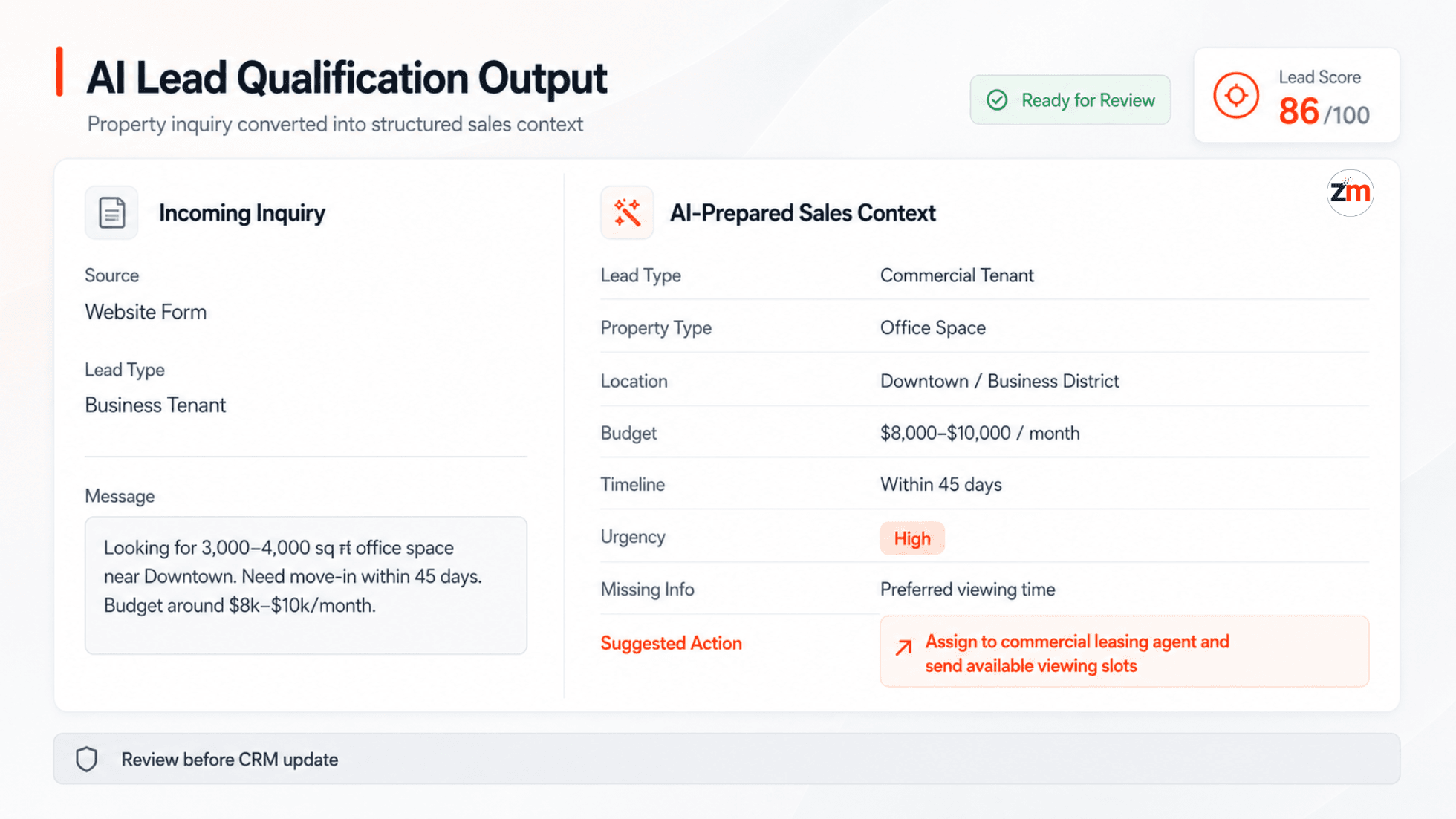
Example structured output:
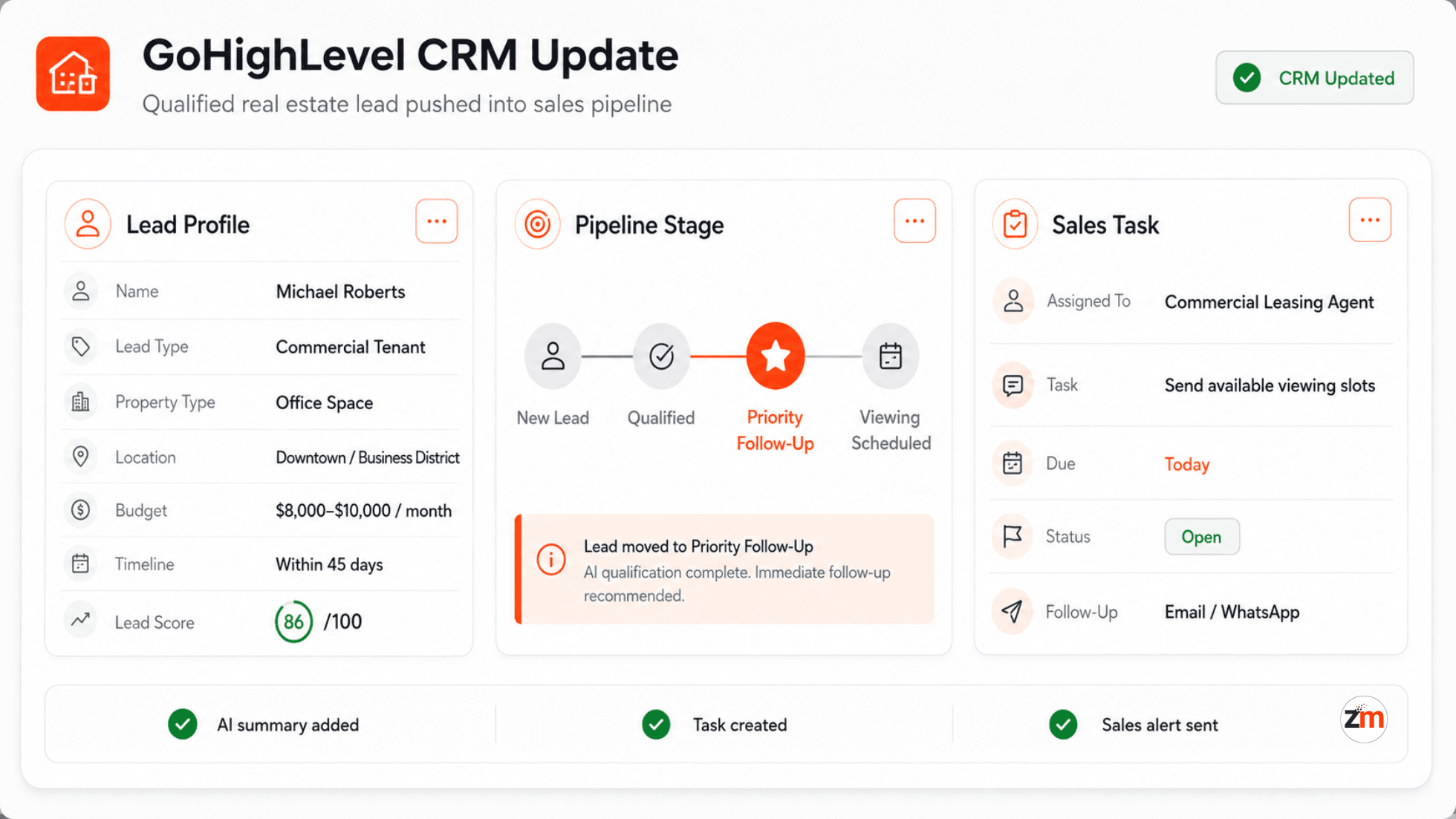
Lead Type: Commercial Tenant
Requirement: Office space
Preferred Location: Downtown / Business District
Budget: $8,000–$10,000 per month
Timeline: Within 45 days
Intent Level: High
Missing Info: Preferred viewing time
Suggested Action: Assign to commercial leasing agent and send available viewing slots
This gave the sales team a ready-to-review lead summary instead of a raw message.
GoHighLevel CRM and Sales Task Automation
After AI qualification, the workflow pushed structured lead data into GoHighLevel.
GoHighLevel was used to:
- create or update contact records,
- create opportunities,
- move leads into the right pipeline stage,
- assign sales tasks,
- add lead summary notes,
- trigger follow-up workflows,
- and track lead status.
For example, a high-intent commercial leasing inquiry could be moved into a priority follow-up stage, assigned to a sales agent, and tagged with property type, location, budget, and urgency level.
Lower-intent inquiries could be routed into a nurture or information-request stage instead of distracting the sales team immediately.
This helped the sales team spend more time on leads that were ready for action.
Sales Notifications and Follow-Up
The workflow also notified the sales team when a qualified lead required action.
Depending on the inquiry source and lead priority, the system could trigger:
- Slack alerts for internal visibility,
- email alerts for sales reps,
- WhatsApp notifications for urgent inquiries,
- GoHighLevel tasks,
- and follow-up message drafts.
The follow-up process was not blindly automated for every lead.
For high-value or unclear inquiries, the sales team could review the AI summary and suggested response before sending the final message.
This allowed the workflow to improve speed without removing human judgment from important sales conversations.
Human Review Layer
Human review was important because real estate sales conversations often involve high-value decisions.
The system prepared the lead summary and suggested next action, but the sales team could still:
- verify the lead details,
- edit the qualification summary,
- adjust the priority,
- change the assigned agent,
- approve or modify the follow-up message,
- request missing information,
- or disqualify the lead.
This avoided the risk of AI sending incorrect or poorly matched follow-ups.
The goal was not to replace the sales team.
The goal was to remove the repetitive first layer of lead review so the team could respond faster with better context.
Results and Business Impact
The automation helped the client make the lead intake and qualification process faster, cleaner, and more consistent.
The impact included:
- first-level lead review reduced from around 10–15 minutes per inquiry to under 2 minutes,
- manual CRM entry effort reduced by approximately 60–70%,
- new inquiries became CRM-ready within minutes,
- high-intent leads were easier to identify and prioritize,
- sales tasks were created more consistently,
- follow-up ownership became clearer,
- and the sales team had better context before contacting the lead.
The workflow did not replace sales judgment. It gave the sales team a better starting point.
Instead of reading every inquiry from scratch, sales reps could start with an AI-prepared summary, lead score, property preference, suggested action, and CRM task.
What This Project Proves About Zestminds
This project shows Zestminds' ability to build AI-assisted lead qualification workflows for industry-specific sales processes.
The work was not just about connecting a form to a CRM.
It required understanding how real estate leads are handled, what information sales teams need, how to qualify buyer or tenant intent, when to assign agents, when to trigger follow-up, and where human review should stay in the process.
The workflow combined:
- n8n automation,
- OpenAI/GPT-based lead qualification,
- GoHighLevel CRM and pipeline automation,
- Slack, email, and WhatsApp alerts,
- follow-up workflows,
- human review,
- and activity logs.
This is where Zestminds brings value as an AI workflow automation partner: by combining automation tools, AI APIs, CRM workflows, and business process understanding into practical systems that support real sales teams.
Frequently Asked Questions
Which tools were used in this real estate lead qualification workflow?
The workflow used n8n for orchestration, OpenAI/GPT APIs for AI lead qualification, GoHighLevel for CRM and pipeline automation, and Slack, email, and WhatsApp alerts for sales team notifications.
What did AI do in the workflow?
AI analyzed incoming property inquiries and extracted details such as property type, location, budget, timeline, intent, urgency, missing information, and suggested next action.
Did AI automatically contact every lead?
No. The workflow could prepare follow-up drafts or trigger workflows, but high-value or unclear leads could still be reviewed by the sales team before direct outreach.
Why was GoHighLevel used?
GoHighLevel was used to manage contact records, opportunities, pipeline stages, sales tasks, and follow-up workflows.
What was the main business benefit?
The workflow reduced manual lead review time, made CRM updates more consistent, helped prioritize high-intent leads faster, and improved sales follow-up ownership.
Need Help Qualifying and Routing Real Estate Leads Faster?
Zestminds can help you build an AI-assisted lead qualification workflow that connects your lead sources, CRM, sales team, and follow-up process.
Whether your leads come from website forms, property portals, ads, email, or WhatsApp, we can help turn raw inquiries into structured CRM-ready sales tasks.
Table of Contents
- Project Snapshot
- Client Context
- Manual Lead Qualification Before Automation
- The Core Challenge
- What Zestminds Built
- Workflow After Automation
- Tech Stack Used
- AI Lead Qualification Logic
- GoHighLevel CRM and Sales Task Automation
- Sales Notifications and Follow-Up
- Human Review Layer
- Results and Business Impact
- What This Project Proves About Zestminds
- Frequently Asked Questions
- Need Help Qualifying and Routing Real Estate Leads Faster?
Before You Scale Further, Review the Architecture.
Let’s evaluate where your system stands — and where it may break under growth.
Schedule an Architecture Review 30-minute technical discussion. No obligation.