
From Manual Operations to Automated Workflows: A Practical SME Case Study
This case study outlines how a growing SME moved from fragmented, manual operations to structured, automated workflows by focusing on practical system design rather than over-engineering.
Introduction
As small and mid-sized businesses grow, internal operations often struggle to scale at the same pace. Processes that once worked through spreadsheets, emails, and messaging tools start introducing delays, inconsistencies, and unnecessary manual effort.
This case study explains how a growing SME transitioned from fragmented, manual workflows to a structured and automated internal system. The focus was on improving operational clarity without over-engineering or disrupting existing day-to-day work.
Background: An Operations-Heavy SME
The business involved in this engagement was a growing SME with a lean team handling a high volume of operational tasks. Daily work relied on multiple tools, including online forms, email communication, spreadsheets, and internal messaging platforms.
While the business was performing well commercially, internal processes had evolved organically. There was no single system to manage incoming data, track task progress, or maintain consistent operational visibility.
To preserve confidentiality, the business is described in an industry-agnostic manner. The challenges addressed are common across many SMEs.
The Operational Challenges of Manual Workflows
As operational volume increased, several issues became increasingly visible:
- Data was scattered across multiple tools with no single source of truth
- Manual data entry caused delays and occasional errors
- Reporting required manual consolidation and context switching
- Task ownership and status were difficult to track consistently
- Key workflows depended heavily on specific individuals
Individually, these issues were manageable. Together, they created operational friction and limited the business’s ability to scale reliably.
At-a-Glance Overview
| Problem | Solution | Outcome |
|---|---|---|
| Manual workflows across multiple tools with limited visibility | Centralized internal system with workflow automation and background processing | Reduced manual effort, clearer operations, and a scalable foundation |
Designing a Practical Automation Strategy
The engagement began by understanding how work actually moved through the business. Instead of starting with tools or technology, the focus was on mapping real workflows as they existed on the ground.
This mindset aligns closely with our broader thinking around planning automation initiatives carefully before committing to complex builds.
The strategy followed a few guiding principles:
- Automate only repeatable and predictable tasks
- Keep human judgment where decisions were required
- Avoid over-engineering or unnecessary complexity
- Ensure the system remained easy for the team to adopt
The objective was to reduce operational noise while improving reliability and clarity.
Building an Internal System with Automation Support
A lightweight internal web-based system was implemented to centralize operational data and reduce dependency on manual coordination.
The core system included:
- A centralized internal dashboard for daily operations
- Role-based access for different team members
- A single database serving as the source of truth
- Clear task states and operational visibility
This approach replaced fragmented tracking methods without forcing a major change in how the team worked.
Automation Layer Using n8n and Zapier
To orchestrate workflows across tools and systems, an automation layer was introduced.
- n8n was used for workflow orchestration, conditional logic, and event-based triggers
- Zapier was used selectively for lightweight SaaS integrations where custom development was unnecessary
This hybrid approach allowed flexibility while keeping long-term control within the internal system.
Using FastAPI for Background Processing
Certain operations needed to run asynchronously to keep the main application responsive. For this purpose, FastAPI was used as a background processing service.
Typical responsibilities included:
- Processing incoming data from forms and webhooks
- Validating and normalizing structured inputs
- Handling scheduled jobs and retries
- Triggering automation workflows reliably
This ensured that time-consuming tasks did not block user-facing operations.
Where AI Was Used and Where It Was Not
AI was applied selectively as part of our broader approach to building generative AI systems. The focus remained on reducing manual effort rather than automating judgment.
- Classifying incoming requests into predefined categories
- Parsing unstructured text from emails or form submissions
- Flagging anomalies or incomplete inputs for human review
AI outputs were always reviewed within structured workflows and were never treated as final decisions.
System Architecture (Simplified)
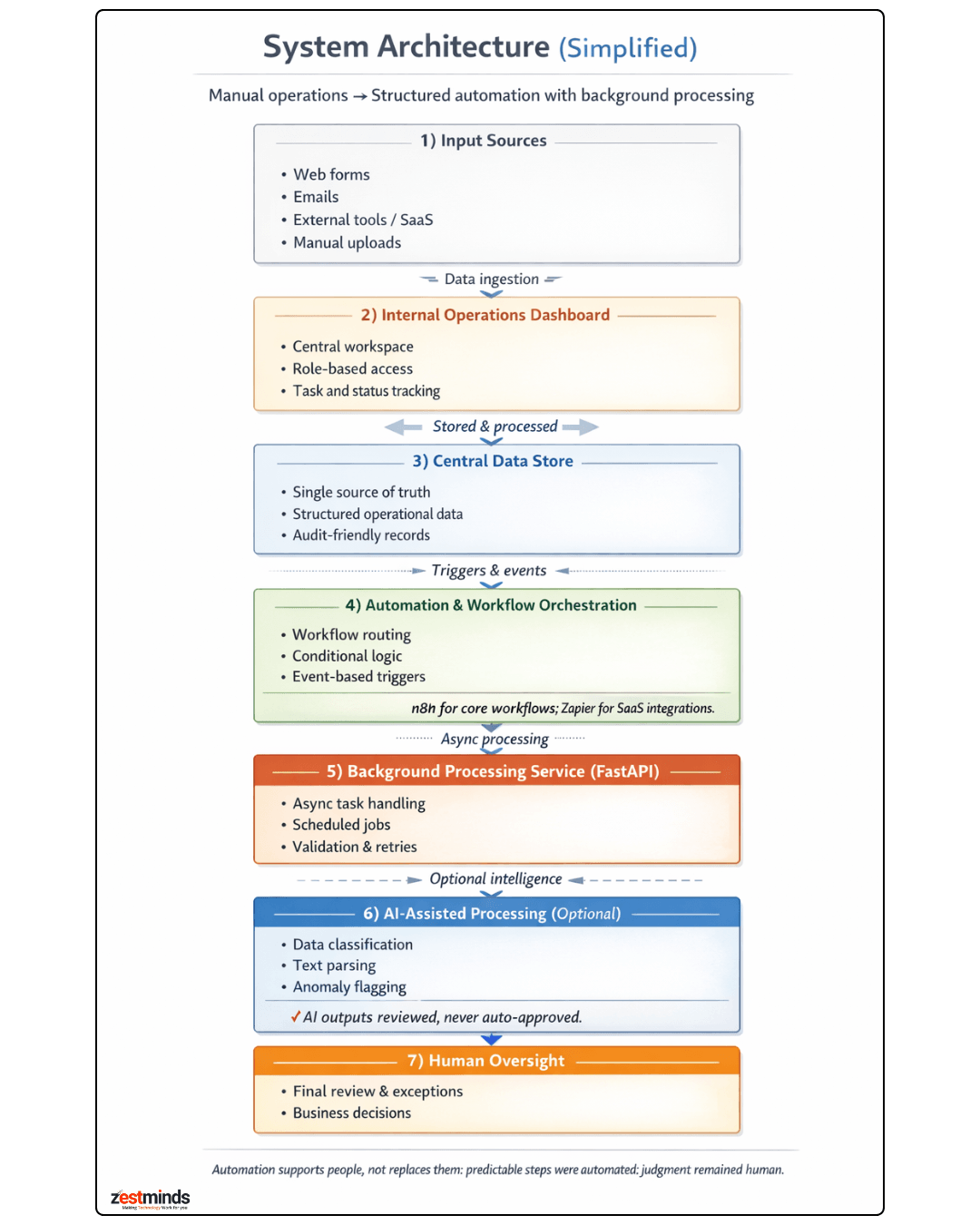
The system architecture was designed to keep workflows predictable while ensuring humans remained in control of business decisions.
Automation supported people rather than replacing them. Predictable steps were automated, while judgment-based decisions remained human-led.
Results: Operational Clarity Without Complexity
The changes were incremental but meaningful:
- Manual effort for routine tasks was reduced
- Operational visibility improved across the team
- Errors caused by duplication or missed steps decreased
- Reporting became faster and more consistent
A similar approach to practical automation can also be seen in this AI automation case study focused on content workflows.
Lessons for Growing SMEs
- Automation works best when workflows are clearly defined
- Internal tools outperform spreadsheets as teams grow
- Background processing is critical for reliability and scale
- AI adds value only inside structured systems
- Simple systems adopted early prevent complex problems later
Table of Contents
- Introduction
- Background: An Operations-Heavy SME
- The Operational Challenges of Manual Workflows
- At-a-Glance Overview
- Designing a Practical Automation Strategy
- Building an Internal System with Automation Support
- Automation Layer Using n8n and Zapier
- Using FastAPI for Background Processing
- Where AI Was Used and Where It Was Not
- System Architecture (Simplified)
- Results: Operational Clarity Without Complexity
- Lessons for Growing SMEs
Before You Scale Further, Review the Architecture.
Let’s evaluate where your system stands — and where it may break under growth.
Schedule an Architecture Review 30-minute technical discussion. No obligation.