
MVP vs Long-Term SaaS Architecture: What to Build Now, And What to Delay
Your early SaaS architecture decisions determine how expensive growth becomes later. This guide helps you decide what to build now, what to delay, and when to evolve.

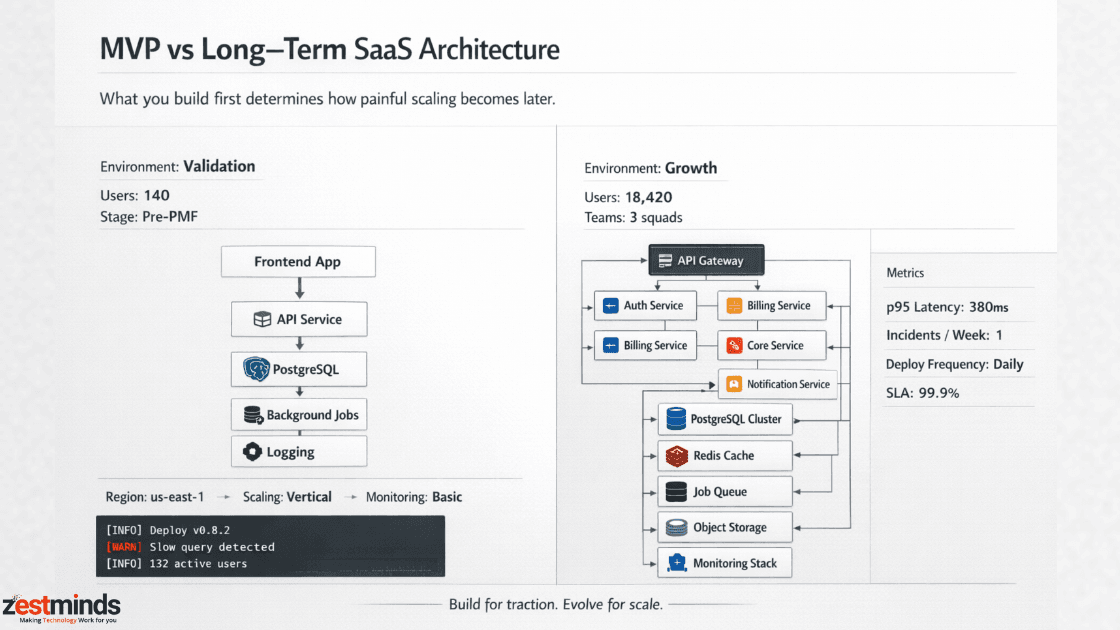
Every founder says, "We'll refactor later."
Every CTO says, "If we don't design this properly now, we'll regret it."
Both are right. And both can quietly derail momentum if they're not aligned.
The real question isn't whether to optimize for speed or scalability.
It's when to optimize for each, and how to do it without boxing yourself in.
Let's approach this the way seasoned product teams actually do: calmly, strategically, and with business context in mind.
The Real Trade-Off: Speed vs Structural Integrity
At the MVP stage, your biggest risk isn't bad architecture.
It's building something nobody truly needs.
But here's the nuance experienced teams understand:
weak early structure can slow you down just when you finally start getting traction.
So how do you think about this?
Imagine you're opening a restaurant.
If you're testing the menu, you don't build a luxury dining hall with imported stone. You start with a focused setup, enough to serve customers well.
But you also don't cook in a kitchen that shuts down every night.
Speed without stability creates chaos.
Stability without validation creates waste.
Experienced founders often note that early architecture decisions are less about perfection and more about intentional restraint.
| Choice | What You Gain | What You Risk | When It's Rational |
|---|---|---|---|
| Optimize for Speed | Fast iteration, early validation | Technical debt, refactor pressure | Pre-PMF, low traffic, high uncertainty |
| Optimize for Structure | Long-term stability, cleaner evolution | Slower releases, wasted runway | Strong revenue signals, complex domain constraints |
| Balanced MVP | Controlled learning with maintainability | Requires discipline and clear boundaries | Early traction with growing usage and real feedback loops |
What Founders Usually Get Wrong
You've probably seen at least one of these:
- Overbuilding infrastructure before real users exist
- Choosing microservices because "that's how big tech does it"
- Designing for a million users when you have 20 sign-ups
- Or the opposite: stitching everything together with zero thought for maintainability
Both extremes create technical friction.
Early-stage SaaS should optimize for learning velocity.
Not architectural elegance.
Not hypothetical scale.
Learning velocity.
A Simple Mental Model
There are three natural stages of SaaS architecture maturity:
- Validation Architecture – Prove demand
- Stabilization Architecture – Support paying users
- Scale Architecture – Optimize performance, resilience, and cost
Most startups blur these lines.
They try to build phase three systems while still validating phase one assumptions.
That mismatch is expensive.
What an MVP Architecture Must Include (And Nothing More)
An MVP architecture is not "throwaway code."
It's a deliberately constrained system designed for clarity and speed.
That distinction matters.
- Must include: Modular backend structure; clean relational schema with indexing; secure auth and password hashing; logging and error monitoring; a single deployable service.
- Nice to have: Basic background jobs; minimal caching; usage analytics.
- Do not build yet: Microservices mesh; multi-region failover; event streaming infrastructure; over-abstracted service layers.
1. A Clean, Maintainable Core
At minimum, you need:
- Clear separation between frontend and backend
- A structured, well-thought-out database schema
- Authentication that's secure and reliable
- Logging and basic monitoring
What you don't need:
- Distributed service meshes
- Multi-region redundancy
- Heavy abstraction layers "just in case"
Your MVP should feel like a well-organized workspace, focused, functional, easy to navigate.
Not a smart city with empty streets.
Many teams only realize this after experiencing why most MVP architectures start breaking within 6–12 months (https://www.zestminds.com/blog/mvp-architecture-breaks-6-12-months/).
2. Monolith > Microservices (Most of the Time)
For most early SaaS products, a modular monolith is the right move.
Why?
- Faster development cycles
- Easier debugging
- Simpler deployments
- Lower operational overhead
Microservices introduce network boundaries, observability challenges, deployment coordination, and hidden failure modes.
Those are scale-stage concerns.
Many CTOs share a common lesson: microservices solve team scaling problems more than product validation problems.
If you have a small team, keep the system cohesive.
Even engineering case studies from companies like Stripe and Shopify show evolution over time, not complexity from day one.
3. A Scalable Data Model (Even If You Don't Scale Yet)
This is where maturity shows.
You don't need distributed databases.
But you absolutely need:
- Thoughtful indexing
- Clear relational design
- Avoidance of messy, short-term schema hacks
Infrastructure can be replaced.
A tangled data model lingers for years.
Data is the real foundation of your SaaS.
4. Observability From Day One
This is non-negotiable.
Even in MVP mode:
- Structured logging
- Error monitoring
- Usage visibility
If you can't see what your users are doing, you're making decisions in the dark.
And growth rarely rewards guesswork.
5. Security That Matches Reality
You don't need enterprise-grade governance frameworks.
But you do need:
- Secure authentication
- Proper password handling
- Rate limiting
- Encrypted connections
Security best practices are well documented in resources like the OWASP Top Ten security risk guidelines (https://owasp.org/www-project-top-ten/), and ignoring them early often creates avoidable technical debt.
Security shortcuts tend to resurface at the worst possible time, often when you're speaking to investors or enterprise prospects.
What to Intentionally Delay Until After Traction
Here's where discipline separates confident teams from anxious ones.
Complex architecture often feels like progress.
But complexity is rarely the bottleneck in early SaaS.
| Capability to Delay | Why Expensive Early | Trigger Signal | Minimum Viable Version |
|---|---|---|---|
| Microservices | Orchestration overhead and higher operational load | 3+ squads, domain conflicts, clear ownership boundaries | Modular monolith with clean internal modules |
| Multi-region infrastructure | Cost, complexity, and failure modes multiply | Global traffic requirements, SLA commitments, regional compliance | Single region with backups and disaster recovery basics |
| Kubernetes clusters | DevOps overhead and slower iteration for small teams | Scaling bottlenecks, deployment complexity, team maturity for ops | Managed PaaS or simple container deployment |
| Event streaming | Debugging complexity and operational overhead | Async workload spikes, event volume growth, queue backlogs | Simple job queue with retries and monitoring |
| Advanced tenancy | Schema complexity and longer delivery cycles | Enterprise contracts, strict isolation needs, audit demands | Logical tenant separation with clear access control |
1. Microservices Architecture
Unless:
- You have multiple independent teams
- Clear domain boundaries are emerging
- Performance constraints are proven
You don't need microservices.
They increase operational and cognitive load.
If your team still fits in one conference room, keep your architecture equally cohesive.
2. Advanced DevOps Pipelines
Yes, you need CI/CD.
No, you don't need:
- Multi-cluster Kubernetes orchestration
- Region failover from day one
- Enterprise-grade traffic engineering
Foundational principles around scalable cloud systems are already outlined in the AWS Well-Architected Framework guidance on scalable cloud design (https://aws.amazon.com/architecture/well-architected/), and most early-stage SaaS products don't require more than those core patterns.
Keep operations boring.
Boring systems tend to be reliable systems.
3. Extreme Performance Optimization
Optimize when metrics demand it.
Not when imagination suggests it.
If:
- APIs are consistently timing out
- Queries are measurably slow
- Real users are experiencing friction
Then act.
Until then, focus on product value.
Premature optimization drains runway quietly.
4. Over-Engineered Multi-Tenancy
Many SaaS founders overcomplicate tenancy models early.
Start simple:
- Clean tenant separation
- Logical boundaries
- Clear access control
You can evolve isolation models later as customer requirements grow.
5. Event-Driven Complexity Everywhere
Event buses, streaming pipelines, distributed queues, these tools are powerful.
But they also increase debugging complexity and operational overhead.
Unless your workload truly demands asynchronous scale, delay it.
Architectural elegance should follow real constraints, not anticipation.
The Inflection Point: When to Evolve Beyond MVP Architecture
This is where timing becomes strategic.
Re-architecture should not be driven by fear.
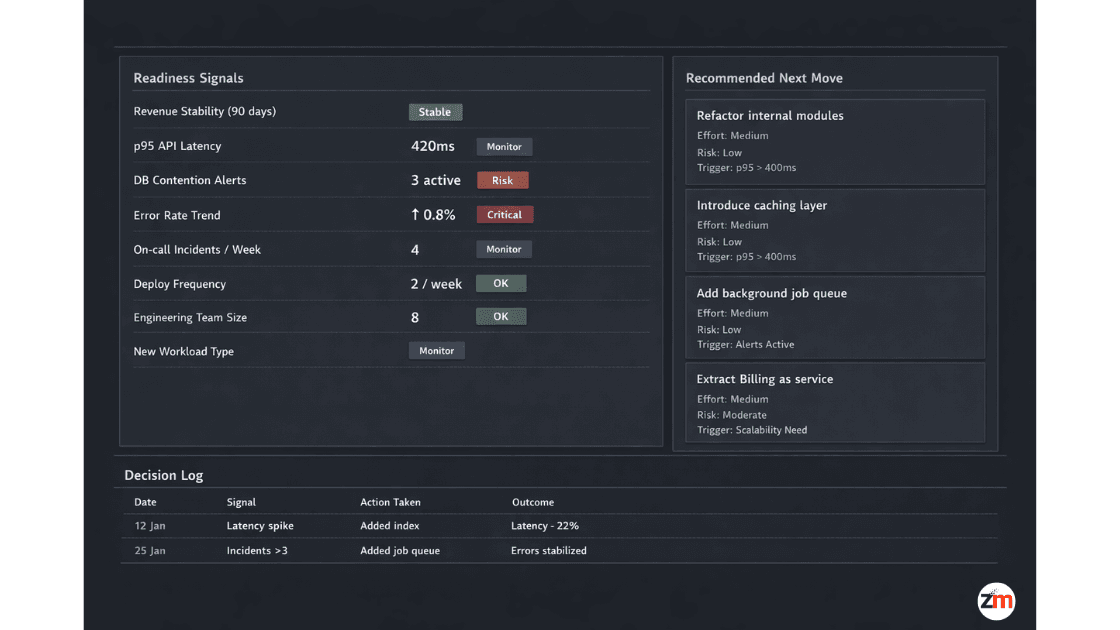
It should be triggered by evidence.
Signal 1: Sustained Revenue Growth
When revenue stabilizes and grows, your system is no longer experimental.
It's a business asset.
Resilience, uptime, and performance now affect trust and brand perception.
Signal 2: Proven Performance Bottlenecks
Not hypothetical ones.
Real ones:
- Increasing API latency
- Database contention
- Scaling failures during usage spikes
When engineering time shifts from building features to firefighting infrastructure, evolution is due.
Signal 3: Team Expansion
If your engineering team grows significantly, coordination changes.
Architecture often needs clearer domain boundaries to reduce team friction.
System design should reflect team structure.
Signal 4: Product Expansion
When you add:
- AI pipelines
- Real-time collaboration
- High-volume background processing
Your original MVP structure may stretch thin.
That's when thoughtful modular decomposition begins.
Controlled Evolution vs Big Rewrite
The "big rewrite" is tempting.
It promises a clean slate.
In reality, it often stalls velocity, burns morale, and reintroduces bugs.
Incremental refactoring wins.
If you're unsure whether evolution or replacement is appropriate, it helps to understand how to think through the rewrite vs refactor decision as a CTO (https://www.zestminds.com/blog/rewrite-vs-refactor-cto-decision/).
- Extract services gradually
- Add caching where measured
- Introduce async workflows intentionally
Evolution compounds.
Revolutions disrupt.
A Practical Architecture Roadmap for Founders & CTOs
Let's make this concrete.
Below is a phased approach we've seen work repeatedly in SaaS transitions from MVP to growth.
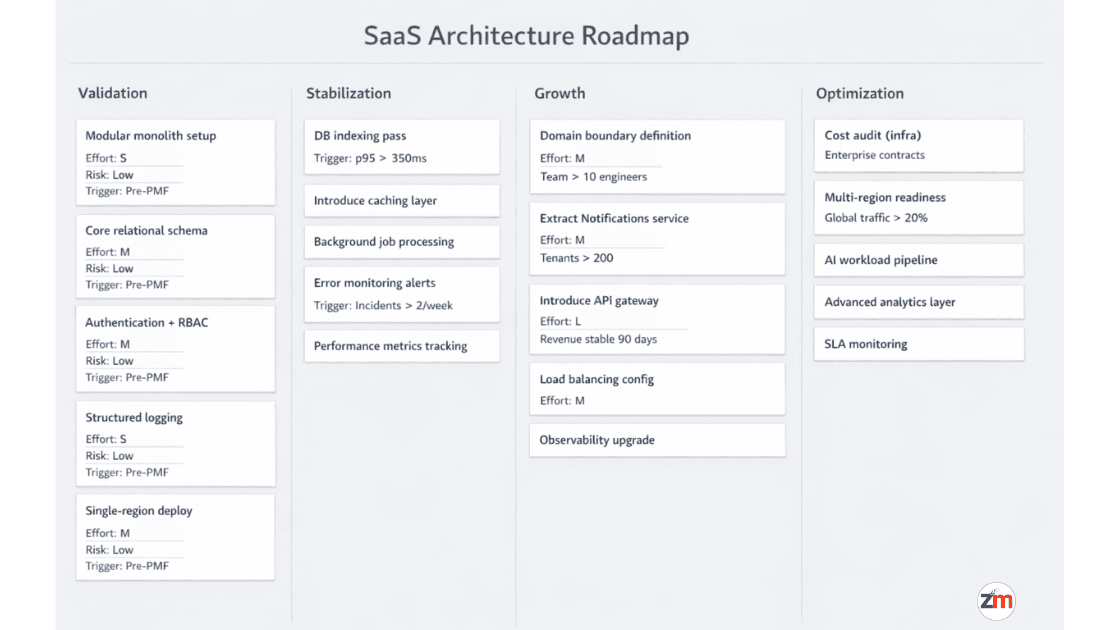
You can see how this progression plays out in this real-world SaaS transition case study (https://www.zestminds.com/easy-marketing-app-case-study).
Phase 1: Validation (0–1,000 Users)
- Modular monolith
- Single primary database
- Managed hosting
- Basic monitoring
- Clean API boundaries
Primary focus: Speed and insight.
Phase 2: Stabilization (1,000–10,000 Users)
- Query optimization
- Caching introduction
- Background job handling
- Stronger alerting
Primary focus: Reliability and user trust.
Phase 3: Growth (10,000+ Users or Strong Revenue)
- Domain-driven decomposition
- Selective service extraction
- Scalable infrastructure
- Load balancing
Primary focus: Operational resilience.
Phase 4: Optimization & Intelligence
- Cost control
- AI integration
- Advanced analytics
- Regional redundancy
Primary focus: Strategic leverage.
The Real Decision Framework
Before investing in new infrastructure, ask yourself:
- Does this accelerate product validation?
- Does it solve a real, present constraint?
- Or are we building for a future that hasn't arrived yet?
Architecture maturity should mirror business maturity.
Not exceed it.
A Scenario: Two Startups
Startup A builds:
- Kubernetes clusters
- Microservices
- Event pipelines
- Distributed logging stacks
They have 30 beta users.
Startup B builds:
- A clean monolith
- A strong data model
- Clear API design
- Managed cloud hosting
They ship updates weekly.
Experienced founders often note that clarity compounds faster than complexity.
Complexity feels sophisticated.
But clarity wins traction.
Frequently Asked Questions
1. Is a modular monolith always better than microservices for SaaS MVPs?
For most early-stage SaaS products, yes.
A modular monolith reduces operational overhead, simplifies deployments, and accelerates iteration. Microservices usually become justified when team size, domain boundaries, or scaling complexity create coordination friction.
The decision should be based on team and system stress, not industry trends.
2. How do I know if my SaaS architecture is becoming technical debt?
Technical debt becomes visible when:
- Feature delivery slows noticeably
- Small changes require touching multiple unrelated modules
- Performance issues reappear despite patches
- Developers hesitate to modify core systems
When engineering time shifts from building value to working around structure, architecture maturity is lagging behind business growth.
3. When is a full rewrite justified instead of incremental refactoring?
A rewrite may be justified when:
- Core architectural assumptions were fundamentally wrong
- Scaling constraints cannot be resolved incrementally
- The system prevents new product expansion
However, most growing SaaS platforms evolve successfully through controlled refactoring rather than a complete rebuild.
4. Should I design for multi-region and enterprise compliance from day one?
Only if your early customers demand it.
Multi-region infrastructure, strict data isolation, and compliance-heavy architectures increase cost and complexity. For most startups, these become relevant after traction, not before.
Design clean boundaries early, scale infrastructure when signals justify it.
5. What metrics should trigger architectural evolution?
Architecture should evolve when you observe measurable signals such as:
- Sustained revenue growth
- Increasing API latency or database contention
- Frequent incident response
- Growing engineering team size
- Expansion into new workload types like AI or real-time systems
- Architecture decisions should follow data, not anticipation.
6. How often should SaaS architecture be reviewed?
For early-stage SaaS, a structured review every 6–12 months is reasonable.
For growth-stage products, reviews should be aligned with major milestones, funding rounds, team expansion, enterprise onboarding, or performance bottlenecks.
Architecture is not static. It should evolve with business maturity.
Conclusion
MVP vs long-term SaaS architecture is not a theoretical debate.
It's a sequencing decision.
Build enough structure to support learning.
Delay complexity until traction justifies it.
Evolve your system in alignment with revenue, usage, and team maturity.
Strong SaaS companies don't overbuild.
They build in layers, deliberately.
If you're currently debating whether to refactor, scale, or simplify your SaaS architecture, stepping back for a structured architecture review can clarify your next move.
We offer a focused SaaS Architecture Review for founders and CTOs navigating this transition, practical, vendor-neutral, and grounded in real-world growth experience. If you're ready to move forward, you can hire dedicated developers with SaaS scaling experience (https://www.zestminds.com/hire-dedicated-developer) to execute the next phase with confidence.
Table of Contents
- MVP vs Long-Term SaaS Architecture: What to Build Now, And What to Delay
- The Real Trade-Off: Speed vs Structural Integrity
- What an MVP Architecture Must Include (And Nothing More)
- What to Intentionally Delay Until After Traction
- The Inflection Point: When to Evolve Beyond MVP Architecture
- A Practical Architecture Roadmap for Founders & CTOs
- Frequently Asked Questions
- Conclusion
Shivam Sharma
Before You Scale Further, Review the Architecture.
Let’s evaluate where your system stands — and where it may break under growth.
Schedule an Architecture Review 30-minute technical discussion. No obligation.