
Why Startup MVP Architecture Breaks After 6–12 Months
Most startup MVP architectures do not fail overnight.
They erode quietly under decisions that were perfectly reasonable at the time and never revisited. The breaking point usually arrives when real users, real data, and real business expectations collide.
This article explains why that moment is so common, what usually causes it, and how founders should think about MVP architecture before growth turns small shortcuts into expensive bottlenecks.
Note: In this article, MVP means Minimum Viable Product, not the Model-View-Presenter software design pattern.

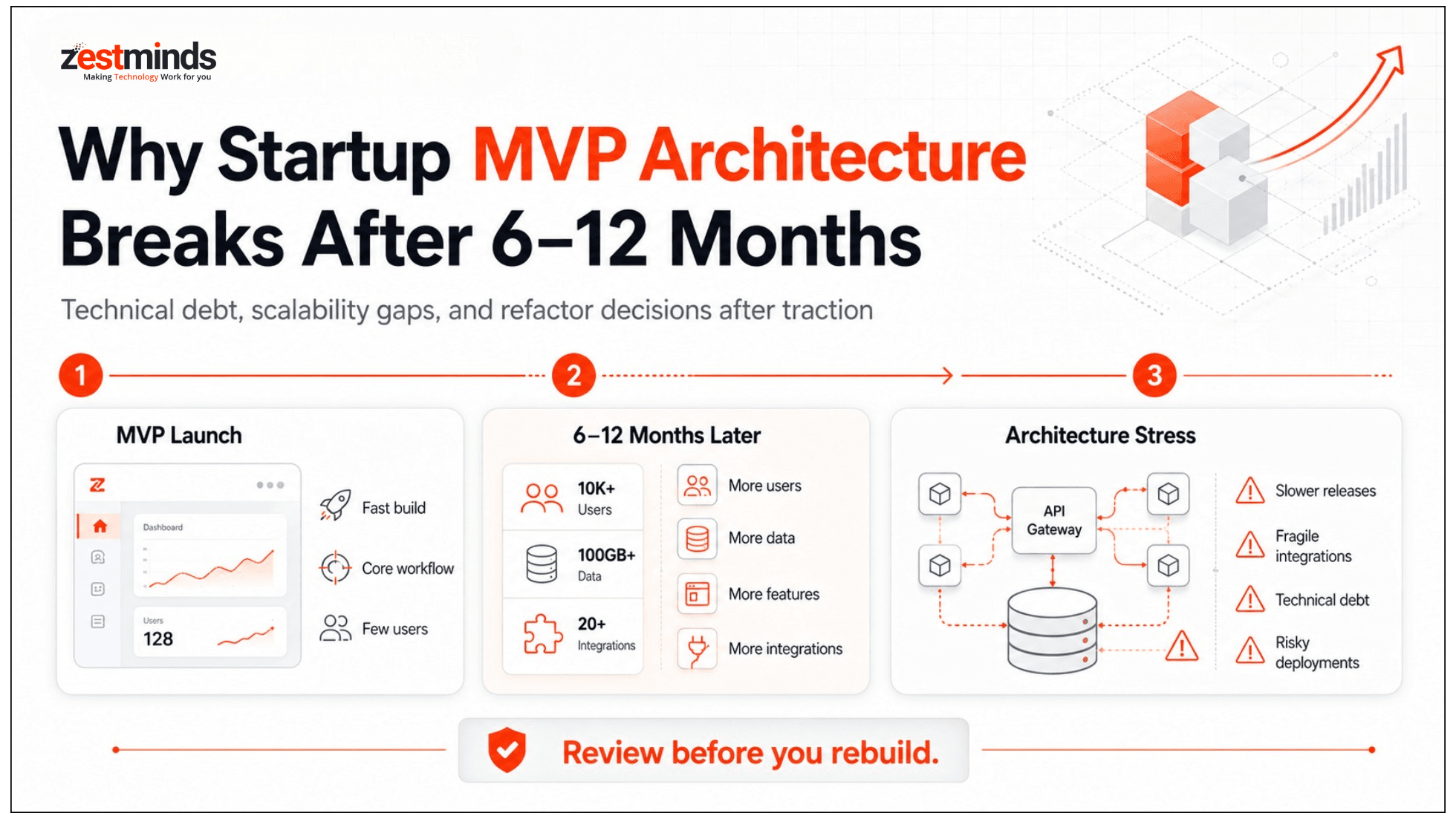
MVP Architecture Is Built for Speed, Not Longevity
An MVP exists to answer one question: Should this product exist at all?
It is not meant to answer: Can this system handle growth, complexity, integrations, reporting, and long-term scale?
Most founders understand this conceptually.
Where things slip is in execution.
Early on, every incentive pushes toward speed:
- Ship fast
- Validate assumptions
- Preserve runway
- Avoid overthinking architecture
- Get real user feedback quickly
So teams optimize for short-term delivery, not long-term resilience.
That is not always a mistake.
It is often a conscious trade-off.
The real problem starts when that trade-off fades into the background and the same prototype decisions quietly become permanent product foundations.
The Hidden Assumption That Causes Trouble
Most MVPs are built around an unspoken belief:
"We will figure it out later."
That belief is reasonable if "later" is intentional and planned.
In practice, something else happens:
- The MVP gains traction
- Features are layered on incrementally
- Users behave in ways no one anticipated
- Data volume increases steadily
- Performance issues surface intermittently
- Manual workarounds become daily operations
Yet the architecture stays stuck in prototype mode.
At this stage, the system is not misbehaving.
It is doing exactly what it was designed to do.
Why the 6–12 Month Mark Is the Danger Zone
The first few months are forgiving:
- Low traffic masks inefficient queries
- Manual fixes hide missing workflows
- Small teams solve problems through direct communication
- Engineers patch issues quickly and move on
Around the 6–12 month window, three shifts usually happen together:
- Usage becomes unpredictable
- Product scope stretches beyond the original MVP
- Business expectations rise sharply
Because these shifts compound rather than arrive in isolation, architectural cracks surface faster than teams expect and therefore feel sudden.
Not because early decisions were foolish, but because the context has changed.
The Core Mismatch
MVP architecture is usually optimized for:
- Few users
- Narrow workflows
- Limited data
- Fast iteration
- Short feedback loops
Growth-stage products demand:
- Predictable performance
- Clear domain boundaries
- Scalable data access
- Operational stability
- Safer deployments
When you expect MVP architecture to behave like a growth-stage system, frustration is inevitable.
This mismatch, not incompetence or poor engineering, is the root of most sudden architecture failures, especially when teams skip fundamentals like an MVP planning checklist early on.
- MVP architecture optimizes for speed, learning, and narrow workflows
- Growth-stage architecture requires stability, boundaries, and predictability
- Problems arise when MVP decisions are treated as permanent
That is why working with an experienced MVP development team matters most when speed and future flexibility both need to be balanced.
Early Technical Decisions That Quietly Create Future Bottlenecks
Most architectural breakdowns do not come from one dramatic error.
They emerge from a series of sensible decisions that compound over time.
Individually, each choice feels harmless.
Collectively, they create a system that resists change.
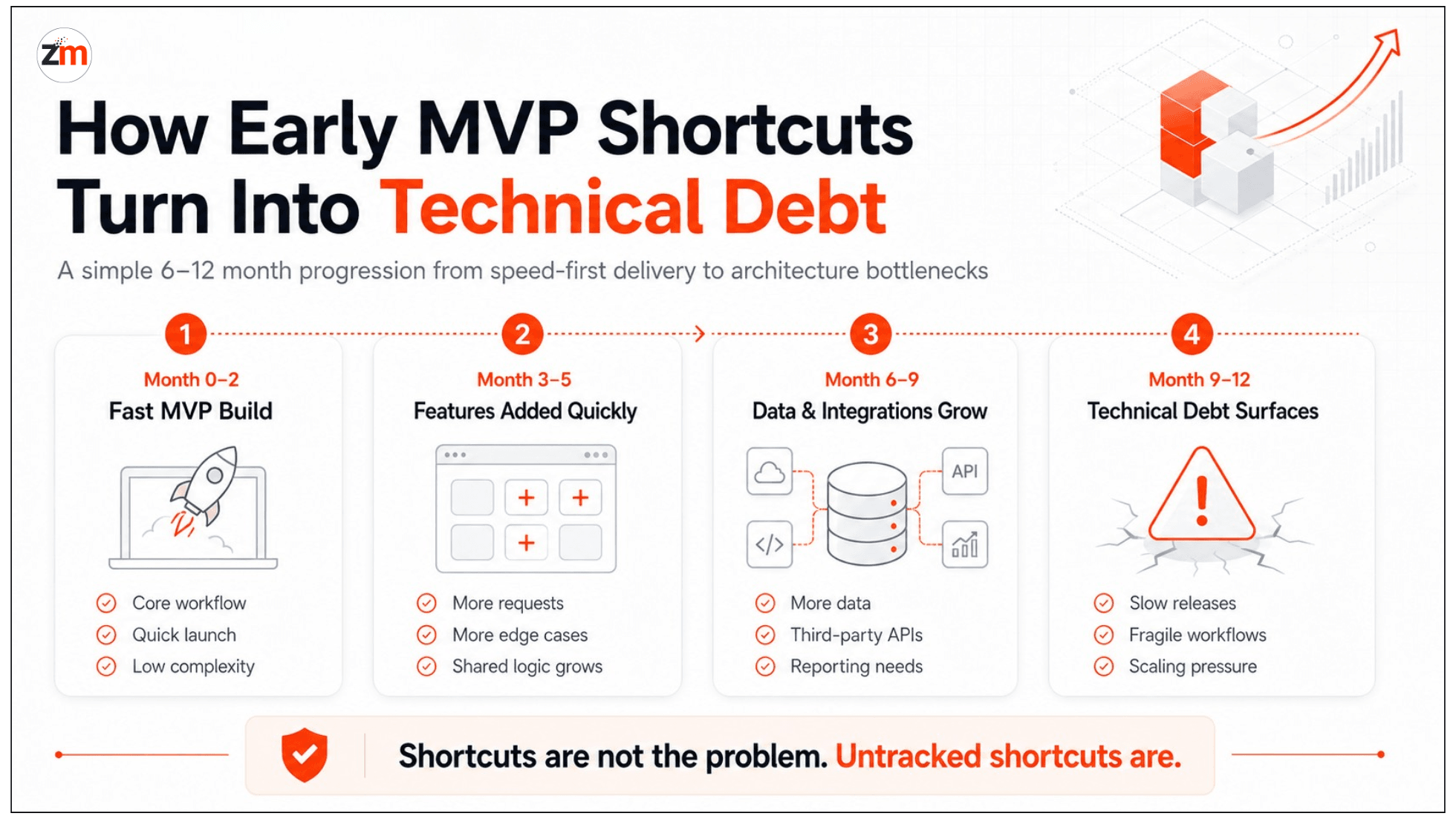
Decision 1: Treating the Database as a Dumping Ground
In many MVPs, the database becomes:
- A shared state for everything
- A place where business logic quietly leaks
- A structure optimized purely for getting it working
- A reporting source nobody designed intentionally
Tables evolve organically:
- Fields added just for now
- Relationships implied rather than enforced
- No clear ownership of data domains
- Temporary columns becoming permanent business logic
This works until the business grows.
Later, when you need:
- Reliable reporting
- Performance tuning
- Safe data migrations
- Feature isolation
- Customer-specific analytics
You discover that everything depends on everything else, which means even small changes carry outsized risk.
For example, a SaaS billing change may accidentally affect onboarding because both workflows depend on the same user-status field. A reporting query may slow down live workflows because analytics and transactional data were never separated. Small shortcuts become business risks.
Decision 2: Blurring Domain Boundaries
Early MVP codebases often lack clear separation between:
- User management
- Billing
- Core product logic
- Admin workflows
- External integrations
Why? Because boundaries slow you down at the start.
So logic gets shared:
- One service quietly does too much
- Functions grow longer and harder to reason about
- Side effects pile up
- One feature change creates bugs in unrelated workflows
The system still runs, but understanding it requires tribal knowledge.
When new engineers join, velocity drops.
Not because they are inexperienced, but because the system offers no clear mental model and therefore resists onboarding.
Decision 3: Overloading a Single Architecture Pattern
Many MVPs pick one pattern and apply it everywhere:
- Everything is a monolith
- Or everything is event-driven
- Or everything must be async
- Or every workflow is pushed into the same backend service
Patterns themselves are not the issue.
Uncritical consistency is.
Different parts of a system have different needs:
- User-facing APIs need predictability
- Background jobs need resilience
- Integrations need isolation
- Reporting needs efficient data access
- Admin workflows need control and auditability
When one pattern dominates, friction shows up elsewhere, often quietly, until it slows the entire system.
Decision 4: Optimizing for Today's Team, Not Tomorrow's
Early teams are small and tightly aligned.
Communication is fast. Context is shared.
So architecture starts relying on:
- Verbal knowledge
- Unwritten conventions
- We all know how this works thinking
- Direct founder-to-developer decisions
As the team grows, that implicit knowledge disappears.
The architecture has not changed, but the environment has.
Suddenly:
- Bugs increase
- Deployments feel risky
- Simple changes take longer than expected
- New developers need weeks to understand basic flows
The system did not degrade.
The assumptions it relied on no longer hold and therefore demand structural change.
Why These Decisions Are Hard to Undo
Each of these choices embeds itself deeply:
- In data structures
- In APIs
- In deployment workflows
- In developer habits
- In customer-facing expectations
Undoing them requires coordination and focus, two things growing startups rarely have in abundance.
That is why architectural issues feel overwhelming when they surface.
They are not new problems.
They are accumulated ones.
Overengineering vs Underengineering: Both Kill MVPs
Founders are often warned about overengineering.
That warning is valid, but incomplete.
Underengineering is just as dangerous, and far more common.
| Dimension | Overengineering | Underengineering |
|---|---|---|
| Initial speed | Slow | Fast |
| Early confidence | High | High |
| Change cost later | Very high | Very high |
| Typical failure mode | Too complex | Too fragile |
| Root cause | Premature abstraction | Ignored constraints |
| Best response | Simplify what does not create value | Stabilize what growth depends on |
Overengineering: Solving Problems You Do Not Have
Overengineering typically looks like:
- Premature microservices
- Heavy abstractions before clarity exists
- Complex orchestration for simple workflows
- Tooling designed for scale that never arrives
The cost is easy to spot:
- Slower development
- Higher cognitive load
- Operational overhead without payoff
- More time spent managing architecture than learning from users
Most founders are aware of this risk.
So they swing hard in the opposite direction.
Underengineering: Ignoring Problems You Will Have
Underengineering shows up as:
- No clear module boundaries
- No migration strategy
- Little to no observability
- No plan for data growth
- No safe deployment or rollback process
The system works, until it does not.
When reality catches up:
- Fixes become reactive
- Refactors are postponed
- Technical debt compounds quietly
- The roadmap slows because every feature needs cleanup first
Underengineering does not fail loudly.
It fails late, when change is most expensive, because earlier shortcuts block later options.
The False Binary Founders Fall Into
Many teams frame architecture as a choice between:
- Simple now or scalable later
That framing is misleading.
The better question is:
"Which decisions will be hardest to reverse?"
Strong MVP architecture avoids premature complexity without blocking future options.
That means:
- Clear domain ownership
- Replaceable components
- Explicit constraints
- Conscious, documented shortcuts
It is not about building for scale from day one.
It is about not preventing scale later.
A Practical Mental Model
Think of MVP architecture like renting an apartment.
You do not remodel it as if you will live there forever.
But you also do not knock down load-bearing walls.
You:
- Keep changes reversible
- Avoid irreversible shortcuts
- Accept imperfection with awareness
Most MVPs fail architecturally because no one is tracking which walls matter most.
What Changes After Traction and Why MVPs Cannot Handle It
Traction is not just more users.
It brings different behavior, higher expectations, and less tolerance for instability.
This is where MVP architecture is truly tested and often exposed.
Usage Patterns Stop Being Linear
Early users are forgiving.
They explore, tolerate friction, and accept rough edges.
Post-traction users behave differently:
- They use the product daily
- They depend on it for real work
- They push edge cases without realizing it
- They expect reliability because the product now supports real operations
Suddenly:
- Queries spike at odd hours
- Certain workflows dominate system load
- Rare bugs become recurring incidents
- Support tickets expose hidden process gaps
An architecture built around average usage struggles when usage becomes uneven and therefore becomes brittle under real-world conditions.
Data Volume Changes the Cost of Mistakes
Early-stage data fits comfortably in memory.
Queries are fast. Indexes are forgiving. Reports still load.
After traction:
- Tables grow large
- Joins become expensive
- Temporary fields turn permanent
- Reporting starts competing with live product usage
A query that once took milliseconds now takes seconds.
Background jobs overlap. Retries stack up. Dashboards that were once harmless start slowing down real workflows.
The architecture did not change, but data gravity did. This is why broader system design principles, such as the guidance in the Google Cloud Architecture Framework, matter more once a product starts moving from validation to real usage.
Product Scope Expands Beyond the Original Mental Model
Most MVPs are built around one primary use case.
After traction:
- Secondary use cases emerge
- Feature requests multiply
- Integrations become unavoidable
- Customers ask for reporting, permissions, alerts, and automation
Now the system needs:
- Clear boundaries
- Predictable APIs
- Versioning strategies
- Reliable background workflows
MVP architectures often lack these, not because of poor design, but because they were not necessary early on.
For SaaS founders, this is usually the moment where MVP development turns into long-term SaaS product development.
This is when teams say:
"We did not design for this."
Which is true.
They did not design for evolution.
Operational Expectations Rise
Before traction:
- Downtime is tolerated
- Manual fixes are acceptable
- Logging is optional
- Deployment risk feels manageable
After traction:
- Downtime erodes trust
- Bugs affect revenue
- Incidents demand explanations
- Manual workarounds slow the team down
You now need:
- Observability
- Rollback strategies
- Clear ownership
- Stable deployment workflows
What once felt like overhead becomes non-negotiable because the business now depends on the system.
This is where platform engineering support can help teams improve reliability, deployment safety, monitoring, and operational readiness without blindly rebuilding the product.
Why This Feels Like a Sudden Failure
From the outside, it looks abrupt:
- Everything was fine last month
- The system cannot handle growth
- Every new feature is taking too long
Internally, it is simpler:
- Assumptions expired
- Constraints changed
- Architecture did not evolve
The system did not break randomly.
It broke on schedule.
Common MVP Scalability Problems After Traction
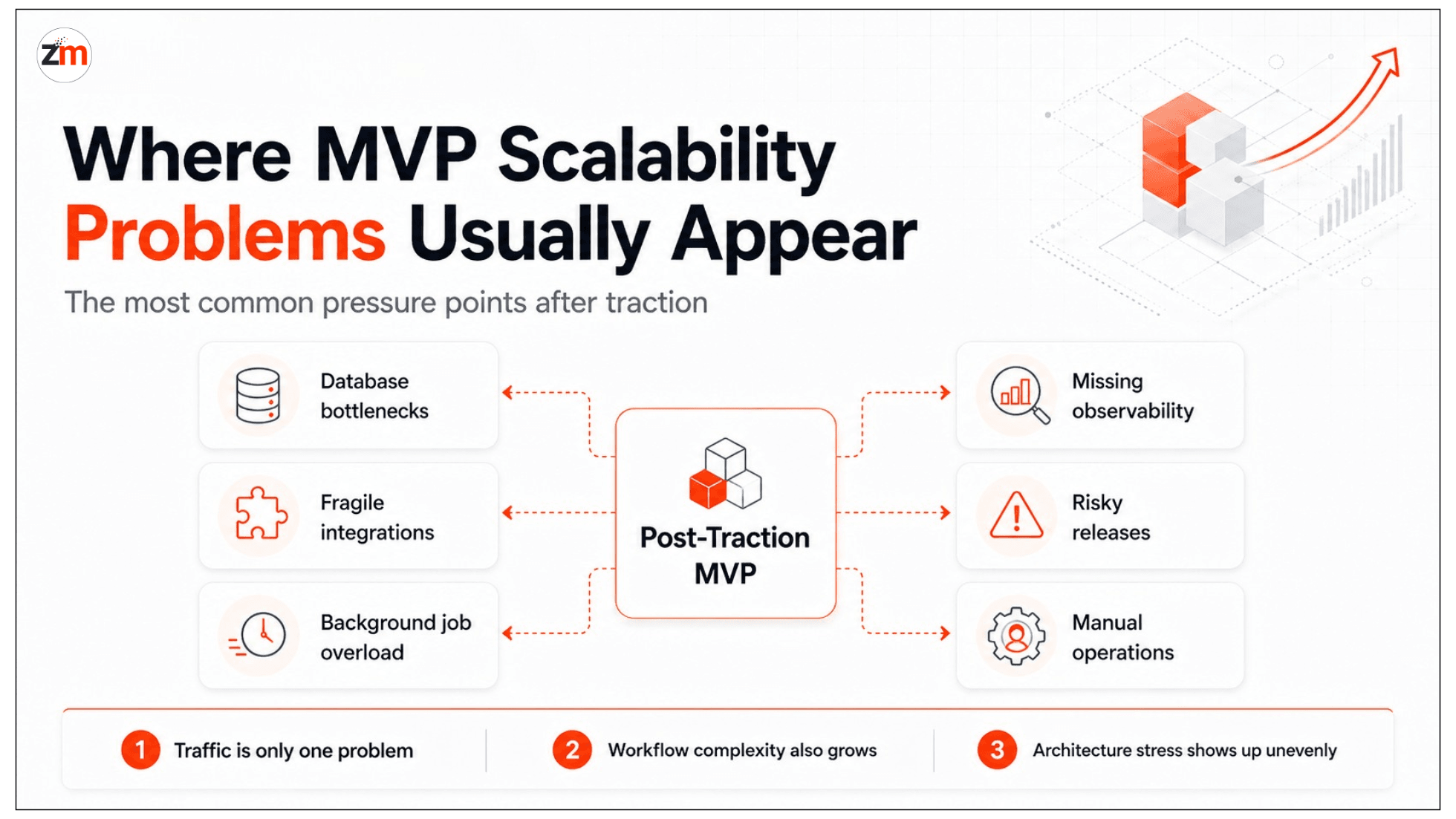
Scalability problems are not always about traffic spikes.
In many MVPs, the bigger issue is that the product starts supporting more workflows than the original architecture was designed to handle.
Common MVP scalability problems include:
- Slow database queries: Reporting, dashboards, and filters become slower as data grows.
- Fragile integrations: A third-party API failure blocks core product workflows.
- Overloaded background jobs: Emails, notifications, reports, imports, and retries compete for the same queue.
- Tightly coupled modules: Billing, user permissions, onboarding, and core product logic affect each other unexpectedly.
- Manual operations: Admin tasks that were acceptable for 20 users become painful at 2,000 users.
- Missing observability: Teams know something is slow, but cannot quickly identify where the bottleneck is.
- Risky releases: Small updates require extra caution because nobody knows the full blast radius.
These issues are not always signs that the MVP was built badly.
They are signs that the product has outgrown its original assumptions.
The business impact is real. Feature delivery slows, support tickets increase, customer trust becomes harder to protect, and roadmap time shifts from growth to cleanup.
How Founders Should Think About MVP Architecture Instead
The most common mistake founders make is not choosing the wrong stack.
It is treating architecture as a one-time decision.
Architecture is not a single choice.
It is a series of commitments made over time.
Shift from Right Architecture to Right Questions
Instead of asking:
- Should we use X or Y?
- Is this scalable?
- Should we rebuild everything?
Ask:
- What will be hardest to change later?
- Which assumptions are we locking in?
- Where do we need isolation and flexibility?
- What will block the next 6–12 months of product growth?
These questions lead to better outcomes than any framework comparison because they surface risk early.
Design for Evolution, Not Perfection
Strong MVP architecture embraces imperfection but does so intentionally.
That means:
- Explicit boundaries, even if they are simple
- Interfaces that can evolve
- Components that can be replaced
- Shortcuts that are documented instead of forgotten
In practice:
- A modular monolith beats fragmented microservices for many early products
- A thin queue abstraction beats hard-coded background logic
- Clear API contracts beat tightly coupled internal calls
- A simple deployment process beats heroic manual releases
The goal is not elegance.
The goal is optionality.
Make Technical Debt Visible, Not Invisible
Technical debt is not the enemy.
Unacknowledged debt is.
Founders should ensure:
- Shortcuts are documented
- Trade-offs are understood
- Revisit points are planned
- Architecture discussions are tied to business milestones
When debt is visible:
- Refactoring becomes intentional
- Surprises decrease
- Architecture discussions align with business reality
- Teams know what to fix first and what can wait
The conversation shifts from:
"Engineering is blocking us."
to:
"We need to invest here to support growth."
Align Architecture Decisions With Business Milestones
Architecture should evolve alongside:
- User growth
- Revenue complexity
- Team size
- Customer expectations
- Operational risk
Not all at once.
A practical guideline many experienced teams follow:
- Pre-traction: optimize for learning
- Post-traction: optimize for stability
- Scaling: optimize for independence
Treating MVP architecture as permanent ignores how companies actually grow. This is why the strongest teams review architecture decisions around real product milestones instead of waiting until every release becomes risky.
Taken together, these patterns explain why startup MVP architectures break after the first 6–12 months and what founders can do to avoid repeating the same failure cycle.
MVP Technical Debt Checklist Before Scaling
Before adding more features, hiring more developers, or rebuilding from scratch, founders should make technical debt visible.
Use this checklist to identify risk areas:
- Code structure: Are modules clearly separated, or does one service handle everything?
- Database design: Are relationships clear, indexed, and safe to change?
- API boundaries: Are core workflows exposed through predictable interfaces?
- Background jobs: Are retries, failures, and long-running tasks handled safely?
- Integrations: Can third-party failures be isolated without breaking the product?
- Observability: Can the team quickly find where a performance issue starts?
- Deployment process: Can the team release and roll back safely?
- Documentation: Are shortcuts and trade-offs written down?
- Testing: Are the most business-critical workflows protected?
- Ownership: Does the team know who owns each major product area?
This checklist should not become a reason to pause the entire roadmap.
Its purpose is to separate urgent risks from acceptable trade-offs.
Some debt can wait. Some debt will block growth. The danger is not knowing which is which.
When Should You Bring in an MVP Architect or Architecture Consultant?
A Minimum Viable Product architect or architecture consultant is most useful when the product is no longer just being validated and the next set of decisions will affect growth, reliability, and team speed.
You should consider outside architecture help when:
- Your team cannot clearly decide whether to refactor or rebuild
- Feature delivery is slowing even though the team is working hard
- Database, API, or integration problems keep coming back
- Developers avoid touching certain parts of the codebase
- You are about to onboard more engineers but the system has no clear boundaries
- You need to scale the product without turning every release into a risk
- You are evaluating whether a new development partner can safely take over or extend the product
The goal is not to produce a fancy architecture document nobody uses.
The goal is to understand what should be fixed first, what can be left alone, and what could block the next stage of growth.
For founders who are evaluating how a product team thinks before handing over important work, it can also help to review how our product engineering process works.
Rebuild, Refactor, or Replace: Making the Right Call
When architectural pain becomes visible, founders face a difficult decision:
Do we rebuild, or fix what we have?
There is no universal answer.
But there is a reliable way to think about it.
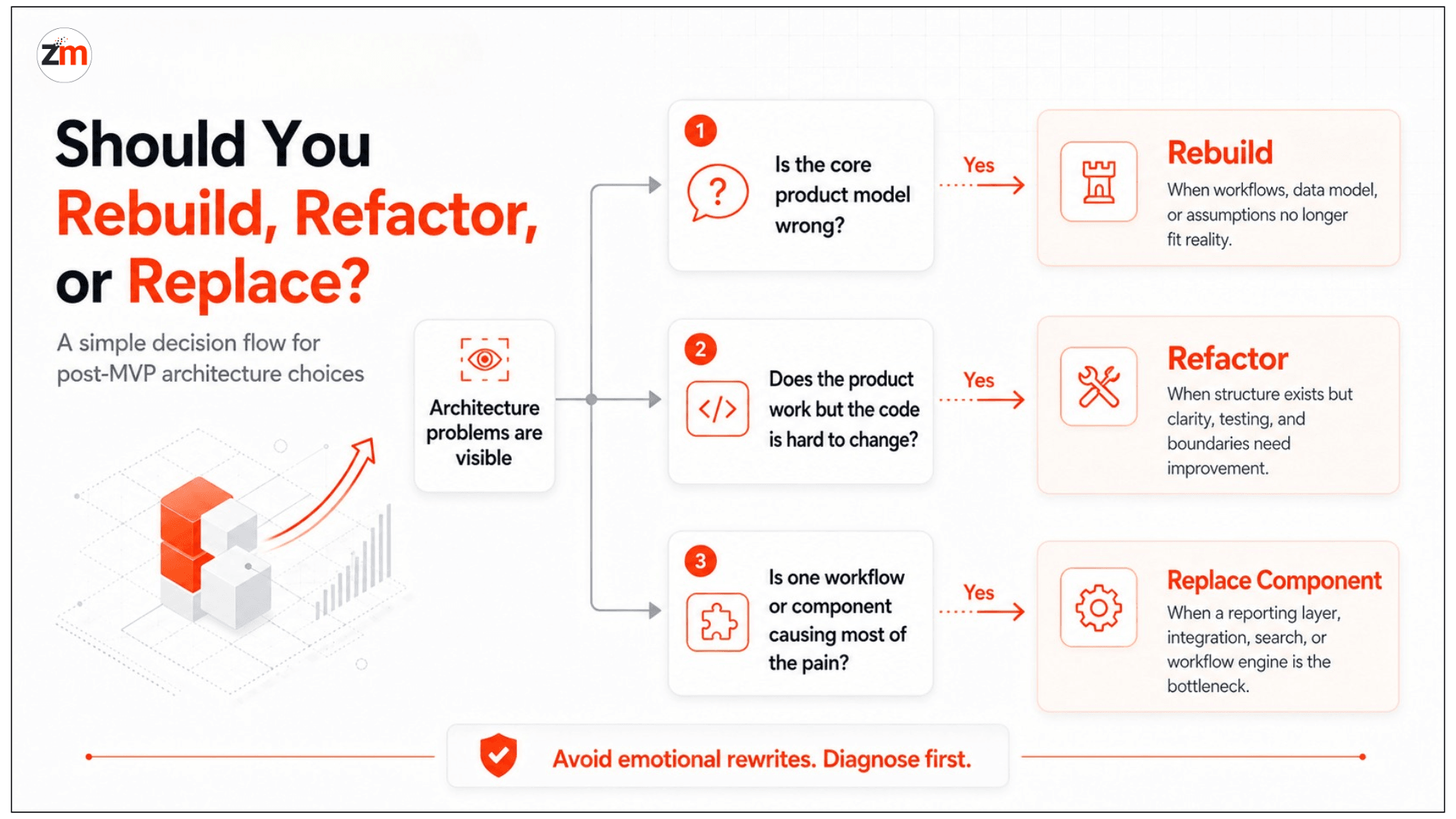
Rebuild When the Mental Model Is Wrong
If the core assumptions are flawed, about users, workflows, or data, a rebuild may be justified.
Common signals:
- Core entities no longer reflect reality
- Workarounds dominate business logic
- New features constantly fight the structure
- The product now serves a different workflow than the one it was originally built for
In these cases, rebuilding is not failure.
It is realignment.
That said, rebuilds should be scoped and deliberate, not emotional responses to frustration.
Refactor When Structure Exists but Needs Clarity
If the system:
- Mostly works
- Has identifiable boundaries
- Suffers from complexity, not chaos
- Can be improved without stopping product delivery completely
Refactoring is often the smarter move.
This may involve:
- Extracting clearer modules
- Cleaning up data models
- Introducing explicit interfaces
- Improving tests and deployment safety
Refactors preserve momentum while improving stability and usually cost far less than full rewrites.
This is where targeted migration and refactoring support can help teams improve structure without throwing away a working product.
Replace When a Single Component Is the Bottleneck
Sometimes the issue is not the entire system.
It is:
- A reporting layer
- A third-party integration
- A background processing pipeline
- A search module
- A notification or workflow engine
In these cases, replacing one component, rather than touching everything, can deliver disproportionate value.
This requires architectural awareness:
- Understanding dependencies
- Managing blast radius
- Isolating change safely
- Protecting business-critical workflows during transition
Clear boundaries make this easier.
MVPs without them make it harder, but not impossible.
Related proof: See how Zestminds approached workflow complexity, product structure, and scalable SaaS development in a Laravel SaaS CRM case study.
Decision Table: Rebuild, Refactor, or Replace?
| Situation | Better Direction |
|---|---|
| Product model no longer matches real usage | Rebuild or redesign the core model |
| System works but code is hard to change | Refactor in planned phases |
| One workflow or integration blocks growth | Replace or isolate that component |
| Database structure slows reporting | Refactor or partially redesign data access |
| Releases feel risky | Improve testing, CI/CD, rollback, and deployment flow |
The Founder's Role in the Decision
Founders do not need to design the solution.
But they do need to:
- Understand the trade-offs
- Align architectural work with business goals
- Give teams room to fix structural issues
- Avoid pushing feature speed at the cost of long-term product health
The worst outcome is not choosing rebuild or refactor.
It is avoiding the decision until growth forces a crisis.
What a Post-MVP Architecture Review Should Check
If your product is approaching or has passed the 6–12 month mark, the most valuable exercise is a structured architecture review.
Not a rewrite plan.
Not a tooling debate.
Just an honest assessment of:
- Which assumptions no longer hold
- Where change is hardest
- What will block growth next
- Which risks are technical, operational, or business-critical
A practical post-MVP architecture review should check:
- Codebase structure: Are modules understandable, separated, and safe to change?
- Database design: Can the data model support reporting, growth, and future workflows?
- API boundaries: Are internal and external APIs predictable and versionable?
- Integration reliability: Can external service failures be isolated?
- Infrastructure: Is hosting, scaling, deployment, and rollback handled safely?
- Observability: Can the team trace errors, slow requests, and background job failures?
- Security basics: Are authentication, authorization, data access, and secrets handled properly?
- Technical debt: Which shortcuts are acceptable and which are blocking growth?
- Roadmap risk: Which upcoming features will be expensive unless architecture improves first?
A review should also look at how safely the team can introduce change. AWS Well-Architected guidance on change management is a useful reference point here because MVP failures often appear when deployments, patches, scaling changes, or feature releases become difficult to predict.
That clarity alone can save months of reactive work and help founders decide whether to refactor, rebuild, replace one component, or continue improving the existing system.
For startups looking beyond a one-time review, choosing a long-term development partner can help connect architecture decisions with delivery, roadmap ownership, and ongoing product evolution.
Need a practical next step? If you are not sure whether your MVP needs refactoring, rebuilding, or scaling support, book a CTO-led MVP architecture review. The goal is to identify what to fix first, what to leave alone, and what could block growth next.
Frequently Asked Questions
In this article, does MVP mean Minimum Viable Product or Model-View-Presenter?
Here, MVP means Minimum Viable Product. This article is about startup product architecture, not the Model-View-Presenter software design pattern.
Why do startup MVP architectures break after 6–12 months?
They usually break because the product moves beyond its original assumptions. More users, more data, new features, and higher reliability expectations expose shortcuts that were acceptable during validation.
What are common MVP scalability problems after traction?
Common issues include slow database queries, fragile integrations, missing observability, overloaded background jobs, tightly coupled modules, and features that become risky to change.
How can founders identify MVP technical debt before it slows growth?
Watch for slower feature delivery, repeated bugs, unclear ownership, hardcoded workflows, missing logs, risky deployments, and engineers avoiding parts of the codebase.
Should a startup rebuild or refactor its MVP?
Refactor when the product mostly works but needs cleaner structure. Rebuild only when the core data model, workflows, or product assumptions no longer match how the business operates.
When should you bring in an MVP architect or architecture consultant?
Bring one in when your team cannot clearly decide what to fix first, whether to rebuild or refactor, or how to scale without slowing product delivery.
What should a post-MVP architecture review check?
It should review the codebase structure, database design, APIs, integrations, deployment process, observability, security basics, technical debt, and the safest refactor or rebuild path.
Can MVP architecture problems be avoided completely?
Not completely. MVPs involve trade-offs by design. The goal is to keep shortcuts visible, reversible, and reviewed before they become expensive growth blockers.
Author note: This article reflects hands-on experience reviewing, stabilizing, and rebuilding MVP architectures for startups across SaaS, AI-driven platforms, workflow-heavy systems, and data-heavy products at Zestminds.
Table of Contents
- MVP Architecture Is Built for Speed, Not Longevity
- Early Technical Decisions That Quietly Create Future Bottlenecks
- Overengineering vs Underengineering: Both Kill MVPs
- What Changes After Traction and Why MVPs Cannot Handle It
- Common MVP Scalability Problems After Traction
- How Founders Should Think About MVP Architecture Instead
- MVP Technical Debt Checklist Before Scaling
- When Should You Bring in an MVP Architect or Architecture Consultant?
- Rebuild, Refactor, or Replace: Making the Right Call
- What a Post-MVP Architecture Review Should Check
- Frequently Asked Questions
Shivam Sharma
Before You Scale Further, Review the Architecture.
Let’s evaluate where your system stands — and where it may break under growth.
Schedule an Architecture Review 30-minute technical discussion. No obligation.