
Swift vs Flutter for iOS Development in 2025: Which One Should You Really Choose?
Swift vs Flutter in 2025 is no longer a simple "native vs cross-platform" debate. With AI-native apps, Vision Pro readiness, and multi-platform UX shaping product decisions, choosing the right stack now determines your speed, scalability, and long-term cost. This guide gives founders and CTOs a clear, 2025-grade comparison to help you decide with confidence.

Introduction
Building an iOS app used to be simple. You learned Swift, opened Xcode, followed Apple’s guidelines — and your path was clear.
But 2025 is a very different universe.
Apps today are expected to be AI-smart, multi-device ready, fast, intuitive, and future-proof across iPhone, iPad, Watch, Mac, and even Vision Pro. The stack you choose now determines everything from speed to long-term scalability.
That’s why one debate still refuses to die:
“Should you build your iOS product in Swift (native) or Flutter (cross-platform)?”
Both ecosystems have evolved dramatically since 2019:
- SwiftUI matured into a powerful UI framework.
- Flutter’s Impeller engine closed much of the performance gap.
- Dart 3 improved async workflows.
- Xcode Cloud and Codemagic transformed CI/CD.
- Apple’s Neural Engine pushed on-device AI forward.
- Flutter expanded into desktop, web, and embedded devices.
Choosing the wrong framework today doesn’t just slow a project down — it creates expensive bottlenecks like:
- Delayed time-to-market.
- Higher development costs.
- Slower iteration cycles.
- Lower App Store stability.
- Difficult hiring or scaling teams.
This guide is here to help you avoid that.
Below, you’ll get a 2025-grade, founder-friendly comparison of Swift vs Flutter for iOS development — not the outdated “Swift is fast, Flutter has hot reload” narrative. We’ll go deep into:
- Real-world performance benchmarks.
- AI + ML capabilities.
- Scalability and architecture.
- Vision Pro readiness.
- UX differences.
- Talent availability and long-term cost.
- Zestminds’ experience building both stacks.
- A clarity-driven decision matrix.
By the end, you’ll know exactly which framework fits your product, budget, and 24-month roadmap — with confidence.
Why This Question Matters More Than Ever in 2025
Choosing a mobile tech stack is no longer just an engineering decision. It’s a business strategy decision tied to:
- Speed vs scalability.
- Native performance vs multi-platform reach.
- AI integration roadmap.
- Hiring cost and availability.
- Future-proofing for Apple’s evolving ecosystem.
- Budget constraints for MVPs and rapid releases.
If you launch an app today without:
- AI-powered experiences.
- Continuous delivery and CI/CD.
- Stable multi-device support.
- Near-native performance.
…your competitors will outrun you before you even hit PMF.
We see this daily when founders and CTOs reach out to Zestminds after reading our guides on smart MVP development or what makes web applications successful. They ask questions like:
- “Should our first version be in Swift or Flutter?”
- “Will Flutter slow us down later when scaling?”
- “Does Swift deliver real performance benefits or is it just perception?”
- “What about Vision Pro? What about AI?”
This guide answers those questions with clarity — not jargon.
Need help deciding fast? If you already have a rough roadmap or pitch deck, we can do a free 20-minute stack validation call and tell you whether Swift, Flutter, or a hybrid approach makes the most sense for your product.
Swift vs Flutter in 2025 — The Modern, Real-World Comparison
Let’s dive straight into the pillars that actually matter for product teams today.
1. Performance & Speed (2025 Reality Check)
TL;DR: Swift is still the performance king, but Flutter’s Impeller engine has narrowed the gap enough for most business apps.
Is Swift still faster than Flutter?
Swift (Native iOS)
Swift delivers performance that feels like the app is “breathing with the device.” Why?
- Compiles directly to ARM64.
- Access to Metal, GPU, and Apple Neural Engine.
- SwiftUI and Combine now provide smooth, predictable transitions.
- Best-in-class input latency and animation control.
Flutter (Impeller Engine, 2025)
The Impeller engine transformed Flutter’s iOS experience:
- Eliminated shader jank.
- Improved frame stability.
- Much smoother animations than Flutter 2020–2022.
- Still slightly behind Swift in CPU-heavy tasks.
Verdict: Swift wins raw performance, especially where micro-latency matters. For most business apps, Flutter is fast enough and the difference isn’t noticeable.
Want a deeper technical take? We often pair performance discussions with backend choices and architecture in our MVP planning for founders. If you’re planning a data-heavy or AI-intensive product, consider reading our MVP in 6–8 weeks guide alongside this comparison.
2. UI/UX Quality — SwiftUI vs Flutter UI
TL;DR: SwiftUI gives you the most Apple-native feel; Flutter gives you perfectly consistent UI across all platforms.
Which feels more native?
SwiftUI
- 100% native Apple look and feel.
- Works beautifully across iPhone, iPad, Watch, Mac, Vision Pro.
- Accessibility built in.
- Dynamic Island, widgets, and haptics are fully aligned with Apple’s design language.
Flutter UI
- Custom-rendered UI engine → consistent design across devices and platforms.
- Great for unified brand experiences.
- Seasoned iOS users can sometimes feel the difference.
- Cupertino package is good, but not perfect Apple-native parity.
.png)
Verdict: SwiftUI wins for true Apple-native experiences. Flutter wins when you want the same design everywhere.
3. AI & ML Capabilities — The Most Important Factor in 2025
TL;DR: Swift dominates on-device AI; Flutter shines for cloud-based AI integrations.
Every modern app now includes AI in some form:
- Personalized experiences.
- On-device inference.
- Generative capabilities.
- Real-time insights.
- LLM-driven interactions.
Swift for AI
- Full access to CoreML, Vision, NaturalLanguage, and Apple Neural Engine.
- Extremely fast on-device inference.
- Ideal for privacy-sensitive domains: healthcare, fintech, medical.
Flutter for AI
- Excellent for cloud-based AI (OpenAI, Gemini, etc.).
- Limited for heavy on-device ML.
- Relies on plugins for TFLite and MLKit.
- Not as deeply optimized for Apple silicon.
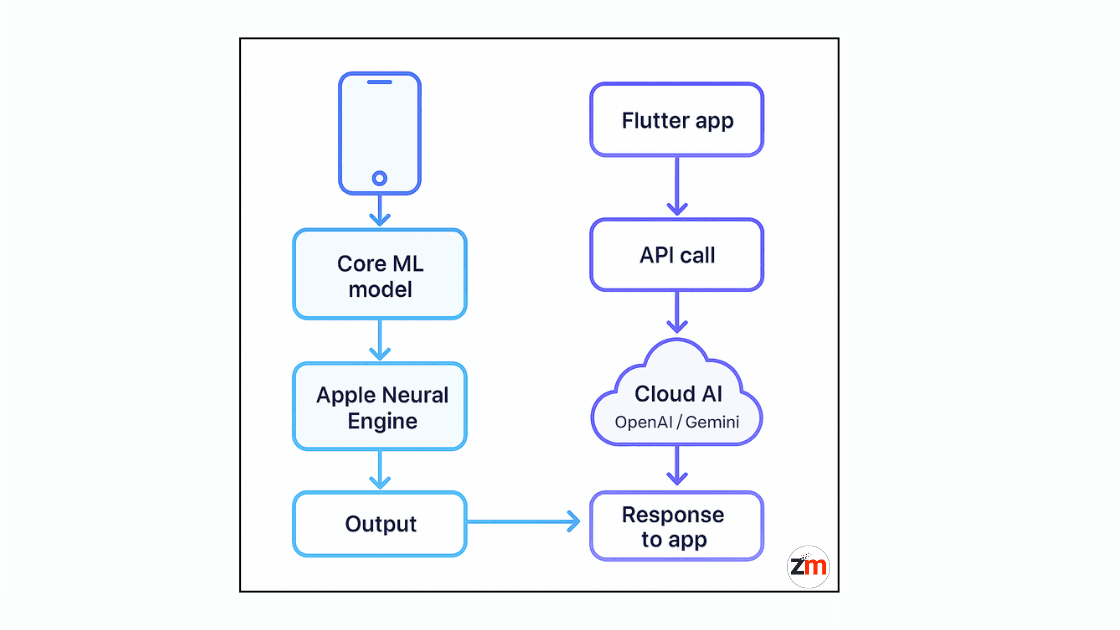
Verdict: If AI runs on device → Swift wins by miles. If AI runs in the cloud → Flutter performs perfectly fine.
4. App Store Stability & Approval
TL;DR: Swift is the safest bet for predictable App Store behavior; Flutter is stable but relies more on plugin quality.
Swift
- Apple-native by design.
- Predictable performance across iOS versions.
- Fastest review and approval cycles.
- No dependency on third-party rendering engines or UI layers.
Flutter
- Extremely stable since the Impeller engine.
- Still susceptible to quirks on new iOS releases.
- Occasional animation or plugin-related issues.
Verdict: Want predictable App Store behavior? Choose Swift. Need cross-platform reach and can handle occasional updates? Flutter works well.
5. Development Speed & Productivity
TL;DR: Flutter wins for speed and iterations; Swift wins for final polish and platform depth.
Flutter
- Hot Reload provides a massive productivity boost.
- One codebase for iOS and Android.
- Fastest MVP and iteration cycle.
- Codemagic and GitHub Actions provide slick CI/CD pipelines.
Swift
- No true hot reload.
- Xcode Previews help, but not enough for rapid cycles.
- Slower rebuild times.
- Xcode Cloud is solid but less flexible than Codemagic.
Verdict: Flutter wins MVPs and rapid prototyping. Swift still wins when you’re polishing a production-grade, Apple-first product.
Micro-CTA: If you’re under pressure to ship a working MVP in the next 6–10 weeks, talk to us before you lock the stack. We can often save founders 30–50% on time and rework just by choosing the right framework on day one.
6. Talent Availability & Hiring Cost
TL;DR: Swift specialists are premium; Flutter talent is more abundant and affordable.
Swift
- More specialized talent pool.
- Higher hourly rates globally.
- Mature senior ecosystem.
- Strong fit for long-term iOS-first teams.
Flutter
- Larger global pool of developers.
- Generally more affordable hourly rates.
- Easier to assemble product teams quickly.
Verdict: Budget-conscious teams usually lean toward Flutter. Enterprise-grade, Apple-first teams often invest in Swift.
7. Security & Compliance
TL;DR: For high compliance and security-sensitive apps, Swift is the clear winner.
Swift
- Full access to Keychain and Secure Enclave.
- Excellent fit for fintech, healthcare, legal, and enterprise apps.
Flutter
- Perfectly fine for standard business apps.
- High-compliance apps require extra encryption and careful plugin choices.
Verdict: If security and compliance are critical, Swift wins easily.
8. Scalability and Enterprise Readiness
TL;DR: Swift scales best for Apple-first ecosystems; Flutter scales best for multi-platform SaaS.
Swift
- Predictable scaling for iOS-first products.
- Ideal for large, evolving Apple ecosystem platforms.
Flutter
- Great for multi-platform SaaS products.
- Deep iOS optimizations sometimes require native modules in Swift.
Verdict: Apple-first enterprise → Swift. Multi-platform SaaS → Flutter.
9. VisionOS & Apple’s Future Ecosystem
TL;DR: If Vision Pro or spatial computing are on your roadmap, Swift is non-negotiable.
Swift
- Official, first-class support for Vision Pro.
- SwiftUI is the native framework for visionOS.
Flutter
- Early, experimental visionOS support.
- Not ready for high-end AR or premium spatial experiences.
Verdict: For future-proof Apple experiences, especially Vision Pro, go with Swift.
10. Integrations, Backend, Cloud Support
TL;DR: Flutter plays best with cloud-native SaaS; Swift excels with secure enterprise backends.
Flutter
- Excellent with REST, GraphQL, and Firebase.
- Works smoothly with Node, Python, Laravel, and other common backends.
Swift
- Strongest with Apple-native cloud stacks and secure enterprise APIs.
Verdict: SaaS and cloud-native products → Flutter. Enterprise and secure integrations → Swift.
11. Setup Experience
TL;DR: Swift wins setup simplicity; Flutter wins day-to-day developer experience once configured.
Swift
- Single ecosystem and tool (Xcode).
- Fast initial setup for iOS-only teams.
Flutter
- Requires Flutter SDK, IDE, and device configuration.
- Heavier initial setup.
- After setup, development often feels smoother and faster.
Verdict: Setup simplicity → Swift. Ongoing productivity → Flutter.
Quick Comparison Table (2025)
TL;DR: Use this as a quick reference when debating Swift vs Flutter with your team.
| Feature | Swift | Flutter |
|---|---|---|
| Performance | ⭐⭐⭐⭐⭐ | ⭐⭐⭐⭐ |
| UI Quality | Fully native | Consistent across platforms |
| On-device AI | Leads (CoreML + ANE) | Limited |
| MVP Speed | Moderate | Fastest |
| App Size | Smaller | Larger |
| VisionOS | Best | Weak |
| CI/CD | Good | Excellent |
| Hiring Cost | Higher | More affordable |
| Cross-platform | No | Yes |
| Long-term scalability | Excellent | Good |
When You Should Choose Swift (Real Scenarios)
TL;DR: Choose Swift when you are building deeply Apple-native, performance-heavy, or compliance-sensitive products.
Swift is the clear choice when your app requires:
- Deep Apple ecosystem alignment.
- High-end performance.
- On-device AI.
- Vision Pro or Watch support.
- Enterprise-grade stability.
- Real-time, precision features.
Example: A fintech app that uses biometric authentication and requires micro-latency will almost always perform better in Swift.
When You Should Choose Flutter (High-ROI Scenarios)
TL;DR: Choose Flutter when speed, budget, and multi-platform reach matter more than deep native access.
Flutter is ideal when you need:
- Fast iOS + Android launch.
- A tight budget and high pressure to ship.
- Consistent UI across platforms.
- Cloud-powered AI integrations.
- Rapid iteration cycles.
- A single, unified product team.
Example: A two-sided marketplace startup needing apps for both platforms in 8–10 weeks will typically see better ROI with Flutter.
Decision Matrix 2025 — Swift vs Flutter
| Scenario / Priority | Swift | Flutter |
|---|---|---|
| AI-heavy apps (on-device AI, CoreML, Neural Engine) | ✅ | ⚠️ (better for cloud AI) |
| Multi-platform (iOS + Android, web, desktop) | ⬜ | ✅ |
| Budget-friendly MVP (launch in < 10 weeks) | ⬜ | ✅ |
| Vision Pro / spatial computing roadmap | ✅ | ⬜ |
| Deep hardware access (sensors, Secure Enclave, WatchOS) | ✅ | ⬜ (needs native modules) |
| Fast iteration & feature velocity | ⚠️ | ✅ |
Zestminds Case Stories (Real-World Clarity)
Here are two real-world patterns we see repeatedly in our projects at Zestminds.
Case 1: AI-Powered Booking App (Southeast Asia)
A startup approached us wanting:
- iOS + Android apps.
- AI-based gig matching.
- Geo-location recommendations.
- Real-time scheduling.
- Fast launch (under 12 weeks).
- Limited budget.
We evaluated Swift vs Flutter. Flutter won.
Why:
- Needed to launch on both platforms simultaneously.
- UI was custom, not default iOS or Material look.
- Integrations were cloud-based, not heavily native.
- AI engine was server-side.
Outcome: We delivered a feature-rich dual-platform app in 10 weeks, saving them ~45% cost. You can read more about our multi-platform work in our AI-powered booking platform case study and AdBar AI content automation case study.
Case 2: Real-Time Medical iOS App (US Healthcare)
A healthcare company needed:
- High-frequency sensor tracking.
- HIPAA-friendly architecture.
- Apple Watch support.
- On-device ML for anomaly detection.
In this case, Flutter was never an option. Swift won immediately.
Why:
- Direct native access to sensors.
- Secure Enclave usage for sensitive data.
- Perfect performance under high CPU load.
- Native WatchOS integration.
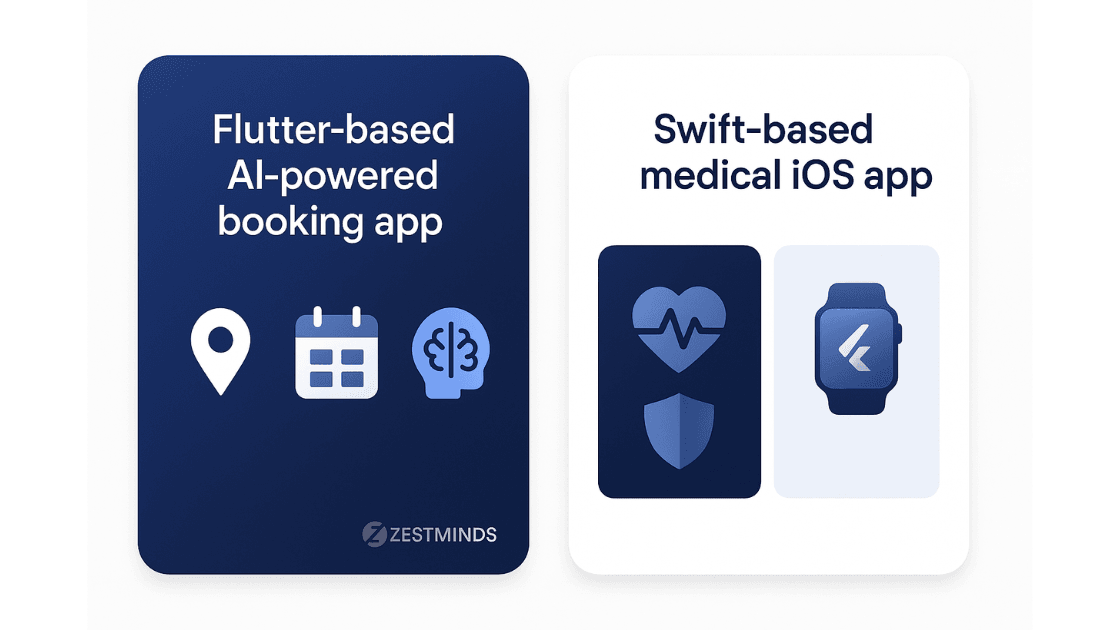
Outcome: We built a clinical-grade iOS solution that passed strict health compliance and testing.
Founder-Friendly Decision Matrix
TL;DR: Use this matrix in your next internal tech stack meeting.
- iOS-only: Swift.
- iOS + Android: Flutter.
- Deep native hardware use (camera, sensors, AI): Swift.
- Cloud-based AI: Flutter.
- On-device AI: Swift.
- Budget-friendly MVP: Flutter.
- Vision Pro support: Swift.
- Fastest iteration: Flutter.
Cost Breakdown (2025)
TL;DR: Flutter is usually cheaper for multi-platform MVPs; Swift is safer for Apple-first products over the long term.
- Flutter MVP: Often 30–50% cheaper for cross-platform builds.
- Swift development: Higher initial cost but lower risk for Apple-only apps.
- Flutter maintenance: Cheaper (one codebase).
- Swift maintenance: Higher if you also maintain Android separately.
Architecture, Testing & Scalability
TL;DR: Swift is strongest for enterprise-scale; Flutter is strongest for fast-moving SaaS.
Swift
- Supports patterns like Clean Swift, MVVM, VIPER.
- Excellent for long-term enterprise codebases.
- Strong concurrency support with async/await.
Flutter
- Uses BLoC, Riverpod, GetX, and other state-management approaches.
- Widget tests and golden tests provide huge QA advantages.
- Great fit for fast-moving SaaS and product-led teams.
2025 Trends That Change the Decision
TL;DR: AI, multi-platform UX, and Vision Pro are the three big forces reshaping Swift vs Flutter decisions.
Trend 1: AI-native apps are default
- Swift wins on-device AI with CoreML and Neural Engine.
- Flutter wins cloud AI integrations via APIs.
Trend 2: Multi-platform UX is a competitive advantage
- Flutter leads for iOS + Android + web + desktop experiences.
Trend 3: Vision Pro is pushing teams toward Swift
- Swift and SwiftUI are the default path for spatial computing on Vision Pro.
Final Swift vs Flutter Summary
TL;DR:
- Apple-first, AI-heavy, performance-sensitive products → Swift.
- Fast-moving startups, SaaS, MVPs, multi-platform → Flutter.
- Security-first industries → Swift.
- Design consistency across platforms → Flutter.
What Founders Still Get Wrong
Even in 2025, we see the same mistakes:
- Choosing based only on v1, not the 24-month roadmap.
- Assuming Flutter is always cheaper (poor architecture can be costly).
- Assuming Swift is only for “premium” apps.
- Ignoring AI strategy (on-device vs cloud).
- Choosing based on developer familiarity instead of product fit.
Zestminds Expert Advice
Here’s the guidance we usually give in our strategy calls:
- If you’re unsure, start with a Flutter MVP.
- If your app has deep Apple-specific features, go Swift from day one.
- If Vision Pro or WatchOS are on your roadmap, stay with Swift.
- If your product is UI-driven and brand-heavy across platforms, Flutter gives you more control.
- For extreme scalability, consider hybrid strategies (Swift for iOS core, Flutter for Android/web UI).
Mini Cheat Sheet (Bookmark This)
Choose Swift When:
- On-device AI is critical.
- You need the highest-performance UI.
- You’re targeting Vision Pro or WatchOS.
- You operate in compliance-heavy industries.
- You are iOS-first or iOS-only.
- You need deep hardware usage.
Choose Flutter When:
- You need iOS + Android together.
- You want an MVP in under 10 weeks.
- You are working with a limited budget.
- You rely on cloud AI integrations.
- You want the same UI across platforms.
- You care about fast iteration cycles.
Summary
Swift is best for iOS apps needing native performance, deep Apple integration, Vision Pro support, and secure on-device AI. Flutter is best for cross-platform apps, fast MVPs, consistent UI, cloud AI integrations, and cost-efficient development. The right choice depends entirely on your product roadmap, platform strategy, and long-term technical requirements.
Conclusion — So, What Should You Choose?
Both Swift and Flutter are powerful in 2025 — but for completely different purposes.
- Swift is the best way to deliver a premium, Apple-native, AI-ready iOS product.
- Flutter is the smartest choice when you want speed, multi-platform reach, and efficiency.
Your decision should always follow your 24-month roadmap, not just your immediate v1 launch.
Zestminds has built both Swift and Flutter apps across fintech, healthcare, AI platforms, marketplaces, SaaS, and on-demand services. We don’t just build apps — we help founders choose what will scale without regret.
Build Your iOS or Cross-Platform App With Zestminds
Ready to build something powerful in 2025?
Zestminds can help you choose the right stack, build your MVP faster, and scale without friction.
We offer:
- Native iOS (Swift/SwiftUI) development.
- Cross-platform Flutter development.
- Full-stack backend engineering.
- AI/ML integrations.
- UI/UX design.
- MVP consulting and product planning.
- Long-term maintenance and scaling.
Email: [email protected]
Visit: https://www.zestminds.com/contact-us
Frequently Asked Questions
Q1: Is Swift or Flutter better for iOS development in 2025?
A1: Swift is best for iOS-only, AI-heavy, and performance-critical apps. Flutter is ideal when you need both iOS and Android, faster time-to-market, and better cost efficiency.
Q2: Can Flutter fully match the native iOS experience?
A2: Flutter delivers smooth, high-quality UI, but expert iOS users may still notice subtle differences. SwiftUI remains the top choice for a 100% Apple-native look and feel.
Q3: Which framework is better for AI-powered apps?
A3: Swift is stronger for on-device AI, thanks to CoreML and the Apple Neural Engine. Flutter is excellent when most AI runs in the cloud using APIs like OpenAI, Gemini, or Cohere.
Q4: Which is better for building a startup MVP?
A4: For most early-stage startups, Flutter is the better MVP choice because it offers one codebase for iOS and Android, faster iterations, and lower initial development cost.
Q5: Do Flutter apps face App Store approval issues?
A5: No. Flutter apps are reviewed the same way as native apps. Most rejections happen because of product or policy issues, not because the app was built with Flutter.
Q6: Which is cheaper — Swift or Flutter?
A6: Flutter is usually 30–50% cheaper for cross-platform MVPs. Swift tends to be more expensive upfront but is ideal for Apple-first products where performance, security, or Vision Pro support is critical.
Q7: Is Swift required for Vision Pro or WatchOS apps?
A7: Yes. Swift with SwiftUI is the recommended and most reliable way to build production-grade VisionOS and WatchOS apps in 2025. Flutter’s support in this area is still experimental.
Q8: Can Flutter scale for enterprise applications?
A8: Flutter can scale very well for multi-platform SaaS and internal tools. However, apps that depend on deep iOS hardware access or strict compliance may still need Swift modules for critical paths.
Q9: Which framework is better for secure or compliant apps?
A9: Swift is better for security-first and compliance-heavy apps because it can use native Keychain, Secure Enclave, and low-level security APIs. Flutter relies on plugins, which adds extra review and maintenance overhead.
Q10: How do I choose between Swift and Flutter for my roadmap?
A10: Look at your 24-month roadmap, not just your MVP. Choose Swift if deep Apple integration, on-device AI, Vision Pro, or compliance are central to your product. Choose Flutter if you prioritize speed, budget, multi-platform reach, and a unified UI across devices.
Table of Contents
- Introduction
- Why This Question Matters More Than Ever in 2025
- Swift vs Flutter in 2025 — Real-World Comparison
- 1. Performance & Speed
- 2. UI/UX Quality
- 3. AI & ML Capabilities
- 4. App Store Stability & Approval
- 5. Development Speed & Productivity
- 6. Talent Availability & Hiring Cost
- 7. Security & Compliance
- 8. Scalability & Enterprise Readiness
- 9. VisionOS & Apple’s Future Ecosystem
- 10. Integrations, Backend & Cloud Support
- 11. Setup Experience
- Quick Comparison Table
- When You Should Choose Swift
- When You Should Choose Flutter
- Zestminds Case Stories
- Founder-Friendly Decision Matrix
- Cost Breakdown (2025)
- Architecture, Testing & Scalability
- 2025 Trends That Change the Decision
- Final Swift vs Flutter Summary
- What Founders Still Get Wrong
- Zestminds Expert Advice
- Mini Cheat Sheet
- Summary
- Conclusion
- Build Your iOS or Cross-Platform App With Zestminds
- Frequently Asked Questions
Shivam Sharma
Before You Scale Further, Review the Architecture.
Let’s evaluate where your system stands — and where it may break under growth.
Schedule an Architecture Review 30-minute technical discussion. No obligation.