
Dedicated Development Teams Guide for SaaS, AI and Product Engineering
Hiring software talent is easy on paper. Building a reliable product team is not.
Many founders, CTOs and product leaders start with a freelancer, a single developer, or a small agency because the need feels simple at first: build features, fix bugs, move faster. But as the product grows, the real problem becomes bigger than writing code. You need technical continuity, architecture ownership, QA discipline, release planning, DevOps support, and people who understand why the product exists.
That is where a dedicated development team can make sense.
This guide is designed to help you compare the dedicated team model before you speak with a vendor. If you are already looking for a delivery partner, visit our dedicated development teams service page.
In this guide, we will explain what a dedicated team is, when it works, when it does not, what roles you may need, how costs are usually shaped, and how to evaluate the right team without falling into the usual outsourcing traps.

Who This Guide Is For
This guide is useful if you are comparing hiring models and want to understand whether a dedicated team is the right fit before you commit to a vendor or recruitment process.
- Founders moving from MVP to a stable product
- CTOs who need extra engineering capacity
- Product leaders managing a growing roadmap
- SaaS companies that need continuous development
- Businesses building AI, backend, workflow, or mobile products
- Teams deciding between freelancers, agencies, and long-term engineering pods
What Is a Dedicated Development Team?
A dedicated development team is a long-term engineering team that works as an extension of your business.
Instead of hiring one temporary freelancer or outsourcing a fixed task, you get a team that stays close to your roadmap, product context, release cycles, and technical priorities.
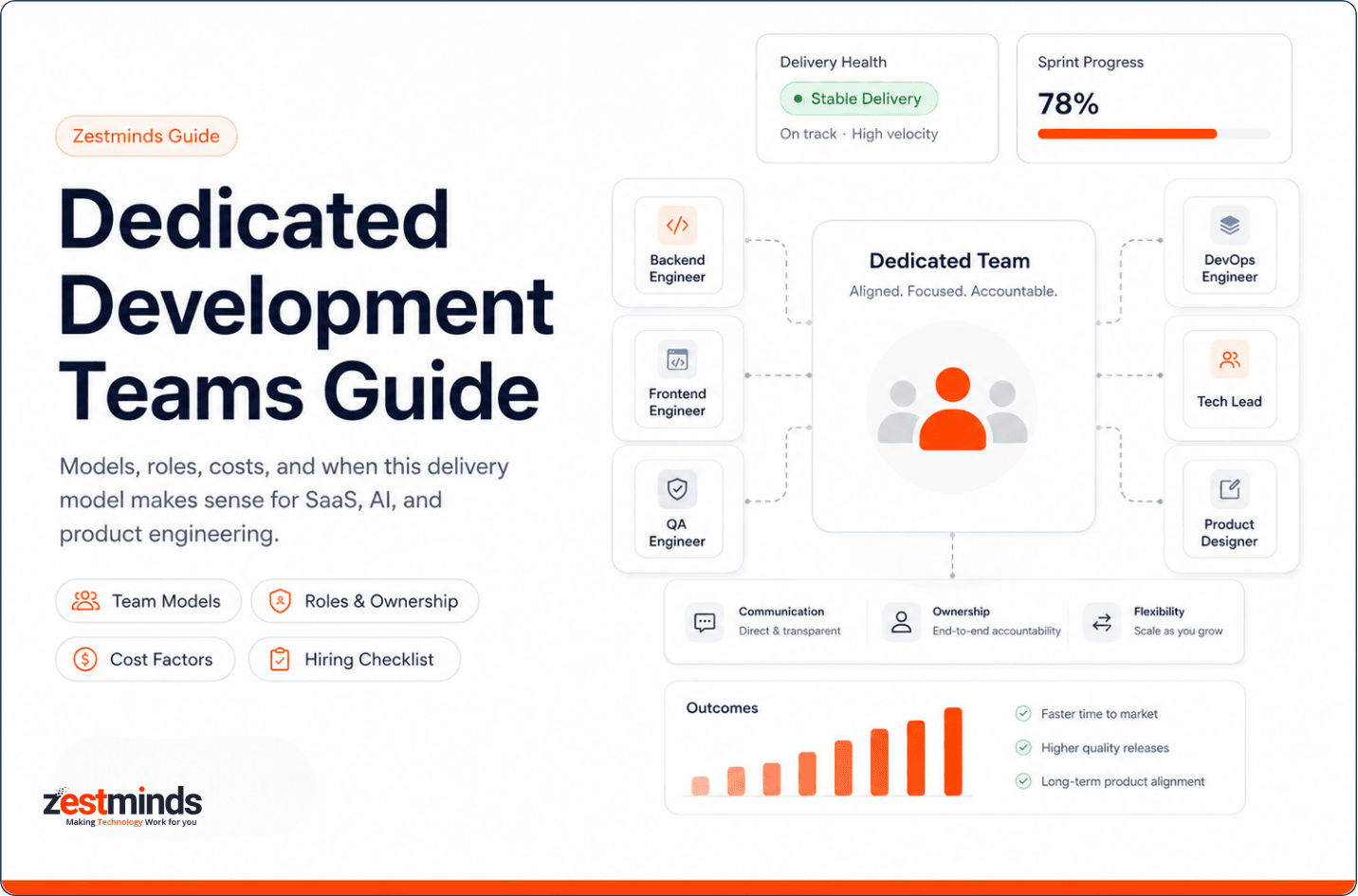
This team may include backend developers, frontend developers, mobile developers, QA engineers, DevOps engineers, UI/UX support, a project manager, and a technical lead depending on your product stage.
The biggest difference is ownership. A good team does not just complete tickets. It understands the product, protects technical quality, improves delivery flow, and helps you avoid short-term decisions that create long-term problems.
A dedicated team is not about renting people. It is about creating a reliable delivery unit around your product.
A dedicated team is not just “more developers”
Many companies think slow delivery can be fixed by adding more developers. Sometimes that helps. Often, it does not.
If requirements are unclear, code quality is weak, testing is missing, deployment is fragile, or priorities change every week, adding more people may only increase confusion.
This model works best when it brings structure, communication, technical leadership, and execution discipline along with engineering capacity.
Dedicated Developer vs Dedicated Team vs Agency vs Freelancer
Before choosing a delivery model, it helps to understand what you are actually buying.
A freelancer, an agency, a single developer, and a long-term engineering pod can all help in different situations, but they are not interchangeable.
| Model | Best For | Main Strength | Main Risk |
|---|---|---|---|
| Freelancer | Small tasks, quick fixes, isolated work | Flexible and fast to start | Limited availability, continuity, and team coverage |
| Dedicated Developer | One specific role such as backend, frontend, or mobile | Focused individual capacity | Still depends heavily on your internal management |
| Traditional Agency | Defined projects with clear scope and timeline | Good for fixed-scope delivery | May not stay deeply involved after launch |
| Dedicated Team | Long-term product engineering, SaaS, AI, MVP scaling, platform work | Continuity, ownership, and scalable capacity | Needs good communication, roadmap clarity, and management rhythm |
If you only need one developer for a specific role, it may be better to hire a dedicated developer.
If you need a structured product team that can own delivery across frontend, backend, QA, DevOps, and product iterations, a dedicated team is usually the better model.
When a Dedicated Team Makes Sense
This model is most useful when your product has moved beyond a one-time build and now needs steady technical ownership.
That usually happens when the business has a roadmap, users, operational pressure, or a product vision that cannot be handled by random short-term resources.
| Situation | Why a Dedicated Team Helps | Useful Starting Point |
|---|---|---|
| SaaS product scaling | SaaS products need ongoing features, QA, integrations, releases, and architecture ownership. | SaaS product development |
| MVP moving to production | The product needs refactoring, QA, stability, monitoring, and predictable release cycles. | MVP development |
| FastAPI or Python backend growth | APIs, deployments, database design, performance, and observability need proper ownership. | FastAPI development services |
| AI product development | AI products need backend logic, workflows, integrations, monitoring, testing, and iteration. | AI development services |
| Workflow automation | Business workflows need reliable integrations, exception handling, approvals, and human review. | AI workflow automation services |
| Legacy product modernization | Older systems need careful refactoring, migration, performance fixes, and long-term support. | legacy software modernization |
Signs you may need this model
- Your roadmap is larger than your current engineering capacity.
- Your internal team is busy with core systems and cannot own every product stream.
- Your MVP has users and now needs better quality, stability, and scale.
- Your backend or deployment process has become a recurring bottleneck.
- You need long-term product knowledge, not just one-time delivery.
- You want a team that can stay involved after launch.
When This Model Is Not the Right Fit
A dedicated team is powerful, but it is not always the right answer. In some cases, it can be unnecessary or wasteful.
This model may not be a good fit if:
- You only need a small landing page or a quick website fix.
- You do not have a product roadmap or clear business priorities.
- You are looking only for the cheapest development option.
- You need a one-time design task, not ongoing engineering.
- You are not ready to communicate regularly with the team.
- You expect the team to guess business priorities without product context.
- Your budget only supports occasional ad hoc work.
For very small tasks, a freelancer or fixed-scope engagement may be enough. For one specific role, hiring a single developer may work better.
The dedicated team model works best when there is enough product complexity to justify continuous ownership.
Typical Dedicated Team Structure
There is no universal team structure. The right setup depends on your product, stack, roadmap, budget, and internal capability.
A small SaaS product may need one backend developer, one frontend developer, and QA support. A growing AI product may need backend, AI workflow engineering, frontend, DevOps, and technical leadership.
| Role | What They Own | When You Need This Role |
|---|---|---|
| Backend Developer | APIs, database logic, integrations, business rules | Most SaaS, AI, marketplace, and workflow products |
| Frontend Developer | Web app UI, dashboards, admin panels, customer-facing interfaces | When users interact with the product through a browser |
| Mobile Developer | iOS, Android, or cross-platform app development | When mobile is part of the product experience |
| QA Engineer | Manual testing, regression testing, test planning, quality checks | When releases must be stable and predictable |
| DevOps / Cloud Engineer | Deployment, infrastructure, CI/CD, monitoring, cloud reliability | When uptime, releases, and scaling matter |
| Tech Lead | Architecture decisions, code review, technical direction | When the system has complexity or long-term roadmap risk |
| Project Manager | Sprint planning, communication, delivery tracking, coordination | When multiple people or workstreams are involved |
| UI/UX Designer | User flows, product screens, design systems, usability | When experience and adoption are important |
If your product is already facing deployment, infrastructure, or reliability pressure, you may also need platform engineering services or DevOps and cloud engineering support as part of the team.
Common Dedicated Team Engagement Models
Dedicated teams can be structured in different ways depending on how much ownership, flexibility, and management support you need.
The right model depends on whether you already have an internal team, how clear your roadmap is, and how much delivery responsibility you want the external team to own.
| Model | Best For | How It Works |
|---|---|---|
| Single Dedicated Developer | One clear role or skill gap | You add one developer to support your internal team or a focused workstream. |
| Small Dedicated Pod | MVPs, SaaS modules, backend ownership | A small team handles development, QA, and delivery coordination. |
| Managed Product Team | Long-term product delivery | Zestminds helps manage team structure, sprint execution, QA, and technical oversight. |
| Extended Engineering Team | Companies with existing internal teams | The team works alongside your in-house engineers and owns selected product areas. |
For example, a startup moving from MVP to paid users may start with a small pod. A SaaS company with an internal CTO may prefer an extended engineering team. A non-technical founder may need a managed team with stronger delivery coordination and technical oversight.
Cost Factors for Dedicated Development Teams
Dedicated team cost depends on more than hourly rates. The cheapest team is not always the most affordable team in the long run.
A low-cost setup that creates rework, unstable releases, poor architecture, and unclear communication can become more expensive than a slightly higher-cost team that works properly.
| Cost Factor | Why It Matters |
|---|---|
| Team size | One developer costs less than a full pod with QA, DevOps, and tech lead support. |
| Seniority | Senior engineers cost more but may reduce risk on complex products. |
| Technology stack | AI, cloud, FastAPI, data pipelines, and mobile work may require deeper expertise. |
| Product complexity | Multi-tenant SaaS, healthcare workflows, AI systems, and marketplaces need more planning. |
| Engagement duration | Longer-term teams often become more efficient as they understand the product deeply. |
| Quality requirements | QA, testing, monitoring, and security add cost but reduce production risk. |
| DevOps needs | Infrastructure, CI/CD, observability, and scaling require additional capability. |
For AI products, cost also depends on model usage, workflow complexity, integrations, data handling, evaluation strategy, and production reliability. Our guide on AI MVP development cost explains some of these variables in more detail.
Do not compare teams only by hourly rate
Hourly rate is easy to compare. Delivery quality is harder.
When evaluating cost, also ask:
- Will this team reduce my management burden or increase it?
- Can they make architecture decisions or only complete assigned tickets?
- Do they have QA and release discipline?
- Will they stay available after launch?
- Can they communicate risks early?
- Will they document decisions and hand over properly?
The right team should make your product execution more predictable, not just cheaper.
How to Hire and Evaluate a Dedicated Team
Choosing a dedicated team is not the same as buying a tool. You are choosing people who may influence your product quality, delivery speed, technical debt, and customer experience for months or years.
Before hiring, evaluate the team across delivery, communication, technical depth, and ownership.
What to check before you hire
- Product understanding: Do they ask about users, workflows, goals, roadmap, and bottlenecks before estimating?
- Technical leadership: Who reviews architecture, code quality, trade-offs, and technical decisions?
- Communication rhythm: How often will you get updates, sprint reviews, and blocker visibility?
- Proof of work: Can they show relevant software development case studies?
- QA process: How do they test, manage regression, and prepare releases?
- Documentation: How are decisions, access, deployment steps, and handover handled?
- Risk handling: Will they challenge weak assumptions or simply say yes to everything?
Dedicated team evaluation checklist
- Do they understand your product goal before estimating?
- Can they explain the recommended team structure clearly?
- Who owns architecture and code review?
- How are sprints, releases, and blockers managed?
- Is QA included or treated as optional?
- Do they provide documentation and handover support?
- Can they show relevant case studies?
- Will you have direct communication with the team?
- How do they handle scaling the team up or down?
You can also review client testimonials and our how we work page to understand how we approach communication, delivery, and long-term collaboration.
A strong engineering partner should not only execute your roadmap. They should help you protect it from avoidable technical risk.
Common Mistakes When Hiring Dedicated Developers
Most dedicated hiring problems do not happen because companies choose bad people intentionally. They happen because the model is misunderstood.
Mistake 1: Hiring only for cost
Cost matters, but if cost becomes the only filter, you may end up with a team that needs heavy supervision, misses quality issues, or creates technical debt.
Mistake 2: Starting without clear ownership
Someone must own product priorities, technical decisions, communication, and delivery rhythm. If nobody owns these, even a good team can struggle.
Mistake 3: Treating developers like task machines
If engineers only receive isolated tasks without product context, they cannot make thoughtful technical decisions. Share business goals, user problems, and roadmap context.
Mistake 4: Ignoring QA and DevOps
A product is not production-ready just because the feature is coded. Testing, deployment, monitoring, and rollback planning matter.
Many backend scaling mistakes appear because teams ignore operational quality until users are already affected.
Mistake 5: Waiting too long to fix architecture
Technical shortcuts are sometimes necessary in early stages. But if they are never revisited, they create delivery drag.
Our article on MVP SaaS architecture mistakes explains why early decisions can slow products later.
Mistake 6: Choosing a team without asking when the model fails
A reliable partner should be honest about fit. If a vendor says this model is perfect for every situation, be careful.
Our article on when hiring dedicated developers fails covers this in more detail.
Dedicated Teams for SaaS, AI and Backend Products
The model becomes especially useful when your product has ongoing technical complexity.
For Zestminds, the strongest use cases are SaaS platforms, AI products, workflow automation systems, FastAPI/Python backends, and long-term modernization work.
For SaaS products
SaaS platforms need continuous iteration. You may start with core workflows, but soon need onboarding, subscriptions, roles, dashboards, analytics, integrations, customer support tools, and admin features.
A dedicated SaaS team can help maintain roadmap speed while protecting architecture and release quality. If SaaS is your main focus, explore our SaaS product development services.
For AI products
AI products often start as experiments but become real software systems very quickly.
You may need LLM integration, retrieval pipelines, workflow orchestration, prompt/version management, human review, logs, permissions, and cost controls.
A dedicated AI team can help you move from prototype to production without treating AI as a magic layer pasted on top of the product. Related capabilities include AI development services, AI workflow automation services, and generative AI solutions.
For FastAPI and Python backends
FastAPI is a strong choice for modern APIs, AI backends, and high-performance Python services. But production FastAPI systems still need structure, testing, deployment planning, observability, and database discipline.
If your backend is growing, our FastAPI project structure guide and FastAPI production issues article can help you understand common scaling concerns. For implementation support, see our FastAPI development services.
For modernization work
Legacy systems often need careful improvement rather than full rewrites.
A stable product team can help refactor modules, improve performance, migrate infrastructure, replace fragile parts, and keep the system running while modernization happens.
If this is your situation, our legacy software modernization services may be more relevant than starting from scratch.
Relevant Zestminds Case Studies
When evaluating a team, case studies are more useful than generic claims. They show how a partner thinks through product complexity, integrations, business constraints, and real delivery.
| Case Study | Why It Is Relevant |
|---|---|
| AI visibility platform case study | Useful for AI SaaS, product development, and early-stage platform execution. |
| HIPAA-compliant AI hospital system | Relevant for complex AI workflows, sensitive data, and regulated product thinking. |
| AI-powered CRM modernization | Useful for CRM, workflow automation, and modernization work. |
| AI content automation case study | Relevant for AI automation, content workflows, and internal productivity systems. |
| AI dating app case study | Useful for mobile product engineering, AI matching, and user-facing product development. |
You can view more examples in our software development case studies section.
How Zestminds Builds Dedicated Teams
At Zestminds, we treat dedicated teams as long-term product delivery units, not random developer allocation.
Our approach starts with understanding your product stage, business goal, current system, team gaps, and delivery pressure. Then we recommend a practical team structure instead of pushing a fixed package.
Depending on the need, your team may include:
- Backend developers for APIs, business logic, and integrations
- Frontend developers for dashboards, portals, and product interfaces
- Mobile developers for iOS, Android, or cross-platform apps
- QA engineers for release quality and regression testing
- DevOps support for deployment, CI/CD, and cloud reliability
- Technical leadership for architecture and code review
- Project coordination for sprint planning and communication
The goal is not just to add people. The goal is to create a team that understands the product, communicates clearly, ships consistently, and protects long-term maintainability.
If you are unsure whether you need one developer, a small pod, or a full product team, we can help you evaluate the right structure before you commit.
You can explore our dedicated development team model or discuss your team requirement with us.
FAQs
What is a dedicated development team?
A dedicated development team is a long-term software team that works as an extension of your business. It may include developers, QA engineers, DevOps support, a project manager, and a technical lead depending on your product needs.
How is a dedicated team different from hiring one developer?
Hiring one developer gives you individual capacity. A dedicated team gives you a broader delivery setup with multiple skills, shared product context, communication rhythm, and technical ownership.
If you only need one role, it may be better to hire a dedicated developer. If you need delivery ownership, a team is usually better.
When should I hire a dedicated development team?
You should consider this model when your product needs continuous development, multiple skills, regular releases, QA, DevOps, architecture support, or long-term technical ownership.
Is a dedicated development team good for startups?
Yes, if the startup has a clear product direction and needs sustained engineering capacity. It may not be ideal for very early experiments with unclear scope and no roadmap.
How much does a dedicated development team cost?
Cost depends on team size, seniority, technology stack, product complexity, duration, timezone needs, QA requirements, and DevOps involvement.
It is better to estimate based on the team structure needed rather than only comparing hourly rates.
Can I start with one developer and scale into a team?
Yes. Many companies start with one dedicated developer and later add frontend, QA, DevOps, or technical leadership as the product grows.
Do I need a project manager with a dedicated team?
If the team has more than one or two people, a project manager or delivery coordinator is usually helpful. This keeps communication, sprint planning, priorities, and blockers organized.
Is a dedicated team better than freelancers?
For long-term product work, usually yes. Freelancers can be useful for small tasks or specialized short-term work. Dedicated teams are better when continuity, collaboration, QA, and roadmap ownership matter.
Can a dedicated team work with our internal team?
Yes. A dedicated team can work alongside your internal engineers, own a module, support a product line, handle maintenance, or extend your capacity without replacing your core team.
Can dedicated teams build AI products?
Yes, if the team has the right AI, backend, workflow, and product engineering experience. AI products need more than prompt writing. They need reliable software architecture, integrations, data handling, testing, and production support.
How long should I hire a dedicated development team for?
Most dedicated teams work best when there is at least a few months of meaningful product work. Very short engagements may be better handled as fixed-scope projects or one-time support.
Can I scale the team up or down later?
Yes. A dedicated team can usually start small and expand as the roadmap, budget, and product complexity grow. The important part is to plan team changes around delivery needs, not panic hiring.
How do I know if Zestminds is the right fit?
Zestminds is a good fit if you need a serious engineering partner for SaaS, AI, backend, mobile, modernization, or long-term product delivery.
You can review client testimonials, explore software development case studies, or discuss your team requirement.
Table of Contents
- What is a dedicated development team?
- Dedicated developer vs team vs agency vs freelancer
- When a dedicated team makes sense
- When this model is not the right fit
- Typical dedicated team structure
- Common engagement models
- Cost factors
- How to evaluate a dedicated team
- Common mistakes to avoid
- Dedicated teams for SaaS, AI and backend products
- Relevant case studies
- How Zestminds builds dedicated teams
- FAQs